
Astronomers Detect Unseen Mass-Gap Object Orbiting a Red Giant Star
Researchers have identified a dark companion to a distant red giant that falls squarely into the elusive mass gap between neutron stars and black holes. The discovery challenges existing models of how massive stars collapse at the end of their lifecycles.

Share this story
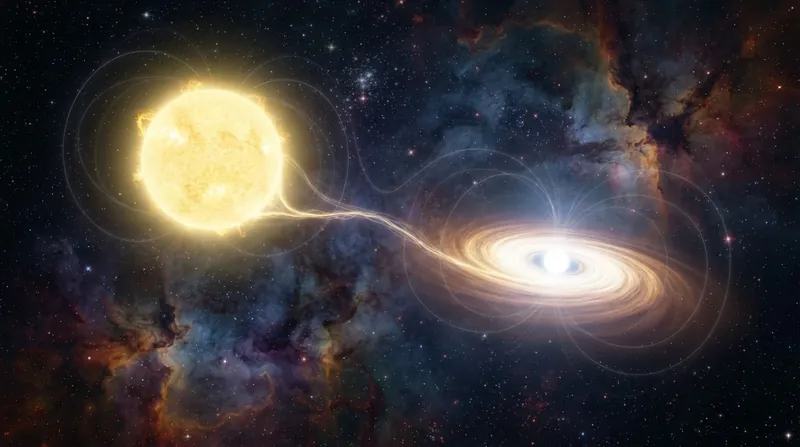
Astronomers analyzing the subtle orbital wobble of a red giant star located 1,465 light-years from Earth have identified a dark, massive companion that defies standard astrophysical classification. The unseen object sits squarely within the theoretical mass gap, a long-debated dead zone between the heaviest known neutron stars and the lightest known black holes.[2][4]
The discovery, detailed this week in the journal Science Advances, centers on a remarkably wide binary star system where the visible red giant orbits a hidden center of mass. Researchers calculated the dark companion's weight at roughly 2.5 to 2.7 solar masses, placing it just above the established theoretical limit for neutron stars.[3][5]
"Finding an object in this specific mass range is like finding a missing evolutionary link in stellar physics," the research team notes in their arXiv preprint. The object is either one of the most massive neutron stars ever detected or an unusually lightweight black hole, both of which fundamentally challenge current stellar formation models.[1][5]
The Mass Gap Mystery
When massive stars exhaust their nuclear fuel, their cores collapse under immense gravity while expelling their outer layers in violent supernova explosions. Cores weighing less than 2.2 times the mass of our sun typically stabilize as neutron stars, which are incredibly dense spheres of degenerate matter roughly the size of a large city.[2][4]
Conversely, stellar cores exceeding five solar masses possess too much gravity for any known physical force to halt their inward collapse, inevitably crushing themselves into black holes. The region between 2.2 and 5.0 solar masses has historically remained empty in observational surveys, leading astrophysicists to term this curious absence the mass gap.[1][2]
Theoretical models have long struggled to explain why nature would consistently fail to produce stellar remnants in this intermediate mass range. Some researchers proposed that the fluid mechanics of supernova explosions naturally prevent cores of this specific size from surviving, either blowing them apart entirely or pushing them rapidly over the threshold into black holes.[2][4]
This newly discovered binary system provides concrete, observable evidence that mass-gap objects do indeed form and can survive in stable, long-term orbits. The companion's existence forces a comprehensive reevaluation of the rapid-collapse theories and supernova mechanics that have dominated stellar astrophysics and textbook models for the past two decades.[3][4]
Because the mass-gap object emits no detectable light or radiation, the research team had to infer its presence entirely through its gravitational influence on its visible partner. They utilized the radial velocity method, precisely measuring minute shifts in the red giant's light spectrum as it moved toward and away from Earth.[1][3]
Tracking a Stellar Wobble
The spectral data revealed that the red giant is locked in a wide, highly elliptical orbit, completing one full revolution every 780 days. By calculating the visible star's mass and its exact orbital velocity, the astronomers could mathematically isolate the gravitational pull of the unseen companion and determine its minimum mass.[3][5]
"The amplitude of the radial velocity curve leaves no room for ambiguity regarding the companion's minimum mass," the researchers write in their Science Advances publication. The precise data rules out the possibility of a white dwarf or a standard main-sequence star, leaving a compact stellar remnant as the only viable physical explanation.[3]
The wide separation between the two objects adds another layer of complexity to the binary system's evolutionary history. Most known neutron stars and black holes in binary systems orbit their companions very closely, often stripping material from the visible star and emitting bright, easily detectable X-rays in the process.[1][2]
In this particular system, the vast distance between the red giant and the dark object prevents any significant mass transfer from occurring. Without a steady stream of infalling stellar gas to heat up and emit high-energy radiation, the compact remnant remains entirely silent across the entire electromagnetic spectrum.[2][4]
This complete radio and X-ray silence makes the object exceptionally difficult to study directly using traditional high-energy observatories. Astronomers must rely entirely on the precise astrometric and spectroscopic measurements of the red giant to constrain the companion's properties, a technique that has only recently become sensitive enough to detect such wide binaries.[1][5]
A Silent Companion
The European Space Agency's Gaia mission played a foundational role in identifying the initial anomalies in the red giant's proper motion across the sky. By cross-referencing Gaia's astrometric data with ground-based spectroscopic surveys, the researchers could filter out false positives and confirm the binary nature of the system with high statistical confidence.[1][3]
If the object is indeed a supermassive neutron star, it would require an extremely stiff equation of state to prevent total gravitational collapse. The nuclear matter inside the star would have to repel itself with unprecedented force, implying that the strong nuclear force becomes highly repulsive at short distances to prevent a singularity.[2][5]
Alternatively, if the object is a low-mass black hole, it would raise immediate questions about how such a lightweight singularity could form without accreting additional mass later. Current supernova models struggle to produce black holes lighter than three solar masses without invoking exotic, unverified physics or highly unusual progenitor stars.[1][4]
The evolutionary pathway that created this wide binary system remains a subject of intense debate among the research team and the broader astronomical community. When the progenitor of the dark companion exploded as a supernova, the resulting shockwave and sudden mass loss should have disrupted the binary, sending the red giant flying into space.[3][5]
Surviving a Supernova
The fact that the system remained gravitationally bound suggests that the supernova explosion was either highly asymmetrical or unusually weak. A "failed supernova," where the star's core collapses directly into a black hole without generating a massive outward explosion, could explain the system's survival, but this contradicts the supermassive neutron star hypothesis.[2][4]
"We are looking at a system that survived an event that typically destroys wide binaries," the authors note in their 2026 publication. The orbital parameters indicate that the system has remained stable for millions of years, perfectly preserving the forensic evidence of its violent and unusual formation.[3][5]
The discovery relies heavily on data from large-scale spectroscopic surveys, which monitor millions of stars simultaneously to detect minute gravitational wobbles. As these automated surveys accumulate more data over the coming years, astronomers expect to find a hidden population of similar mass-gap objects scattered throughout the Milky Way galaxy.[1][2]
Identifying a larger sample of these dark companions is crucial for determining whether this specific object is an anomaly or part of a standard evolutionary track. A single system can only constrain theoretical models so much, but a population of mass-gap objects would definitively rewrite the textbooks on stellar death and remnant formation.[2][4]
Theoretical physicists are already using the system's precise parameters to test alternative theories of gravity and modified Newtonian dynamics. Because the binary is so wide and the gravitational field so relatively weak at that distance, it serves as a natural, undisturbed laboratory for probing the limits of general relativity on stellar scales.[4][5]
The Search for More
The research team has already secured follow-up observation time on the Very Large Telescope in Chile to refine the system's orbital parameters. By measuring the binary's inclination angle with greater precision, they hope to narrow the mass estimate and potentially determine the object's true physical nature.[1][3]
If the mass estimate drops closer to 2.2 solar masses, the supermassive neutron star classification becomes highly probable. Conversely, if further observations push the minimum mass firmly above 2.7 solar masses, the astronomical community will likely have to accept the existence of exceptionally lightweight black holes as a standard cosmic phenomenon.[2][5]
The implications of this discovery extend far beyond stellar astrophysics, potentially impacting the ongoing study of gravitational waves. The LIGO and Virgo observatories have previously detected distant mergers involving mass-gap objects, but finding one in a stable, observable binary system nearby provides a completely different context for studying their properties.[1][4]
The implications of this discovery extend far beyond stellar astrophysics, potentially impacting the ongoing study of gravitational waves.
For now, the dark companion remains a physical paradox silently orbiting a distant red giant star. The system stands as a clear, observable reminder that the universe still contains fundamental structural mysteries, waiting to be uncovered by the careful, sustained observation of a single star's subtle motion through the galaxy.[2][4]
Key points
- Astronomers discovered an unseen object weighing 2.5 to 2.7 solar masses orbiting a red giant star 1,465 light-years away.
- The object falls into the "mass gap," a range between the heaviest neutron stars and the lightest black holes where remnants are rarely found.
- Detected via the radial velocity method, the dark companion emits no light or X-rays, making it exceptionally difficult to study directly.
- The system's survival challenges existing supernova models, suggesting the progenitor star collapsed without destroying the wide binary orbit.
What we don’t know
- Whether the dark companion is a supermassive neutron star or a low-mass black hole.
- How the wide binary system survived the violent supernova explosion that created the compact remnant.
- If this object represents an isolated anomaly or the first of a large, hidden population of mass-gap objects.
How we got here
Pre-2010s
Theoretical models firmly establish the mass gap between 2.2 and 5.0 solar masses, supported by a lack of observational evidence for remnants in this range.
2015-2020
Gravitational wave observatories like LIGO detect the first distant mergers involving objects that appear to fall within the mass gap.
Early 2026
Astrometric data from the Gaia mission reveals unusual proper motion in a red giant star 1,465 light-years away.
November 2026
Researchers publish spectroscopic data confirming the red giant is orbiting an unseen 2.5-to-2.7-solar-mass companion.
- Observational Astronomers
- Focus on finding hidden stellar remnants using new astrometric techniques.
- Theoretical Astrophysicists
- Focus on revising supernova mechanics and the nuclear equation of state.
- Evolutionary Modelers
- Focus on how binary systems survive violent stellar deaths.
Perspectives this story doesn't cover
- Nuclear physicists studying the strong force at extreme densities
- Gravitational wave researchers comparing this local object to distant merger events
Sources
Source coverage
5 outlets
3 viewpoints surfaced





- [1]Phys.orgObservational Astronomers
A likely supermassive neutron star might shed light on the mass gap between neutron stars and black holes
Read on Phys.org → - [2]Scientific AmericanObservational Astronomers
Newfound invisible object in space could be a rare supermassive neutron star
Read on Scientific American → - [3]Science AdvancesTheoretical Astrophysicists
Discovery of a likely supermassive neutron star in a remarkably wide binary
Read on Science Advances → - [4]BioScienceEvolutionary Modelers
Hidden Object 1,465 Light-Years Away Defies Stellar Evolution Models
Read on BioScience → - [5]arXivTheoretical Astrophysicists
Discovery of a likely supermassive neutron star in a remarkably wide binary
Read on arXiv →
More in Science
See all →Cosmic Microwave Background
The 2.725 Kelvin Blackbody Spectrum: How the Cosmic Microwave Background Provides a Snapshot of the Early Universe
6 sources
Stellar Evolution
Astronomers Discover Twin Debris Rings Around a Dead Star, Hinting at the Solar System's Fate
6 sources
Stellar Evolution
Dormant 33-Solar-Mass Black Hole Discovered Less Than 2000 Light-Years From Earth
7 sources
Radio Transients
Astronomers Detect Radio Flashes Every Eight Minutes From Dead Star Paired With Solar Analog
6 sources
Comments
Every angle. Every day.
Get Science stories with full source coverage and perspective breakdowns, free every day.