full timeline
US air traffic control modernization
Transportation Secretary Sean Duffy is asking Congress for an additional $30 billion to overhaul the nation's aging air traffic control infrastructure.
Follow US air traffic control modernization in the Factlen app and get an alert when there is news. Get the app
Share this story
Latest report
Transportation Secretary Seeks $30 Billion More for ATC Modernization
Transportation Secretary Sean Duffy is asking Congress for an additional $30 billion to overhaul the nation's aging air traffic control infrastructure. The request follows a massive telecommunications failure that grounded thousands of flights across the Northeast.
- Transportation Secretary Sean Duffy is requesting an additional $30 billion to modernize the nation's aging air traffic control infrastructure.
- The funding would allocate $10 billion each for replacing control towers, upgrading telecommunications software, and improving airport terminals.
- The request follows a $12.5 billion appropriation in 2025, pushing the total estimated cost of the modernization program to $42.5 billion.
- The announcement comes immediately after a telecommunications failure caused a ground stop at major Northeast airports, delaying roughly 9,500 flights.
- Aviation industry groups, including the Aircraft Owners and Pilots Association, strongly endorsed the funding request to prevent future disruptions.
On September 22, 2026, Transportation Secretary Sean Duffy stood before the Aero Club of Washington and formally asked Congress for an additional $30 billion to overhaul the nation's aging air traffic control infrastructure. The massive funding request arrived just one day after a severed backup fiber-optic cable in New Jersey and a failed circuit at the Philadelphia Terminal Radar Approach Control triggered a cascading ground stop across major Northeast airports.
That single telecommunications failure halted or restricted traffic at Newark Liberty International, John F. Kennedy International, LaGuardia, and Philadelphia International, ultimately delaying or canceling approximately 9,500 flights and forcing more than 100 aircraft to divert. For millions of passengers, the disruption was a stark reminder of the fragility of the systems managing American airspace, anchoring abstract federal budget debates in the immediate reality of stranded travelers and missed connections.[2][4][5]
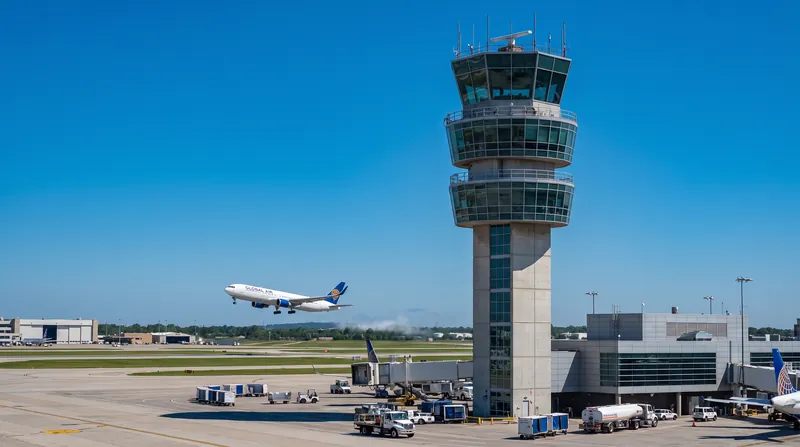
The proposed $30 billion legislative package is divided into three equal $10 billion tranches, each targeting a specific vulnerability in the aviation network. The first $10 billion is earmarked for the wholesale replacement of air traffic control towers, many of which were designed and built in the 1960s and 1970s and are now decades past their intended operational lifespans.
Another $10 billion will fund critical telecommunications upgrades and advanced airspace management software, aiming to strip out the legacy copper wiring that remains a single point of failure in many facilities. The final $10 billion is directed toward broader airport infrastructure and terminal improvements, ensuring that the physical footprint of American airports can handle the increased throughput that a modernized digital tracking system is expected to deliver.[1][3][4][5]
This new funding request builds directly upon a $12.5 billion appropriation that was signed into law in July 2025, which launched the first phase of what the Department of Transportation has dubbed the Brand New Air Traffic Control System. Initially framed by federal officials as a substantial down payment, that 2025 funding was largely dedicated to replacing outdated copper telecommunications wiring with modern fiber optics and upgrading roughly one-sixth of the Federal Aviation Administration’s radio sites.
However, as capital expenditures have rolled into the effort and the sheer scale of the deferred maintenance has become clear, the price tag has ballooned. The new $30 billion ask pushes the total estimated cost of the modernization program to $42.5 billion, a figure that is more than $10 billion higher than the government's initial projections.[4][5]
Federal officials argue that the massive investment is an absolute necessity to prevent cascading airspace failures from becoming a routine feature of domestic travel. FAA Administrator Bryan Bedford recently testified before a House Appropriations subcommittee that the cost of completing just the first phase of the modernization effort had already risen to $16 billion.
Bedford warned lawmakers that halting the momentum now would cause the National Airspace System to slip back into higher delays, higher cancellation rates, and a significantly less resilient airspace. The data supports his urgency: equipment-related delay minutes in 2025 were reportedly 300 percent higher than the historical average recorded between 2010 and 2024, highlighting a system that is increasingly buckling under the weight of modern flight volumes.[3][4][5]
The aviation industry has quickly and uniformly aligned behind the Department of Transportation's funding request, viewing the $30 billion as a long-overdue correction rather than a discretionary expense. The Modern Skies Coalition, an advocacy umbrella group comprising over 60 aviation companies and organizations, formally endorsed the plan, stating that the resources are required to sustain the current momentum and ensure the system has the technology needed to meet future demands.
"AOPA strongly supports Secretary Duffy's proposal for $30 billion more for modernizing our national airspace," said Jim Coon, Senior Vice President of Government Affairs and Advocacy for the Aircraft Owners and Pilots Association. Coon emphasized that the industry is urging Congress to provide the resources rather than pivoting toward privatization models that have been debated in previous legislative sessions.[4]
Coon noted that while tangible progress has been made since the $12.5 billion appropriation in 2025, the recent telecom disruptions across the Northeast underscore the urgent need to sustain the modernization effort. The FAA has already begun deploying new software to help manage the load.
On September 21, 2026—the exact day the Northeast ground stop paralyzed the coast—the agency began limited operation of a new artificial intelligence-supported flight management platform called SMART. The system synthesizes information from approximately 200 distinct data streams to predict congestion, weather impacts, and capacity constraints before they develop into localized bottlenecks, passing alternative route recommendations to human controllers.[4][5]
The integration of predictive software with hardened physical infrastructure is the core of the FAA's pitch to lawmakers. "Combining SMART with our ongoing hardware upgrades gives us the tools to cut flight delays, optimize traffic, and keep airspace capacity across the country safe and open," Bedford said following the rollout.
By replacing legacy copper lines with redundant fiber, satellite, and wireless connections, the agency aims to eliminate the single or dual points of failure that allowed a single construction accident in New Jersey to ground flights from Boston to Philadelphia. The FAA has set a target of September 2027 to completely phase out the outdated copper telecommunications wiring.[2][4][5]
The proposal now heads to a divided Congress, where lawmakers must decide whether to authorize the massive infrastructure outlay in an environment of tight federal budgets. While the sticker shock of a $42.5 billion total program cost is significant, proponents argue that the economic damage caused by routine 9,500-flight disruptions far outweighs the price of the upgrades.
For the average passenger, the abstract debate over federal appropriations translates directly into whether their next holiday flight or business trip will be derailed by a severed cable or a failing 1970s-era radar switch. As the FAA continues to roll out its SMART predictive analytics software at Washington, D.C. area airports, the focus remains on securing the capital needed to bring the physical towers and cables up to the same standard.[1][3][4][5]
Sources
- [1]TravelPulse — US Seeks Another $30 Billion to Modernize Air Traffic Control System Read on TravelPulse →
- [2]LiveNOW from FOX — Outdated FAA systems blamed for flight disruptions as officials seek $30B modernization funding Read on LiveNOW from FOX →
- [3]FLYING Magazine — Duffy Ups DOT's ATC Modernization Ask to $30B Read on FLYING Magazine →
- [4]AOPA — Duffy unveils plan for additional ATC modernization funding Read on AOPA →
- [5]Simple Flying — The US Wants Another $30 Billion For Aviation Upgrades Read on Simple Flying →
Charts, maps and images
Timeline
September 2026
Transportation Secretary Seeks $30 Billion More for ATC Modernization
August 2026
FAA Accelerates $32 Billion Air Traffic Control Overhaul to 2028 Deadline, Citing 300% Surge in Equipment-Related Delays
AI