
The Science of Koji: How a Single Mold Became the Foundation of Asian Fermentation
Aspergillus oryzae, the 'national fungus' of Japan, is the invisible engine behind soy sauce, miso, and sake. Now, its unique ability to rapidly break down proteins and starches is reshaping global culinary techniques.

In short
- Aspergillus oryzae is a domesticated mold essential for making soy sauce, miso, and sake.
- The mold produces amylase to break starches into sugars, and protease to break proteins into savory amino acids.
- Modern chefs are using koji to rapidly dry-age meats and create novel flavor profiles from non-traditional ingredients.
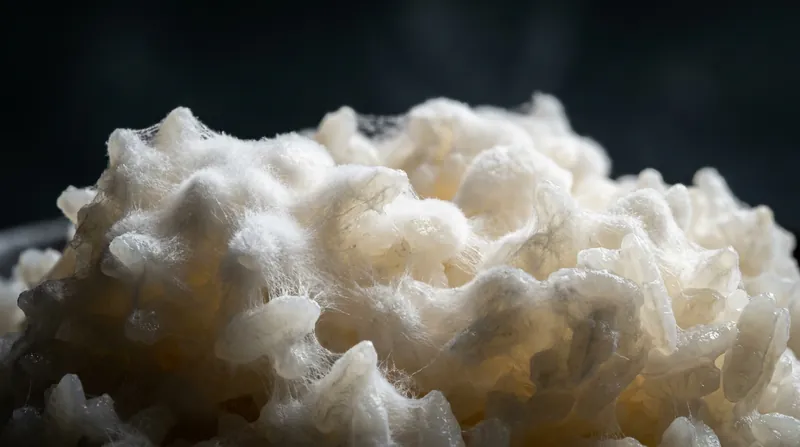
In almost every kitchen on Earth, the sight of white fuzz growing on a batch of cooked rice is a signal to throw it away. Mold is the universal enemy of fresh food, a harbinger of spoilage and decay. Yet, in the most revered culinary institutions—from centuries-old Japanese breweries to the test kitchens of Michelin-starred restaurants—that same white fuzz is cultivated with obsessive, temperature-controlled devotion.[1]
This is Aspergillus oryzae, known commonly as koji. Far from ruining food, this specific mold is the invisible architectural foundation of Asian fermentation. Without it, there is no soy sauce, no miso, no sake, and no mirin. It is a microscopic engine that transforms bland grains and legumes into some of the most complex, savory, and sweet ingredients in the human diet.[2]
To walk into a kojimuro—the cedar-lined incubation room where the mold is grown—is to step into a sauna that smells like roasting nuts, sweet corn, and fresh mushrooms. The air is thick with humidity, kept precisely at body temperature. Here, artisans massage spores into steamed rice, coaxing the mold to bloom over 48 hours until the grains are bound together in a fragrant, snowy mat.[3]
What makes koji so valuable is its voracious appetite and the chemical tools it uses to feed. As the mold grows, it excretes a powerful cocktail of enzymes. The first is amylase, which shears complex, tasteless starches into simple sugars. This is how sake brewers coax sweet alcohol from polished rice, and how a simple rice porridge transforms into amazake, a naturally sweet, creamy beverage with no added sugar.[3]
The second major enzyme is protease, and it is the key to unlocking savory depth. Proteases act like microscopic scissors, snipping long, coiled protein chains into individual amino acids. Chief among these is glutamic acid—the very molecule responsible for umami. When koji is introduced to protein-dense soybeans, it breaks them down over months into the intensely savory pastes and liquids we know as miso and soy sauce.
The domestication of Aspergillus oryzae is one of humanity's greatest feats of biotechnology, predating modern microbiology by millennia. Genomic analysis suggests that ancient brewers in East Asia selectively bred the mold, coaxing it away from its toxic cousin, Aspergillus flavus. Over centuries, they disabled the gene cluster responsible for producing harmful aflatoxins, resulting in a safe, domesticated fungus that the Brewing Society of Japan officially declared the "National Mold" in 2006.[2]
For most of its history, koji was treated strictly as an infrastructural ingredient—a means to an end for making condiments. But over the last decade, a quiet revolution has brought the mold out of the fermentation crock and onto the center of the plate. Chefs realized that the same enzymatic power used to break down soybeans could be applied to almost anything.[3]
The catalyst for this global spread was largely the fermentation lab at Noma in Copenhagen, led by René Redzepi and David Zilber. By publishing their methods in 2018, they demystified the process for Western cooks. They demonstrated how koji could be grown on non-traditional substrates like barley, sunflower seeds, or even bread, creating entirely new categories of flavor that mimic traditional soy sauce but taste of roasted nuts or caramelized grains.
Today, the applications are bound only by imagination. Chefs are using koji to rapidly dry-age meat. By rubbing a steak with koji-inoculated rice, the proteases tenderize the muscle fibers and develop the funky, nutty flavors of a 45-day dry-aged ribeye in a matter of days. The mold essentially pre-digests the meat, amplifying its savory characteristics while softening its texture.
For the home cook, the most accessible entry point is shio koji, a chunky, porridge-like marinade made by mixing rice koji with water and salt. Left to ferment at room temperature for a week, it becomes an all-purpose flavor enhancer. Smeared on a piece of chicken or fish before roasting, it not only seasons the meat but encourages rapid, golden caramelization in the oven due to the newly freed sugars.[3]
Beyond flavor, there is growing interest in the nutritional benefits of koji-fermented foods. The enzymatic breakdown makes nutrients more bioavailable, essentially doing a portion of the digestive work before the food ever reaches the stomach. While claims about live enzymes surviving the acidic environment of the human gut remain a subject of scientific debate, the prebiotic benefits of the fermentation process are well documented.
Despite its magic, working with koji requires precision and respect for food safety. The mold thrives in warm, humid environments—the exact same conditions favored by harmful pathogens. Maintaining pure cultures and preventing cross-contamination is a constant challenge, particularly as amateur fermenters experiment with wilder substrates. The line between a delicious, umami-rich ferment and a spoiled batch of grains is governed entirely by temperature control and sanitation.[1]
As the culinary world increasingly pivots toward plant-based eating, koji is proving to be an invaluable tool. It offers a natural, additive-free way to build the deep, satisfying savory notes that are often missing from vegetarian dishes. By applying ancient fungal technology to modern ingredients, cooks are discovering that the future of flavor might just be a microscopic mold from the past.[3]
The story of koji is a testament to human ingenuity—the ability to look at a decaying grain of rice and see the potential for culinary alchemy. Whether it is quietly fermenting in a cedar barrel in Kyoto or rapidly aging a steak in a Brooklyn test kitchen, Aspergillus oryzae remains the most powerful, transformative ingredient you will never actually taste on its own.[1][2]
Definitions
- Aspergillus oryzae
- The scientific name for the domesticated mold used to ferment starches and proteins in East Asian cuisine.
- Kojimuro
- A specialized, temperature- and humidity-controlled cedar room used traditionally to cultivate koji spores on steamed grains.
- Amylase
- An enzyme produced by koji that breaks down complex carbohydrates into simple, sweet-tasting sugars.
- Protease
- An enzyme that breaks down long protein chains into individual amino acids, creating savory, umami flavors.
- Shio Koji
- A versatile, salty marinade made by fermenting rice koji, water, and salt, used to tenderize and season ingredients.
- Amazake
- A sweet, creamy, non-alcoholic Japanese beverage made by using koji to break down the starches in rice into natural sugars.
Questions & answers
Is the mold in koji safe to eat?
Yes. Unlike its wild relatives, the domesticated Aspergillus oryzae strain has been genetically adapted over centuries and does not produce harmful toxins.
Can I use koji instead of salt?
Koji itself is not salty, but preparations like shio koji (which includes salt) can be used as a salt substitute that adds significantly more depth and umami to a dish.
Does cooking destroy the benefits of koji?
Cooking will deactivate the live enzymes and mold, but the flavor compounds—the sugars and amino acids already created during fermentation—remain intact and often caramelize beautifully.
What does koji actually taste like?
On its own, fresh rice koji has a sweet, floral aroma reminiscent of roasted chestnuts and sweet corn, though it is rarely eaten plain.
Analysis by camp
Traditional Fermentation Artisans
Value the centuries-old methods and cultural heritage of koji in producing foundational Japanese ingredients.
For traditional brewers and miso makers in Japan, koji is not a trendy culinary hack but a revered cultural inheritance. The process of cultivating the mold in a cedar-lined kojimuro is treated with profound respect, relying on generational knowledge of temperature, humidity, and timing. This camp emphasizes that the true mastery of Aspergillus oryzae lies in patience—allowing the enzymes to slowly break down soybeans over months or years to achieve the nuanced, balanced flavors of authentic soy sauce and miso, rather than rushing the process for a quick umami boost.
Modern Culinary Innovators
View koji as a versatile, open-source enzymatic tool that can be applied to non-traditional ingredients.
Pioneered by test kitchens like Noma, this perspective treats koji as a biological technology that can be decoupled from its traditional Japanese applications. Chefs in this camp use the mold's powerful amylase and protease enzymes to rapidly age meats, create novel misos from pistachios or leftover bread, and extract complex flavors from otherwise bland ingredients. For them, koji is a key to unlocking sustainable, intense flavors, particularly in plant-based cooking where deep savory notes are traditionally harder to achieve without meat.
Food Scientists & Microbiologists
Focus on the genomic history, enzymatic mechanisms, and strict food safety parameters of the mold.
From a scientific standpoint, Aspergillus oryzae is a marvel of ancient human-driven biotechnology. Microbiologists study how early brewers successfully domesticated the mold, disabling the gene cluster that produces toxic aflatoxins found in its wild relatives. This camp is primarily concerned with the precise biochemical reactions—how specific temperatures optimize either amylase or protease activity—and the critical importance of sanitation. They caution that as amateur cooks experiment with koji, maintaining pure cultures and preventing the growth of harmful pathogens in warm, humid environments remains paramount.
- Traditional Fermentation Artisans
- Value the centuries-old methods and cultural heritage of koji in producing foundational Japanese ingredients.
- Modern Culinary Innovators
- View koji as a versatile, open-source enzymatic tool that can be applied to non-traditional ingredients.
- Food Scientists
- Focus on the genomic history, enzymatic mechanisms, and strict food safety parameters of the mold.
Perspectives this story doesn't cover
- Industrial food manufacturers scaling koji production
- Allergy specialists studying fungal sensitivities
Sources
Source coverage
3 outlets
3 viewpoints surfaced



- [1]Factlen Editorial Team
Synthesis by Factlen editorial team
Read on Factlen Editorial Team → - [2]WikipediaFood Scientists
Aspergillus oryzae
Read on Wikipedia → - [3]Soil DiningModern Culinary Innovators
What is koji fermentation?
Read on Soil Dining →
More in Food & Drink
See all →Culinary Science
The Science of Koji: How a Domesticated Mold is Rewiring Global Cuisine
6 sources
Culinary Science
The Ancient Chemistry That Makes Corn Digestible, Nutritious, and Delicious
4 sources
Fermentation Science
The 1.0 to 1.5 pH Drop: How Lactic Acid Bacteria Convert Sugars to Acid to Define the Texture and Safety of Sauerkraut and Kimchi
6 sources
Altitude Cooking
The 1°C Drop Per 1,000 Feet: How Barometric Pressure Dictates Boiling Point and Recipe Adjustment
7 sources

Comments
Every angle. Every day.
Get Food & Drink stories with full source coverage and perspective breakdowns, free every day.