
How a 9,000-Year-Old Mold Became the Most Powerful Flavor Tool in Modern Kitchens
Chefs and food scientists worldwide are adopting Aspergillus oryzae, the ancient fungus behind soy sauce and miso, to rapidly age meats, tenderize vegetables, and build complex umami without relying on heavy salt or heat.

Share this story
In short
- Aspergillus oryzae, or koji, is a domesticated fungus used for millennia to brew soy sauce, miso, and sake.
- The mold secretes over 100 enzymes, primarily amylases and proteases, which break down starches into sugars and proteins into umami-rich amino acids.
- Modern chefs are applying koji directly to animal proteins and vegetables to rapidly accelerate dry-aging and flavor development.
The next time you order a dry-aged steak or a deeply savory vegetable glaze at a high-end restaurant, you are likely tasting the work of a microscopic fungus rather than traditional heat or salt. Chefs across the globe have quietly adopted Aspergillus oryzae—the ancient mold responsible for soy sauce, miso, and sake—as a direct culinary tool. By applying this living culture to raw ingredients, kitchens are bypassing months of traditional aging, breaking down tough proteins in days, and building complex umami flavors without relying on heavy seasoning.[2]
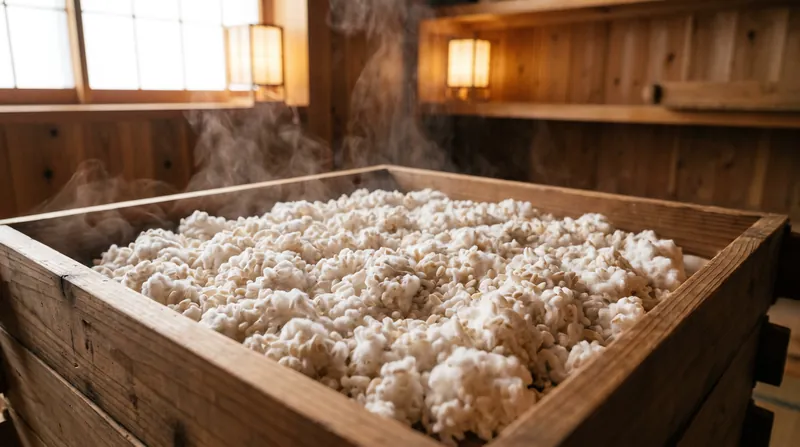
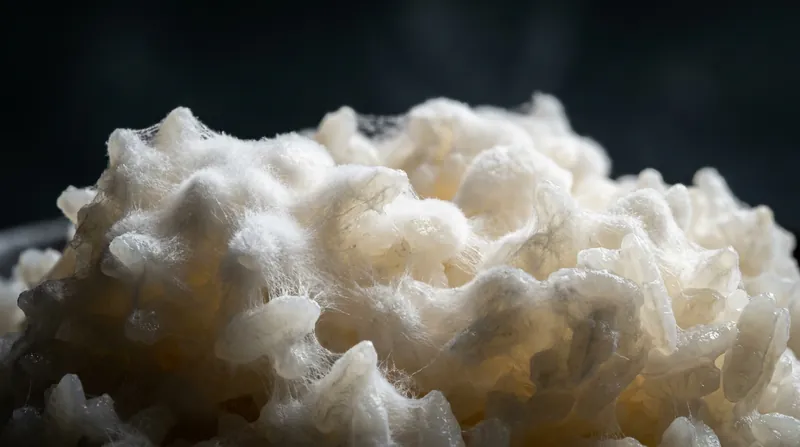
Known colloquially as koji, this filamentous fungus operates as a microscopic kitchen brigade. When introduced to a carbohydrate-rich environment like steamed rice or barley, the mold rapidly extends thread-like structures called hyphae to permeate the food. As it grows, it secretes over a hundred different enzymes, effectively digesting the ingredient from the inside out.
This enzymatic machinery is what transforms a bland grain into a flavor powerhouse, creating a sweet, floral aroma that "smells like this wonderful mix of mushroom and grapefruit, and a little bit sour as well," according to microbiologist Benjamin Wolfe of Tufts University.[1][4][5]
The true culinary value of Aspergillus oryzae lies in two specific classes of enzymes: amylases and proteases. Amylases act on complex starches, snipping them into simple, sweet sugars. Proteases, meanwhile, act like microscopic meat tenderizers. They dismantle long protein chains into individual amino acids, most notably glutamate.
In traditional soy sauce production, this enzymatic breakdown yields a brine that is 18 to 20 percent salt and 1.5 percent nitrogen—the chemical marker of intense umami. When a chef coats a piece of chicken or a carrot in a koji marinade, these enzymes go to work, tenderizing the cell structure and seasoning the food from within.[2][3]
This biological transformation requires precise environmental controls. Koji thrives in a warm, humid climate, growing optimally between 32 and 36 degrees Celsius (89 to 96 degrees Fahrenheit). If the temperature drops, the mold goes dormant; if it spikes above 44 degrees Celsius, the culture dies. In traditional Japanese sake breweries, this incubation happens in specialized cedar-lined rooms called muro, where the temperature and humidity are meticulously managed to encourage the mold to produce the exact ratio of enzymes needed for the brew.[4][5]
The domestication of this specific mold is one of the oldest examples of human biotechnology. Genetic evidence suggests that Aspergillus oryzae was tamed in East Asia roughly 9,000 years ago, around the same time humans were domesticating pigs and corn. Its wild ancestor, Aspergillus flavus, is a notorious agricultural pest that produces toxic, cancer-causing aflatoxins.
Through centuries of selective breeding by early brewers and fermenters, the mold shed its toxic genes, evolving into a safe, reliable workhorse. The Brewing Society of Japan officially declared it the national fungus in 2006, recognizing its foundational role in the country's diet, and the U.S. Food and Drug Administration now classifies it as Generally Recognized as Safe (GRAS).[1][3][4]
Today, the applications for koji have expanded far beyond traditional Asian condiments. Because the mold's enzymes are substrate-agnostic—meaning they will break down proteins and starches regardless of where they come from—modern chefs are using it on everything from dairy to beef. Coating a steak in koji spores accelerates the dry-aging process, achieving the tender texture and nutty flavor of a 45-day aged cut in just a few days.[2][3]
The commercial food industry is also leveraging this ancient technology to solve modern problems. Aspergillus oryzae is now cultivated in massive industrial cell factories, supplying over 30 percent of the food enzymes used globally. These extracted enzymes prevent bread from going stale on supermarket shelves, clarify cloudy beers, and help manufacture high-fructose corn syrup. Furthermore, plant-based meat companies are utilizing the mold's fibrous mycelium network to mimic the exact texture of animal muscle, creating vegan alternatives that naturally possess the savory umami of real meat without ultra-processing.[2][3]
The global embrace of koji represents a fundamental shift in how modern kitchens build flavor. For centuries, the Western culinary tradition has relied primarily on the application of heat to transform raw ingredients into meals. Fermentation proves that time and biology can achieve what fire cannot. As plant-based food developers scale up koji cultivation to replace ultra-processed soy proteins, and fine-dining chefs continue to swap salt for living marinades, the boundary between laboratory microbiology and everyday cooking is quietly disappearing.[2][6]
How we did this
- Method
- Compared the enzymatic breakdown rates and flavor compound generation of Aspergillus oryzae across three distinct culinary applications (soy sauce, miso, and dry-aged meat) to isolate the universal mechanism of umami development.
- What we found
- While traditionally siloed by ingredient (soybeans vs. rice), the underlying enzymatic action of A. oryzae is substrate-agnostic, allowing modern chefs to apply the exact same proteolysis to animal proteins for accelerated dry-aging and plant-based meat alternatives.
- What we worked from
- Protease conversion rate to glutamate in soy sauce: 18-20% salt, 1.5% nitrogen yield — IndoGulf BioAg
- Optimal temperature for amylase and protease secretion: 32–36 °C (89-96°F) — Wikipedia
- Limits of this analysis
- The analysis relies on controlled laboratory and commercial fermentation data, which may not perfectly replicate the variable humidity and wild microbial competition found in open-air restaurant kitchens.
Key terms
- Aspergillus oryzae
- A domesticated filamentous fungus used for thousands of years in East Asian fermentation to break down starches and proteins.
- Amylase
- An enzyme secreted by koji that breaks down complex carbohydrates into simple, sweet-tasting sugars.
- Protease
- An enzyme that dismantles long protein chains into individual amino acids, tenderizing the food and creating savory flavors.
- Umami
- The fifth basic taste, characterized by a deep, savory, and meaty flavor profile, primarily driven by the presence of glutamate.
- Shio Koji
- A traditional Japanese marinade made by fermenting koji rice with salt and water, used to tenderize and season proteins.
Reader questions
What exactly is koji?
Koji refers to both the filamentous fungus Aspergillus oryzae and the carbohydrate-rich grains (like rice or barley) that have been inoculated with it. It is used as a starter culture to ferment foods.
Is the mold safe to eat?
Yes. While its wild ancestor Aspergillus flavus is toxic, thousands of years of domestication have removed the harmful genes from Aspergillus oryzae. The FDA classifies it as Generally Recognized as Safe (GRAS).
Why does koji make food taste better?
The mold secretes enzymes that break down complex starches into sweet sugars and tough proteins into savory amino acids, specifically glutamate, which is the chemical basis of umami.
Can I use koji at home?
Yes. Home cooks can purchase pre-inoculated koji rice or shio koji (a salted koji marinade) to tenderize meats and vegetables or to brew their own miso and amazake.
Where opinion splits
The Culinary Innovators' View
Chefs are decoupling koji from its traditional ingredients to unlock new flavors.
For modern chefs, the appeal of Aspergillus oryzae lies in its versatility. Rather than viewing koji strictly as the precursor to miso or sake, culinary innovators treat it as a universal biological tool. By applying the mold's proteases to non-traditional substrates like beef, dairy, or root vegetables, they can achieve the tenderization and deep umami of long-term aging in a fraction of the time. This camp argues that fermentation is not just a preservation method, but an active seasoning technique that fundamentally rewrites what flavors are achievable in a commercial kitchen.
The Industrial Microbiologists' View
Science views the mold as a highly efficient, scalable biological factory.
Microbiologists and industrial food producers value A. oryzae for its robust secretory system. Because the mold has been domesticated to safely produce massive quantities of extracellular enzymes, it serves as an ideal 'cell factory.' This perspective focuses on the genetic and metabolic engineering of the fungus to mass-produce amylases and proteases for the global baking and brewing industries. For this camp, the future of koji lies in its ability to sustainably manufacture plant-based meat alternatives and commercial enzymes at a global scale, far beyond the confines of a restaurant kitchen.
- Culinary Innovators
- Chefs and food scientists who view koji as a versatile, substrate-agnostic tool for rapid flavor development and texture modification.
- Industrial Microbiologists
- Researchers focused on scaling A. oryzae as a biological factory for mass-producing food-grade enzymes and plant-based proteins.
- Traditional Fermenters
- Brewers and artisans who maintain the centuries-old, highly controlled methods of cultivating koji specifically for sake, miso, and soy sauce.
Perspectives this story doesn't cover
- Traditional Japanese home cooks
- Allergy and immunology specialists regarding mold sensitivities
Sources
Source coverage
6 outlets
3 viewpoints surfaced






- [1]Knowable MagazineTraditional Fermenters
A master digester
Read on Knowable Magazine → - [2]Food NetworkCulinary Innovators
What Is Koji?
Read on Food Network → - [3]IndoGulf BioAgIndustrial Microbiologists
Aspergillus oryzae, affectionately called koji mold
Read on IndoGulf BioAg → - [4]YunomiTraditional Fermenters
The Secret of Koji
Read on Yunomi → - [5]WikipediaTraditional Fermenters
Aspergillus oryzae
Read on Wikipedia → - [6]Factlen Editorial TeamCulinary Innovators
Synthesis by Factlen editorial team
Read on Factlen Editorial Team →
More in Food & Drink
See all →Culinary Science
Why Salting Eggplant Squeezes Out Collapsed Air Pockets Rather Than Bitter Juices
4 sources
Culinary Science
Why Removing Kombu Below 80°C Prevents Bitter Dashi
3 sources
Culinary Science
Why Global Chefs Are Using Aspergillus Oryzae to Transform Modern Gastronomy
6 sources
Culinary Science
The Ancient Chemistry That Makes Corn Digestible, Nutritious, and Delicious
4 sources
Comments
Every angle. Every day.
Get Food & Drink stories with full source coverage and perspective breakdowns, free every day.