
Staged Combustion vs. Gas Generator: How Turbopump Drive Cycles Dictate Rocket Thrust and Complexity
The choice between dumping turbine exhaust or routing it into the main combustion chamber defines the performance ceiling of modern orbital rockets. While gas generator cycles offer simplicity, staged combustion unlocks the immense chamber pressures required for heavy-lift reusability.
By Hunter Cole

Share this story
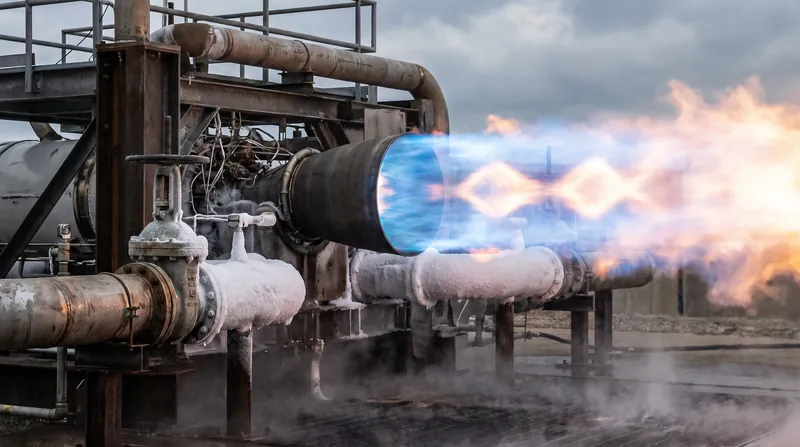
The difference between a gas generator and a staged combustion rocket engine comes down to a single, critical piece of plumbing: what happens to the exhaust from the turbopumps. In a gas generator, the exhaust is dumped overboard, sacrificing overall fuel efficiency in exchange for mechanical simplicity.
In a staged combustion cycle, that exhaust is forced directly into the main combustion chamber, maximizing thrust but exponentially increasing the engineering complexity of the entire system. This foundational architectural choice dictates an engine's maximum chamber pressure, its thrust-to-weight ratio, and ultimately the total payload capacity of the launch vehicle it powers.[3][4]
To understand why this distinction matters, one must look at how liquid rocket engines feed themselves during flight. A modern orbital rocket consumes propellant at an astonishing rate to escape Earth's gravity. SpaceX's Raptor engine, for instance, ingests 650 kilograms of subcooled liquid oxygen and liquid methane every single second it operates.
Pushing that massive volume of fluid into a highly pressurized combustion chamber requires incredibly powerful turbopumps, which operate under immense mechanical loads. Those pumps are the beating heart of the engine, and they require a tremendous amount of energy just to spin.[7]
Those pumps are driven by a turbine, and that turbine requires its own source of hot, high-pressure gas to function. In a traditional gas generator cycle, a small portion of the rocket's fuel and oxidizer is bled off from the main lines and burned in a separate, smaller preburner.
The resulting hot gas spins the turbine to drive the pumps, does its mechanical work, and is then vented out of the vehicle through a separate exhaust pipe. Because this exhaust does not contribute meaningfully to the rocket's main thrust, it represents a direct loss of potential energy.[4]
However, this open-cycle design offers a massive engineering advantage: it keeps the turbine exhaust physically separated from the main combustion chamber. By venting the gas overboard, the preburner only needs to operate at a pressure high enough to spin the turbine, keeping internal pressures manageable and drastically simplifying the engine's plumbing and sealing requirements. For decades, this reliable architecture was the baseline standard for American orbital rockets, powering historic vehicles like the Saturn V and the Falcon 9 with a proven track record of success.[3]
Staged combustion closes that thermodynamic loop. Instead of venting the turbine exhaust into the vacuum of space, a staged combustion engine routes that high-pressure gas directly into the main combustion chamber, where it is burned completely alongside the rest of the propellant. This closed-cycle approach ensures that every single drop of fuel and oxidizer contributes to the vehicle's forward thrust, significantly increasing the engine's specific impulse—the aerospace metric for fuel efficiency. But this efficiency comes at a steep mechanical cost, fundamentally altering the pressure dynamics of the entire propulsion system.[7]
Forcing exhaust gas into a main chamber that is already operating at extreme pressure requires the preburner to operate at an even higher pressure to maintain forward flow. This creates a cascade of mechanical stress throughout the engine, demanding thicker walls, stronger seals, and heavier components. The material science required to survive these conditions is formidable. In an oxygen-rich staged combustion cycle, such as Blue Origin's BE-4 engine, the preburner operates with a massive excess of liquid oxygen to keep temperatures from melting the turbine blades.[2][8]
Hot, high-pressure oxygen is a highly reactive environment that will instantly ignite most standard aerospace metals, requiring the use of advanced superalloys and specialized coatings to prevent the engine from literally consuming itself from the inside out. Blue Origin intentionally designed the BE-4 to be a "medium-performing version of a high-performance architecture," operating at a relatively conservative main chamber pressure of 140 bar. This design choice prioritizes a lifespan of up to 100 flights and robust reusability over achieving the maximum theoretical performance of the cycle.[5][8]
Pushing the staged combustion architecture to its absolute thermodynamic limit results in full-flow staged combustion. SpaceX's Raptor engine utilizes this approach, employing two separate preburners—one running fuel-rich and one running oxygen-rich—to drive two separate turbines. This twin-shaft design converts all of the liquid propellant into a gaseous state before it ever enters the main chamber. By splitting the turbine work across two separate systems, the Raptor is able to achieve a staggering main chamber pressure of 330 bar, more than double that of the BE-4.[7]
The trade-off for this immense power is a thermodynamic environment so extreme that only a handful of full-flow engines have ever been successfully fired since the concept was first explored in the 1960s. The ongoing transition from gas generators to staged combustion represents the maturation of the commercial space industry.
While gas generators remain highly viable for smaller launch vehicles, the physics of deep space exploration and rapid reusability demand the closed-loop efficiency of staged combustion. As metallurgical boundaries are pushed further in 2026 and beyond, the complex plumbing of staged combustion will become the baseline standard for humanity's next generation of heavy-lift architecture.[1][6]
Competing readings
Commercial Launch Providers
Companies prioritizing reusability and heavy-lift capacity favor staged combustion.
For operators like SpaceX and Blue Origin, the immense development cost of staged combustion is justified by the operational economics of reusability. By maximizing specific impulse and chamber pressure, these engines allow launch vehicles to carry more payload while reserving enough propellant to land the booster. The closed-cycle design also eliminates the soot buildup associated with kerosene gas generators, significantly reducing the refurbishment time required between flights.
Small-Sat Launch Startups
Emerging launch providers favor gas generator cycles for their simplicity and lower barrier to entry.
For companies building smaller rockets designed to deliver lightweight satellites to low Earth orbit, the extreme efficiency of staged combustion is unnecessary. Gas generator engines are vastly cheaper to design, manufacture, and test. Because the turbine exhaust is vented overboard, the internal plumbing is simpler and the required metallurgical tolerances are much lower. This allows startups to reach orbit faster and with less capital, accepting a slight penalty in fuel efficiency as a worthwhile trade-off for mechanical reliability.
- Heavy-Lift Operators
- Prioritize maximum efficiency and chamber pressure to enable rapid reusability.
- Small-Sat Providers
- Prioritize mechanical simplicity and lower development costs over maximum theoretical performance.
Sources
Source coverage
9 outlets
2 viewpoints surfaced






- [1]NASA Technical Reports Server
Orbit Transfer Vehicle (OTV) engine, phase A study. Volume 1: Executive Summary
Read on NASA Technical Reports Server → - [2]Aerospace Research Central
Turbopumps for Gas Generator and Staged Combustion Cycle Rocket Engines
Read on Aerospace Research Central → - [3]Journal of Mines, Metals and Fuels
An Overview of Rocket Engine Power Cycles
Read on Journal of Mines, Metals and Fuels → - [4]The Space TechieSmall-Sat Providers
Gas Generator Cycle
Read on The Space Techie → - [5]NASA Technical Reports Server
Chapter 12: Materials for Liquid Propulsion Systems
Read on NASA Technical Reports Server → - [6]Aerospace Research Central
A Comparison Between Two Possible Thermodynamic Schemes for Reusable LOX/LCH4 Engines
Read on Aerospace Research Central → - [7]WikipediaHeavy-Lift Operators
Raptor (rocket engine)
Read on Wikipedia → - [8]WikipediaHeavy-Lift Operators
BE-4
Read on Wikipedia → - [9]Factlen Editorial Team
Synthesis by Factlen editorial team
Read on Factlen Editorial Team →
More in Transportation
See all →Aerospace Engineering
Why Rockets Throttle Down Mid-Ascent to Survive Max Q
3 sources

Orbital Mechanics
Auxiliary Ullage Motors Fire Before Upper-Stage Restarts to Settle Free-Floating Propellant and Prevent Turbopump Cavitation
3 sources
Orbital Mechanics
Graveyard Orbits Require Just 11 m/s of Delta-V Compared With the 1,500 m/s Needed to Deorbit From Geostationary Altitude
4 sources
Orbital Mechanics
Why Orbital Rockets Must Achieve 7.8 km/s Horizontal Velocity and Execute Zero-Lift Gravity Turns
4 sources
Comments
Every angle. Every day.
Get Transportation stories with full source coverage and perspective breakdowns, free every day.