
Zurich Airport Deploys Level 4 Autonomous Shuttles Without Onboard Safety Drivers
Two electric shuttles are now transporting airport employees along a geofenced apron route, monitored entirely from a remote cockpit. The deployment marks one of Europe's first live tests of Level 4 autonomy in a high-security industrial environment.

- Airport Operators
- Focused on solving chronic labor shortages and decarbonizing ground operations through targeted automation.
- Autonomous Tech Developers
- Viewing geofenced industrial zones as the ideal proving ground to validate Level 4 systems before public deployment.
- Transit & EV Advocates
- Highlighting the milestone as a major step forward for zero-emission, driverless public transportation.
Perspectives this story doesn't cover
- Labor Unions representing ground handlers
- Airlines operating at the gates
Key terms
- Level 4 Autonomy
- A classification of self-driving technology where the vehicle can perform all driving tasks under specific conditions without requiring a human to take over.
- Geofencing
- The use of GPS or mapping technology to create a virtual geographic boundary, restricting a vehicle's operation to a specific, pre-approved area.
- Remote Teleoperation
- A system that allows a human operator located in a remote control center to monitor and, if necessary, take manual control of an autonomous vehicle.
- Apron
- The area of an airport where aircraft are parked, unloaded or loaded, refueled, or boarded, characterized by heavy ground-support vehicle traffic.
- Sensor Suite
- The combined array of hardware—such as cameras, radar, and lidar—that an autonomous vehicle uses to perceive its physical surroundings.
Key points
- Zurich Airport has deployed two fully driverless Level 4 electric shuttles to transport employees across the apron.
- The vehicles operate without an onboard safety driver and are monitored by staff in a remote teleoperation cockpit.
- The shuttles travel at a maximum of 30 kilometers per hour on a geofenced route that never crosses aircraft taxiways.
- The project aims to alleviate severe labor shortages in ground handling by freeing up licensed drivers for specialized tasks.
The standard reference point for autonomous transit is the urban robotaxi—a vehicle navigating the unpredictable grid of a public city center. The deployment unfolding this week at Zurich Airport shares that same Level 4 driverless architecture, but it differs in one crucial respect: its operating domain is a tightly geofenced, high-security industrial environment where every other moving object is a trained professional. Rather than dodging distracted pedestrians and delivery bikes, the two electric shuttles now operating on the airport's apron are navigating around baggage tugs, catering trucks, and ground crews.[1][4]
The project, a collaboration between Zurich Airport Ltd. and Chinese autonomous technology company WeRide, reached a critical regulatory milestone in September 2026. The airport officially removed the human safety drivers from the vehicles, transitioning to fully automated operations monitored exclusively from a remote cockpit. This makes the Swiss aviation hub one of the first in Europe to test Level 4 autonomy—where the vehicle handles all driving tasks under specific conditions without human intervention—in a live, mixed-traffic environment. The milestone represents the culmination of a multi-year effort to prove that driverless systems can safely integrate into the highly regulated choreography of commercial aviation.[1][3][4]
For the ground handlers and maintenance staff who work on the apron, this shift changes the daily logistics of getting to the job. The two shuttles, named Nimbus and Stratus, are designed to carry up to eight passengers each. They operate on a fixed airside route connecting the employee entrance at Gate 101 to the maintenance depot at Gate 130. By automating this specific corridor, the airport provides a continuous, predictable transit link that does not require pulling a licensed driver away from other critical ground operations.[3][5]
The route itself was selected to minimize catastrophic risk while still proving the technology's viability. The shuttles travel at a maximum speed of 30 kilometers per hour and make several stops along the way. Crucially, the path is entirely separated from flight operations and never crosses an active aircraft taxiway or runway. This physical separation allowed regulators to approve the driverless phase, knowing the shuttles would never interact with a taxiing commercial airliner, even in the event of a total sensor failure.[3][5]
"Safety was and remains our top priority at all times," says Raphaël Glaesener, Senior Innovation Manager at Zurich Airport Ltd. Because the removal of the onboard safety driver represents a significant leap in operational risk, the initial Level 4 trips are being conducted without passengers. Glaesener notes that after approximately four weeks of empty test operations, the airport expects to open the doors to employees holding the required apron access permits, allowing them to commute on the driverless system.[1][3]
"Safety was and remains our top priority at all times," says Raphaël Glaesener, Senior Innovation Manager at Zurich Airport Ltd.
The underlying technology relies on WeRide's sensor suite and software stack, which has been undergoing phased testing at the airport since March 2025. In May 2026, the project moved to a phase dubbed Rear Seat Operation, where the safety driver stepped away from the steering wheel but remained in the vehicle to monitor the systems. Now, that human presence has been entirely replaced by a remote monitoring setup located in the airport's Innovation Hub, marking the final step in the automation ladder.[3]
This remote cockpit is staffed by employees from partner companies Swissport and Krummen Kerzers. These operators monitor the live telemetry and high-definition video feeds from Nimbus and Stratus, retaining the ability to intervene and provide teleoperation support if a shuttle encounters an edge case it cannot resolve autonomously. The former onboard safety drivers were retrained to manage this remote oversight role, shifting their daily responsibilities from physical driving to digital fleet management and system diagnostics. This setup ensures that human judgment remains in the loop without requiring a physical body in every vehicle.[1][3]
The transition to Level 4 autonomy is not merely a technology demonstration; it is a direct response to the labor economics of modern aviation. Ground handling companies across Europe are struggling to recruit and retain staff for the grueling, shift-based work on the tarmac, which often involves heavy lifting in extreme weather. "The gradual automation of vehicles can make an important contribution for airports given the emerging shortage of skilled workers," explains Coralie Klaus Boecker, Head of the ZRH Innovation Hub at Flughafen Zürich AG. By removing the driver from the shuttle, the airport effectively creates a new labor efficiency.[1][3]
By automating routine employee transit, the airport frees up its limited pool of licensed drivers to operate the specialized equipment that actually turns an aircraft around—baggage loaders, pushback tractors, and fueling trucks. It also aligns with the facility's broader decarbonization mandate, replacing older diesel crew vans with zero-emission electric shuttles. This dual benefit of labor optimization and emissions reduction makes the autonomous shuttle a highly attractive proposition for municipal transit planners and airport authorities alike.[1][4]
The current pilot program is funded and scheduled to run through the end of 2026. During this window, the airport and its partners will evaluate the system's uptime, its ability to handle severe Swiss winter weather, and the latency of the remote cockpit connection. If Nimbus and Stratus prove reliable under these demanding conditions, the airport plans to use the resulting data to draft a comprehensive set of standards for deploying autonomous vehicles across other airport functions, potentially including passenger transit.[3][5]
The success of this geofenced deployment will dictate how quickly other European hubs adopt similar systems. Aviation regulators at neighboring facilities in Brussels and Amsterdam are already monitoring the Zurich data closely. The next verifiable checkpoint arrives in mid-October 2026, when the four-week empty testing phase concludes and the first apron workers step aboard a shuttle with no one at the wheel, testing whether the workforce is ready to trust their commute to a machine.[3][4][5]
Frequently asked
Are there passengers on the autonomous shuttles right now?
Not yet. For the first four weeks of the Level 4 deployment, the shuttles are running their routes empty to ensure the remote monitoring systems function flawlessly before airport employees are allowed to board.
Do the shuttles interact with airplanes?
No. The route is strictly geofenced to connect the employee entrance at Gate 101 to the maintenance depot at Gate 130, and it intentionally avoids crossing any active aircraft taxiways or runways.
What happens if the autonomous system gets confused?
The shuttles are continuously monitored by trained personnel in a remote cockpit at the airport's Innovation Hub. If the vehicle encounters a situation it cannot navigate, the remote operator can intervene and provide teleoperation support.
How fast do the shuttles travel?
The electric shuttles operate at a maximum speed of 30 kilometers per hour, which aligns with the strict speed limits enforced on the airport apron.
Sources
Source coverage
6 outlets
3 viewpoints surfaced





- [1]ElectrekTransit & EV Advocates
Zürich Airport deploys L4 autonomous shuttle – WITHOUT a human monitor
Read on Electrek → - [2]WeRideAutonomous Tech Developers
WeRide Expands European Presence with Autonomous Robobus Shuttle Deployment at Zurich Airport
Read on WeRide → - [3]Flughafen Zürich AGAirport Operators
Zurich Airport has reached a significant milestone with its pilot project for automated driving
Read on Flughafen Zürich AG → - [4]News18aTransit & EV Advocates
Zurich Airport Partners with WeRide to Deploy Two L4 Fully Autonomous Electric Shuttles
Read on News18a → - [5]Future Travel ExperienceAirport Operators
Zurich Airport tests self-driving shuttle bus as it lays groundwork for autonomous technologies
Read on Future Travel Experience → - [6]GreenTVTransit & EV Advocates
Zürich Airport deploys L4 autonomous shuttle – WITHOUT a human monitor
Read on GreenTV →
Comments
More in Automotive & Transportation
See all →EV Range Debate
The 2026 EV Battery Trade-Off: Why 220 Miles Is the New Battleground
8 sources
Aerodynamics
The 20 Percent Fuel Economy Gain: How Slipstreaming Reduces Aerodynamic Drag for Following Vehicles
8 sources
Hypercar Tech
How Tesla's 10,000-PSI SpaceX Thruster Package Changes the Roadster Ownership Reality
6 sources

Marine Autonomy
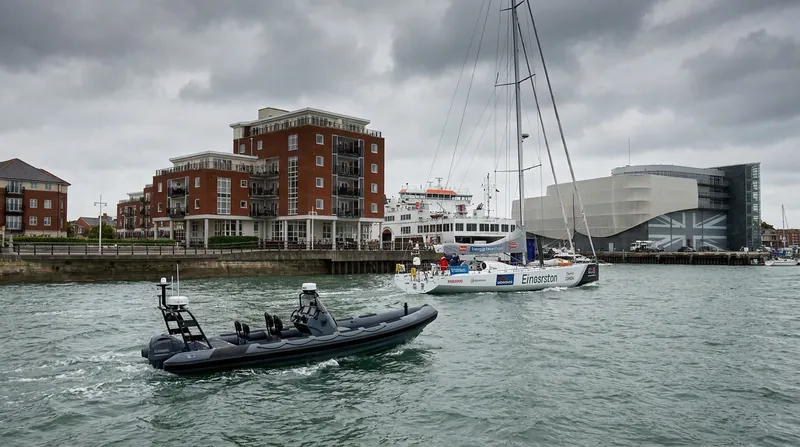
When Algorithms Meet Sailboats: What the Royal Navy's Drone Collision Reveals About Marine Autonomy
6 sources
Every angle. Every day.
Get Automotive & Transportation stories with full source coverage and perspective breakdowns delivered to your inbox.