
Tesla Launches Unsupervised, Paid Robotaxi Service in Dallas and Houston
Tesla has officially launched its first fully unsupervised, paid robotaxi operations in Texas, deploying a fleet of vision-only autonomous vehicles. The launch marks a major escalation in the commercial autonomous vehicle race and serves as the first large-scale public test of 'end-to-end' AI driving architecture.

Share this story
Tesla has officially crossed the threshold from driver-assist software to a commercial transportation utility. As of Thursday morning, the automaker launched its first fully unsupervised, paid robotaxi service in Dallas and Houston, allowing the public to hail driverless cars via a dedicated smartphone app.[1]
The deployment marks a watershed moment in the escalating US mobility race. While competitors like Waymo have operated commercial driverless fleets in cities like Phoenix, San Francisco, and Los Angeles for years, Tesla’s approach relies on a radically different technological foundation that eschews expensive sensors and highly detailed maps.[1][3]
Users within the designated Texas geofences can now summon a vehicle 24 hours a day. The initial fleet consists of roughly 250 company-owned vehicles split between the two cities, operating across major commercial and residential corridors.[2]
To understand the significance of this launch, one must look under the hood at the software architecture. Traditional autonomous vehicles operate on a 'modular' stack. In that system, one software module identifies objects, another predicts their movement, and a third calculates the vehicle's path based on pre-programmed rules.
Tesla’s Texas fleet operates on an 'end-to-end' neural network. Instead of human engineers writing explicit code for how to handle a four-way stop or a yielding pedestrian, the AI is trained on millions of hours of human driving video to intuitively understand how to navigate complex scenarios.[3]
The system takes in raw pixels from the car's eight exterior cameras and outputs steering, braking, and acceleration commands directly. There are no intermediate steps where the car explicitly labels a stop sign or a traffic cone; it simply behaves as a human would when approaching one, based on its vast training data.
This 'vision-only' approach remains highly controversial in the robotics industry. Tesla's vehicles do not use lidar (laser sensors) or radar, relying entirely on optical cameras to gauge depth, speed, and distance.[3]
Critics argue that without the redundancy of lidar, the vehicles are vulnerable to optical illusions, heavy rain, or blinding glare. Tesla counters that humans drive using only two eyes and a neural network (the brain), and that high-resolution cameras paired with massive compute power can replicate and exceed that capability.[3]
The choice of Texas for the inaugural launch is not coincidental. Over the past decade, Texas has cultivated one of the most permissive regulatory environments for autonomous vehicles in the world, actively courting companies looking to bypass the bureaucratic hurdles of the West Coast.
Unlike California, which requires extensive permitting, phased testing, and data reporting through both the DMV and the Public Utilities Commission, Texas state law broadly permits the operation of autonomous vehicles without a human driver, provided the vehicles comply with standard traffic laws and carry adequate insurance.
This state-level preemption means local officials in Dallas and Houston cannot ban the vehicles or cap fleet sizes. However, city transportation departments are actively monitoring the rollout, setting up task forces to track impacts on traffic flow, curb management, and interactions with emergency vehicles.[4]
The economics of the service are designed to aggressively undercut traditional ridehailing. Tesla is launching with a base fare of roughly $1.20 per mile, significantly lower than the average Uber or Lyft fare in the same markets, which often exceed $2.00 per mile.[1]
By removing the driver—who typically accounts for 50% to 70% of the cost of a ridehail trip—Tesla aims to make point-to-point autonomous transit cheaper than owning a personal vehicle, fundamentally altering urban mobility economics.[1][2]
However, this initial deployment is entirely company-owned. Despite years of promises that individual Tesla owners could deploy their personal cars into a 'robotaxi network' to earn passive income while they sleep, the Dallas and Houston fleets are centrally managed, charged, and cleaned by Tesla staff at dedicated depots.[2]
The ultimate test for Tesla's end-to-end architecture will be its ability to scale. Because the system does not rely on pre-mapped 'invisible rails' like its competitors, Tesla claims it can expand to new cities exponentially faster. The coming months in Texas will prove whether that scalability comes at the cost of safety.[3]
Perspectives explored
The Scalability Argument
Proponents believe Tesla's approach is the only mathematically viable way to solve global autonomy.
Advocates for Tesla's vision-only approach argue that relying on high-definition maps and lidar creates a 'brittle' system. Competitors like Waymo must meticulously map every inch of a city before launching, and if a construction crew changes a lane overnight, the map becomes obsolete. By training a neural network to simply 'understand' how to drive based on visual input, Tesla's supporters argue the system can be dropped into any city on Earth and function immediately, making it infinitely more scalable than modular architectures.
The Redundancy Argument
Traditional robotics experts warn that cameras alone cannot guarantee safety in edge cases.
Engineers from competing AV firms and academic institutions argue that cameras are susceptible to the same flaws as human eyes: blinding sunlight, heavy rain, and optical illusions. They maintain that lidar provides ground-truth physical data—bouncing a laser off an object guarantees the object is there, regardless of lighting conditions. This camp views the removal of redundant sensors not as a technological breakthrough, but as a dangerous cost-cutting measure that leaves the AI vulnerable to 'hallucinating' clear roads where obstacles exist.
The Municipal Perspective
City planners are bracing for the impact of driverless fleets on urban infrastructure.
Local officials in Texas find themselves in a complex position. State law preempts them from blocking the deployment, meaning they cannot cap the number of robotaxis on their streets. City planners are primarily concerned with 'curb management'—how driverless cars handle passenger drop-offs in busy downtown corridors without blocking bike lanes or transit buses. They are also closely monitoring how the end-to-end AI interacts with first responders, as previous modular AVs have occasionally struggled to properly yield to fire trucks and ambulances.
Key points
- Tesla has launched its first paid, fully unsupervised robotaxi service in Dallas and Houston.
- The fleet uses 'end-to-end' AI and cameras, bypassing the lidar and HD maps used by competitors like Waymo.
- Texas was chosen due to its permissive state-level regulations that prevent cities from banning autonomous vehicles.
- Fares are priced aggressively at roughly $1.20 per mile to undercut traditional ridehailing apps.
Open questions
- How the vision-only system will perform during severe Texas weather events, such as sudden torrential downpours or localized flooding.
- When, or if, Tesla will allow individual owners to add their personal vehicles to the paid network.
- Whether the $1.20 per mile price point is financially sustainable for Tesla, or if it is a loss-leader to capture market share.
Timeline
2016
Tesla first announces that all new vehicles have the hardware necessary for full self-driving.
2020
Tesla releases 'FSD Beta' to a select group of customers, requiring constant human supervision.
Early 2024
Tesla transitions its software architecture to 'end-to-end' neural networks, removing hundreds of thousands of lines of explicit code.
July 2026
Tesla launches its first commercial, unsupervised robotaxi service in Texas.
- Vision-Only Advocates
- Argue that end-to-end AI using only cameras is the only scalable way to achieve global autonomous driving, as it mimics human biology.
- Redundant Sensor Proponents
- Maintain that commercial robotaxis require lidar, radar, and high-definition maps to guarantee safety and handle edge cases that confuse cameras.
- Local Municipalities
- Express concern over the lack of local regulatory control regarding fleet sizes, traffic congestion, and emergency vehicle interactions.
Perspectives this story doesn't cover
- Human ridehail drivers whose livelihoods are threatened by cheaper autonomous alternatives.
- Disability advocates assessing the accessibility of the new driverless fleet.
Sources
Source coverage
4 outlets
3 viewpoints surfaced




- [1]BloombergRedundant Sensor Proponents
Tesla Initiates Paid Robotaxi Fares in Texas, Challenging Waymo's Sunbelt Dominance
Read on Bloomberg → - [2]Houston ChronicleLocal Municipalities
Driverless Teslas begin charging for rides in Houston: What you need to know
Read on Houston Chronicle → - [3]The VergeVision-Only Advocates
The robotaxi law that could ban Tesla
Read on The Verge → - [4]Dallas Morning NewsLocal Municipalities
Tesla robotaxis hit Dallas streets: City officials monitor traffic impact
Read on Dallas Morning News →
More in Automotive & Transportation
See all →Freight Automation
California DMV Opens Autonomous Trucking Market With Strict New Safety and 500,000-Mile Testing Mandates
3 sources
AV Regulation
EU Grants First Permit for Fully Autonomous L4 Testing on Public Highways in Belgium
2 sources
Delhi EV Mandate
New Delhi Approves Ban on New Petrol 2- and 3-Wheeler Registrations by 2028, Backed by EV Incentives
4 sources
Auto Tech Strategy
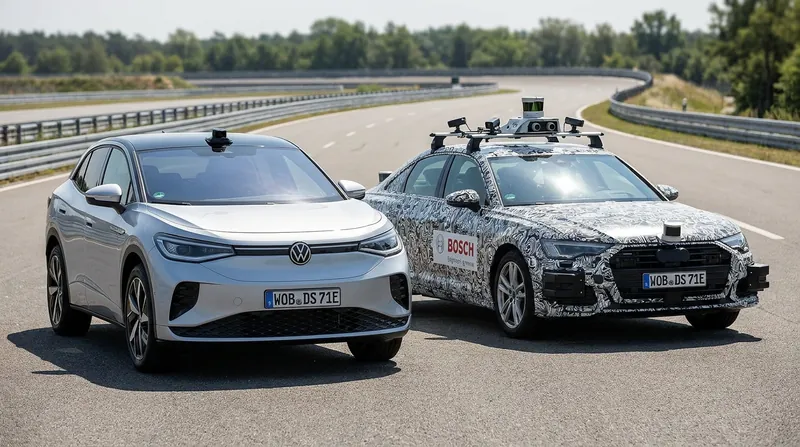
Volkswagen Scraps €1.5 Billion Autonomous Driving Alliance with Bosch Over Software Competitiveness
3 sources
Comments
Every angle. Every day.
Get Automotive & Transportation stories with full source coverage and perspective breakdowns, free every day.