
West Virginia Declares State of Emergency as Historic Flash Floods Claim Lives, Deploy National Guard
Torrential rains dropping up to seven inches of water in hours triggered catastrophic flash flooding across West Virginia, prompting a statewide emergency declaration. The deluge claimed at least two lives, forced over 100 water rescues, and triggered a massive federal and National Guard response to clear debris and stabilize infrastructure.
By Aarav Khanna

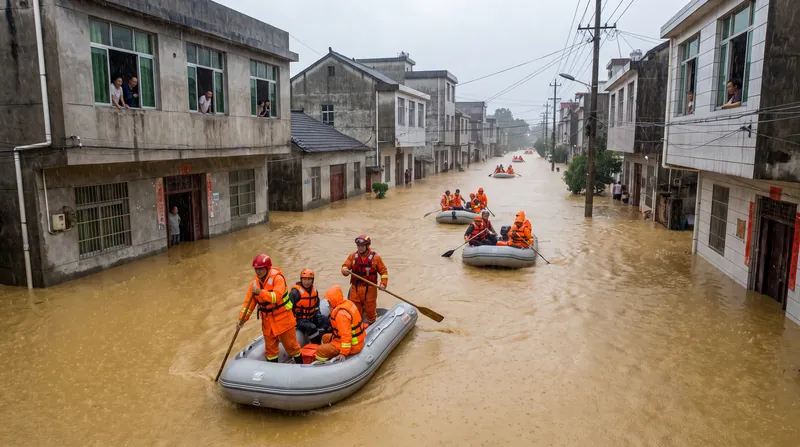
For residents of Appalachia and the broader Mid-Atlantic, the margin of safety between a severe summer storm and a catastrophic loss of property is shrinking. That vulnerability was laid bare across West Virginia, where a sudden deluge overwhelmed local drainage basins and forced a massive state and federal mobilization. Following torrential rains that dropped nearly a month's worth of precipitation in a matter of hours, Governor Patrick Morrisey declared a state of emergency across all 55 counties, activating hundreds of National Guard personnel to manage widespread flash flooding.[1][2]
The immediate human toll has crystallized as search and recovery operations navigate the debris. Authorities confirmed the deaths of two individuals in Upshur County, identified as 59-year-old Judy A. Young and 61-year-old James J. Harper, after their vehicle was swept into the floodwaters. First responders, including swift-water rescue teams and aviation units from the West Virginia National Guard and State Police, executed more than 100 water rescues during the initial hours of the disaster, pulling stranded residents from submerged vehicles and inundated homes.[1][5]
The meteorological mechanics of the event underscore the fragility of the region's topography. Slow-moving thunderstorms stalled over north-central West Virginia, unleashing up to seven inches of rain—with some localized areas recording 4.5 inches in just 37 minutes. This intense precipitation rate overwhelmed the Buckhannon River and its tributaries. Data from the U.S. Geological Survey indicated that the Sand Run stream gauge near Buckhannon surged to record levels, surpassing the historic high-water marks set during the devastating Election Day floods of November 1985.[1][2]
The infrastructure cascade was immediate and severe. Floodwaters washed out bridges, triggered landslides, and forced the closure of major transit arteries, including portions of Interstate 79 and U.S. Route 48. In Weston, muddy water surged into commercial properties, while a sinkhole in Fayetteville swallowed a vehicle, illustrating the rapid destabilization of the ground. The sheer volume of water left local drainage systems entirely incapacitated, transforming neighborhood streets into fast-moving rivers that severed communication and transportation lines.[1]
In response to the infrastructural collapse, the state initiated a highly coordinated military and civilian response. The West Virginia National Guard deployed over 500 members, establishing forward operational hubs and utilizing heavy machinery to clear hundreds of tons of debris from public spaces and waterways. Guard liaison officers embedded with county emergency operations centers to direct aviation assets and swift-water teams, working alongside local fire departments to restore basic access to communities that had been entirely cut off by the rising waters.[4][6]
Federal intervention has now been formalized to backstop the state's exhausted resources. FEMA announced that a major disaster declaration has been approved, unlocking federal funding for affected individuals in Lewis and Upshur counties. This assistance includes grants for temporary housing, home repairs, and low-cost loans to cover uninsured property losses. Federal coordinating officers have been dispatched to the region to establish disaster recovery centers, providing a bureaucratic lifeline to municipalities facing millions of dollars in municipal damage.[3]
The financial exposure for individual residents remains a critical secondary crisis. In these rural counties, fewer than one percent of residential structures carry active National Flood Insurance Program policies, and even within designated regulatory floodplains, coverage rates hover below ten percent. This insurance gap means the vast majority of affected households will be forced to rely on capped federal grants, low-interest loans, or out-of-pocket spending to rebuild, threatening long-term economic stability in an already resource-constrained region.[8]
Beyond the immediate recovery, the event is prompting broader scrutiny of systemic vulnerabilities. Analysts and climate observers point to the accelerating frequency of such extreme precipitation events as a hallmark of a warming atmosphere, where saturated air masses dump unprecedented volumes of water over unprepared terrain.
As utility crews work to restore power to thousands of residents and damage assessments continue, the focus is shifting from emergency triage to long-term mitigation, raising difficult questions about how rural, mountainous communities can adapt their infrastructure to withstand the new baseline of severe weather.[7]
Perspectives explored
State and Federal Responders
Emergency management agencies emphasize rapid mobilization and the logistical challenges of rural disaster recovery.
For state officials and the National Guard, the primary focus remains on immediate life safety and the rapid restoration of critical infrastructure. Guard leadership highlights the seamless integration of military assets with local first responders, pointing to the successful execution of over 100 water rescues as proof of concept for their swift-water training programs. However, federal agencies like FEMA acknowledge the logistical hurdles of operating in mountainous terrain, where washed-out roads and severed communication lines complicate the delivery of aid and the assessment of widespread property damage.
Local Communities
Residents and local officials grapple with the immediate devastation and the looming financial burden of rebuilding.
At the municipal level, the narrative is defined by the sheer scale of the destruction and the inadequacy of existing drainage systems to handle modern storm intensities. Local mayors and county commissioners describe a landscape of total disruption, where homes, businesses, and vehicles were lost in a matter of minutes. The profound lack of flood insurance coverage in these rural areas compounds the anxiety, as residents realize that federal grants may only cover a fraction of their total losses, leaving communities to face a protracted and underfunded recovery process.
Climate and Infrastructure Analysts
Systemic critics view the floods as a predictable consequence of global climate shifts intersecting with vulnerable geography.
Observers focusing on the broader environmental context argue that these 'historic' floods are rapidly becoming the new normal. They point to the physics of a warming atmosphere, which holds more moisture and unleashes it in concentrated, devastating bursts. From this perspective, the disaster in West Virginia is not merely an isolated weather event, but a systemic failure to adapt rural infrastructure to changing climate realities. These critics advocate for a fundamental rethinking of floodplain management and infrastructure investment, warning that without proactive mitigation, mountainous regions will face repeated cycles of catastrophic loss.
Key points
- Torrential rains dropped up to seven inches of water in hours, triggering catastrophic flash floods across West Virginia.
- Governor Patrick Morrisey declared a state of emergency for all 55 counties and deployed over 500 National Guard members.
- Authorities confirmed the deaths of two individuals in Upshur County after their vehicle was swept away.
- FEMA approved a major disaster declaration, unlocking federal funds for temporary housing and home repairs in the hardest-hit counties.
Timeline
July 21, 2026
Slow-moving thunderstorms stall over north-central West Virginia, dropping up to seven inches of rain in hours and triggering catastrophic flash floods.
July 21, 2026
Governor Patrick Morrisey declares a state of emergency for all 55 counties and activates the West Virginia National Guard.
July 24, 2026
Authorities confirm the deaths of two individuals in Upshur County after their vehicle was swept into floodwaters.
August 4, 2026
FEMA announces the approval of a major disaster declaration, unlocking federal funding for affected individuals in Lewis and Upshur counties.
- Local Communities and Observers
- Residents and local officials grapple with the immediate devastation and the looming financial burden of rebuilding.
- State and Federal Responders
- Emergency management agencies emphasize rapid mobilization and the logistical challenges of rural disaster recovery.
- Systemic and Policy Analysts
- Systemic critics view the floods as a predictable consequence of global climate shifts intersecting with vulnerable geography.
Perspectives this story doesn't cover
- Uninsured homeowners facing total property loss without a clear financial safety net.
- Local utility workers tasked with restoring power and water in hazardous, unstable terrain.
Sources
Source coverage
8 outlets
3 viewpoints surfaced







- [1]CBS NewsLocal Communities and Observers
2 dead after flash floods inundate West Virginia; National Guard deployed
Read on CBS News → - [2]The GuardianLocal Communities and Observers
At least two people missing in West Virginia after torrential rain causes flash floods
Read on The Guardian → - [3]FEMAState and Federal Responders
President Donald J. Trump Approves Major Disaster Declaration for West Virginia
Read on FEMA → - [4]National GuardState and Federal Responders
West Virginia Guard Activated to Assist With Flood Response
Read on National Guard → - [5]The WatchersLocal Communities and Observers
Two dead in Upshur County due to catastrophic flooding in West Virginia
Read on The Watchers → - [6]U.S. ArmyState and Federal Responders
Guard responds to severe flooding in West Virginia
Read on U.S. Army → - [7]World Socialist Web SiteSystemic and Policy Analysts
Deadly flooding strikes West Virginia and Texas as global climate catastrophe intensifies
Read on World Socialist Web Site → - [8]Urban InstituteSystemic and Policy Analysts
West Virginia's Flash Flooding Received Minimal Media Coverage Compared With Other Recent Flash Floods
Read on Urban Institute →
More in Environment
See all →Water Policy
EPA Proposes Limiting Federal Water Protections to Year-Round Flowing Sources
4 sources
Colombia Earthquake Recovery
Colombia Faces $13.2 Billion Reconstruction Bill as Post-Earthquake Relief Efforts Fracture
5 sources
Aviation Infrastructure
Venezuela's Main Airport Partially Reopens 10 Weeks After Deadly Earthquake
6 sources

Mount Sinabung
Mount Sinabung Eruption Forces 600 Evacuations and Closes Kualanamu Airport
5 sources
Comments
Every angle. Every day.
Get Environment stories with full source coverage and perspective breakdowns, free every day.