
US Wheat Production Hits 50-Year Low: How the Science of Baking is Adapting
A historic drought has slashed U.S. wheat reserves by 22%, but food scientists and millers are using advanced blending and alternative flours to keep grocery shelves stocked.
By Kabir Mehra

- Baking Industry & Millers
- Focused on maintaining consistent flour quality and protein levels for consumers.
- Agricultural Economists
- Focused on supply chain resilience and global trade adjustments.
- Alternative Flour Advocates
- Focused on the shift toward gluten-free, ancient grains, and plant-based baking.
- Domestic Farmers
- Focused on the impact of the Plains drought and shifting to more resilient crops.
Perspectives this story doesn't cover
- Small-Scale Artisan Bakers
- Fertilizer Suppliers
The agricultural sector received a historic jolt in July 2026 when the U.S. Department of Agriculture released its highly anticipated World Agricultural Supply and Demand Estimates report. The data confirmed what farmers across the Great Plains had feared for months: domestic wheat production has plummeted to its lowest level since 1970. The numbers are undeniably stark, with total output projected at just 1.536 billion bushels for the marketing year. Consequently, national wheat reserves—the crucial buffer that helps stabilize grocery prices during lean years—have been slashed by 22 percent, dropping to 722 million bushels.[1]
Yet, for the food industry and home bakers alike, this is not a story of empty supermarket shelves or impending panic. Instead, it serves as a fascinating catalyst for a massive, science-driven adaptation in how the world mills, blends, and bakes its daily bread. The global commodity market is designed to absorb regional shocks, and the response to this year's harvest demonstrates the remarkable elasticity of modern food science.[4]
To understand the mechanics of this shift, one must look at exactly which type of wheat failed this season. The catastrophic drought that ravaged the High Plains specifically devastated Hard Red Winter wheat, the high-protein crop that serves as the foundational grain for commercial bread, bagels, and pizza dough. Production of this crucial variety collapsed by 29 percent compared to the previous year, dropping well below the one-billion-bushel threshold for the first time in over a decade.[2][3]
Entire fields in traditional breadbasket states like Kansas and Oklahoma were left unharvestable due to the severe lack of moisture, leading to soaring abandonment rates. This specific shortfall is what triggered the current wave of innovation, because in the precise chemistry of baking, not all wheat is created equal. The loss of Hard Red Winter wheat removes the primary structural building block from the domestic baking supply chain.[2]
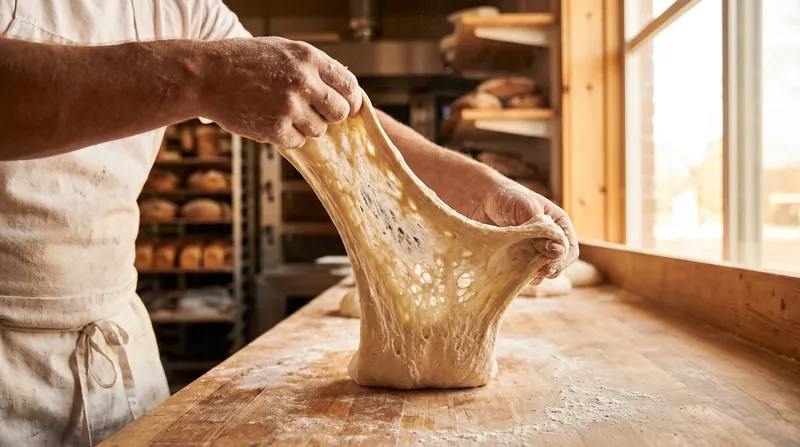
Protein content is the holy grail of bread baking, dictating the structural integrity of every loaf on the grocery shelf. Hard wheat contains exceptionally high levels of glutenin and gliadin, the two vital proteins that link together to form gluten when mixed with water and kneaded. This microscopic gluten network acts like a resilient, elastic web, trapping the carbon dioxide gases released by yeast during the fermentation process.[4]
It is this exact biological mechanism that gives a rustic sourdough its chewy texture and lofty, airy rise. Without sufficient domestic supplies of Hard Red Winter wheat to provide that protein backbone, commercial millers cannot simply substitute the wheat varieties that actually thrived this year. The chemistry simply does not allow for a direct, one-to-one replacement without fundamentally altering the final baked product.[4]
Ironically, while the Great Plains suffered, Eastern Soft Red Winter wheat experienced a phenomenal growing season. This variety boasted record yields of up to 90 bushels per acre in some regions thanks to highly favorable weather and adequate rainfall. However, soft wheat has a significantly lower protein content and a completely different starch structure. It is the perfect ingredient for tender, delicate baked goods like cookies, cakes, pastries, and crackers, where a soft crumb is desired.
Ironically, while the Great Plains suffered, Eastern Soft Red Winter wheat experienced a phenomenal growing season.
But soft wheat lacks the structural integrity and elasticity required to support a rising loaf of bread. If a baker attempts to make a traditional baguette using only soft wheat flour, the dough will inevitably collapse into a dense, flat brick. Faced with this chemical reality, the milling industry is rapidly adjusting its blending strategies to protect the consumer experience and maintain the exact specifications required by massive commercial bakeries.[4]
Commercial flour producers are increasingly importing high-protein wheat from Canada and Australia to mix with the abundant domestic soft wheat. By carefully calibrating these new international blends, millers ensure that the all-purpose and bread flours sitting on supermarket shelves maintain their expected performance and protein percentages. Tighter supplies of hard wheat have caused it to be priced at a premium, providing a strong economic incentive for millers to continuously tweak the exact ratio of grains used in their massive processing facilities.[1]
Beyond traditional wheat blending, the 2026 shortage is accelerating a broader, highly visible transformation in the baking aisle: the mainstreaming of alternative flours. The global market for flour alternatives was already expanding rapidly due to rising consumer demand for gluten-free products, health-conscious eating, and plant-based diets. However, the current squeeze on traditional wheat supplies has pushed these ingredients from niche health-food curiosities to essential, widely adopted commercial substitutes.
Ingredients derived from almonds, chickpeas, coconut, and rice are seeing surging interest from both massive food conglomerates and adventurous home cooks looking to diversify their pantries. These alternatives offer distinct nutritional profiles, often boasting significantly higher protein and fiber content than conventional bleached white flour. Food scientists are developing advanced hydrocolloid blends—using ingredients like xanthan gum and psyllium husk—to mimic the binding properties of gluten in these alternative flours.[4]
Ancient grains are also experiencing a major culinary renaissance as a direct result of the supply chain pressures. Bakers and agricultural scientists alike are increasingly turning to resilient, historically significant crops like spelt, KAMUT, amaranth, and sorghum. These ancient varieties have remained largely unchanged for centuries and often require significantly less synthetic fertilizer than modern, highly optimized hybrid wheat.
More importantly, many of these robust grains have naturally evolved to withstand harsher climate conditions and deeper droughts, making them highly attractive to farmers looking to hedge against future weather volatility. For the consumer, these grains provide complex, nutty flavor profiles and dense nutritional benefits that standard commercial wheat often lacks. The shift toward these grains represents a return to agricultural diversity.[4]
For home bakers, this transitional period in the agricultural market offers a unique opportunity to experiment and refine their craft. While commercial bread flour may see slight price increases or subtle texture changes due to the new international milling blends, recipes can be easily adapted with a little scientific know-how. Adding just a tablespoon of vital wheat gluten—a powdered supplement made from pure wheat protein—to a standard recipe can easily compensate for lower-protein flour blends, ensuring a strong, reliable rise every time.[4]
Alternatively, bakers can lean into the current abundance of domestic soft wheat by shifting their focus to cakes, quick breads, and flaky pie crusts, which actively benefit from the tender crumb that soft flour provides. The agricultural sector is also looking far beyond the current season to ensure long-term resilience in the global food supply. With climate volatility increasingly threatening traditional breadbaskets, researchers are accelerating the development of highly drought-resistant wheat varieties.[4]
Agronomists are exploring advanced hybrid strains that can maintain their crucial high protein levels even when subjected to extreme heat stress and minimal rainfall. Ultimately, while the 2026 wheat harvest represents a historic low for domestic production, it highlights the remarkable flexibility and scientific ingenuity of the modern food system. Through precise scientific blending, the embrace of alternative crops, and everyday culinary adaptability, the timeless art of baking is evolving rather than halting.[4]
Key points
- U.S. wheat production has fallen to its lowest level since 1970 due to a severe Plains drought.
- The drought specifically devastated Hard Red Winter wheat, which provides the protein necessary for baking bread.
- Millers are adapting by importing Canadian and Australian wheat to blend with domestic soft wheat.
- The shortage is accelerating the adoption of alternative flours made from almonds, chickpeas, and ancient grains.
- Home bakers can adapt by adding vital wheat gluten to lower-protein flours to ensure a proper rise.
Why this matters
While a 50-year low in U.S. wheat production sounds alarming, it is actually driving a wave of scientific innovation in the baking aisle. Understanding how millers are blending new flours and how to use alternative grains ensures that your home baking remains successful despite the shifting agricultural landscape.
Viewpoints in depth
Agricultural Economists
Focused on supply chain resilience and global trade adjustments.
Economists emphasize that while the domestic drop to 1.536 billion bushels is historically significant, the global commodity market is designed to absorb such shocks. They point to increased imports from Canada and Australia as proof that the supply chain can pivot. However, they caution that relying heavily on international markets exposes the U.S. to geopolitical trade risks and currency fluctuations, making domestic crop resilience a long-term economic imperative.
Baking Industry & Millers
Focused on maintaining consistent flour quality and protein levels for consumers.
For commercial millers, the challenge is entirely scientific. Because they cannot rely on the usual volume of high-protein Hard Red Winter wheat, they are forced to completely recalibrate their blending formulas. Industry experts note that maintaining the exact protein percentage required for commercial baking means sourcing alternative high-protein grains and carefully mixing them with the abundant, but weaker, Soft Red Winter wheat to ensure consumer recipes don't fail.
Alternative Flour Advocates
Focused on the shift toward gluten-free, ancient grains, and plant-based baking.
Proponents of alternative flours view the traditional wheat shortage as an accelerator for dietary diversity. They argue that over-reliance on a single monocrop like Hard Red Winter wheat is ecologically and nutritionally limiting. By shifting focus to drought-resistant ancient grains like sorghum and nutrient-dense alternatives like chickpea or almond flour, they believe the food system can become both more sustainable and healthier for consumers.
Frequently asked
Why is U.S. wheat production at a 50-year low in 2026?
A catastrophic drought in the U.S. High Plains severely damaged the Hard Red Winter wheat crop, pushing total domestic production to its lowest level since 1970.
Will there be a shortage of flour at the grocery store?
No. While domestic reserves are down 22%, millers are adapting by importing wheat from Canada and Australia and adjusting their flour blends to maintain steady supplies.
Can I use soft wheat flour to bake bread?
Soft wheat has lower protein content, making it ideal for cakes and cookies but poor for bread. Bakers can add vital wheat gluten to lower-protein flours to help bread dough rise.
What are the best alternatives to traditional wheat flour?
The market is seeing a surge in alternative flours made from chickpeas, almonds, and rice, as well as ancient grains like spelt and KAMUT, which offer different nutritional benefits.
Sources
Source coverage
4 outlets
4 viewpoints surfaced




- [1]USDAAgricultural Economists
World Agricultural Supply and Demand Estimates (WASDE)
Read on USDA → - [2]Brownfield Ag NewsDomestic Farmers
USDA cuts U.S. wheat crop guess further
Read on Brownfield Ag News → - [3]SyngentaAgricultural Economists
USDA lowers 2026-27 U.S. wheat ending stocks estimate
Read on Syngenta → - [4]Factlen Editorial TeamBaking Industry & Millers
Synthesis by Factlen editorial team
Read on Factlen Editorial Team →
Comments

More in Food & Drink
See all →Tea Culture
The Orange Pekoe Standard: How International Tea Grades Classify Leaf Size and Quality
5 sources
Food Labeling
The 20% to 40% Variation: How Different Countries Define a 'Serving Size' for Packaged Food
5 sources
Flour Milling
The 0.45% Ash Content: How European Flour Type Numbers Define Global Baking Grades
6 sources
Espresso Mechanics
The 9-Bar Maximum: How 1940s Spring-Lever Engineering Established the Global Standard for Espresso Extraction
7 sources

Every angle. Every day.
Get Food & Drink stories with full source coverage and perspective breakdowns delivered to your inbox.