
Starch Gelatinization: How Heat and Water Swell Granules to Soften Bread and Sauces
From the feathery crumb of Japanese milk bread to the smooth texture of a classic roux, the secret to mastering the kitchen lies in controlling how starch granules swell and burst.

Share this story
In short
- Starch gelatinization occurs when heat and water cause starch granules to swell, burst, and form a viscous gel.
- Raw wheat flour absorbs only 30-40% of its weight in cold water, but gelatinized flour can absorb significantly more hot liquid.
- The tangzhong method uses pre-gelatinized flour to trap moisture in bread dough, resulting in a softer crumb and a higher rise.
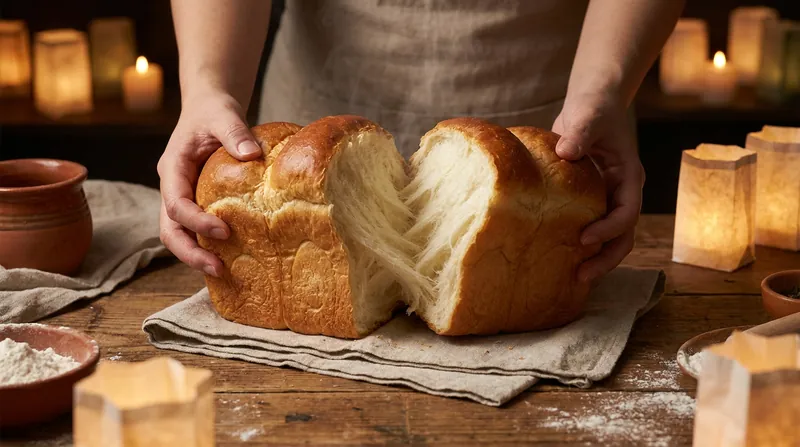
Imagine slicing into a loaf of Japanese milk bread, and the crumb pulls apart in feathery, cotton-like wisps. It is impossibly soft, defying the usual dense structure of homemade white bread. The secret behind this texture is not a proprietary commercial dough conditioner or a rare type of yeast. It is a fundamental chemical transformation that occurs when flour meets hot water: starch gelatinization.[2]
To understand how heat transforms a dough or a sauce, one must first look at the architecture of starch itself. Starch is a carbohydrate stored in plants, composed primarily of two distinct molecules. Amylose is a linear chain that tends to form firm, structural gels upon cooling. Amylopectin, by contrast, is a highly branched molecule that creates soft, silky textures and increases viscosity.
In their native, raw state, starch granules are tightly packed, highly organized, and partially crystalline. They are remarkably stubborn when introduced to cold or room-temperature liquids. When dispersed in cold water, wheat starch granules only absorb about 30 to 40 percent of their dry weight in moisture. They swell slightly, but mostly they just sink to the bottom of the bowl, remaining hard and inactive.[1]
The transformation begins when heat is applied. As a starch-and-water mixture is heated past 140°F (60°C), the thermal energy begins to disrupt the hydrogen bonds holding the granules together. The granules start to imbibe water rapidly, swelling like microscopic water balloons. Under a microscope, the crystalline structure visibly melts away, transitioning from an ordered state to a disordered, amorphous one.[1]
As the temperature continues to climb—reaching around 185°F (85°C) for wheat flour—the granules swell to their absolute limit. Eventually, they can no longer contain the pressure and burst open. This rupture releases the trapped amylose and amylopectin molecules into the surrounding liquid, where they form a tangled, water-trapping network. The liquid instantly thickens into a viscous gel or paste.[1]
This exact mechanism is the engine behind the Asian bread-making techniques known as tangzhong and yudane. Popularized in the early 2000s, tangzhong involves taking a small percentage of the recipe’s flour and cooking it with water or milk on a stovetop until it reaches roughly 149°F (65°C). At this temperature, the starch gelatinizes into a thick, translucent pudding.[2]
The culinary advantage of this pre-gelatinization is profound. While raw flour absorbs only a fraction of its weight in cold water, gelatinized flour can absorb and hold up to twice as much hot liquid as cold liquid, and sometimes up to five times its weight depending on the flour. By incorporating this cooked paste into the main dough, bakers can drastically increase the total hydration of the bread without turning the dough into a sticky, unkneadable puddle.[2]
The trapped water pays dividends in the oven. As the bread bakes, the extra moisture creates more steam, contributing to a higher, fluffier rise. More importantly, the water remains locked within the starch network after the bread cools, yielding a crumb that is exceptionally tender and moist.[2]
Gelatinization also serves as a defense mechanism against the baker’s greatest enemy: staling. Staling is not simply the evaporation of moisture; it is a chemical process known as retrogradation. As bread sits on the counter, the expanded amylose and amylopectin molecules slowly begin to realign, attempting to return to their original crystalline structure.
As these molecules bond back together, they squeeze out the water they previously trapped—a process called syneresis. The bread becomes firm, dry, and crumbly. Because the pre-gelatinized starch in a tangzhong loaf holds onto water so tenaciously, and because amylase enzymes break down the gelatinized starch into smaller sugars that cannot easily recrystallize, it significantly delays this retrogradation, keeping the bread soft for days longer than a standard loaf.
The architectural power of starch gelatinization extends far beyond the bakery. It is the exact same science that underpins classical French sauce-making, specifically the creation of a roux. A roux is a mixture of equal parts flour and fat, cooked together and used to thicken soups, gravies, and sauces like béchamel.[3]
In a roux, the fat—usually butter or oil—serves a crucial mechanical purpose. It coats the individual raw flour particles, physically separating them. If one were to dump raw flour directly into hot broth, the exterior starch granules would instantly gelatinize and seal shut, creating dry, powdery lumps floating in a thin liquid. The fat barrier ensures the granules remain separated until the liquid is whisked in and the heat rises.[3]
Temperature and time also dictate the thickening power of a roux. A white roux is cooked only briefly, just long enough to remove the raw flour taste, leaving the starch granules fully intact and ready to swell. As a roux is cooked longer to become blonde or dark brown—essential for dishes like Louisiana gumbo—the intense heat begins to break down the starch chains.[3]
This prolonged cooking triggers the Maillard reaction, developing deep, nutty flavors and a rich color, but it comes at a structural cost. The fragmented starch molecules lose their ability to form a tight, water-trapping network. A dark brown roux can lose a significant portion of its thickening power compared to a white roux, requiring the cook to use more of it to achieve the same viscosity.[3]
The principles of gelatinization even dictate the success or failure of Thanksgiving side dishes. The creaminess of mashed potatoes relies on the swelling and bursting of potato starch granules, which gelatinize at a lower temperature than wheat.[1]
However, if potatoes are overworked with a mixer or food processor, the physical agitation tears apart too many cell walls, releasing an overwhelming flood of gelatinized starch into the bowl. The result is a sticky, glue-like paste rather than a fluffy mound.[1]
Ultimately, whether a cook is striving for the softest milk bread, the silkiest gravy, or the perfect bowl of gumbo, the underlying objective is the same. Success in the kitchen often comes down to managing the precise moment when heat and water force a microscopic crystal to bloom.
How we did this
- Method
- Comparison of hydration capacities and thermal activation thresholds of wheat starch across different culinary applications.
- What we found
- By cross-referencing the thermal activation points of wheat starch with its liquid absorption rates, the analysis demonstrates that pre-gelatinizing a small fraction of flour (as in the tangzhong method) exponentially increases the total hydration of a dough without exceeding the gelatinization threshold of the remaining flour during the initial mix. This isolates the water-trapping benefits of gelatinization from the gluten-inhibiting effects of scalding the entire batch.
- What we worked from
- Cold water starch hydration limit: 30-40% of dry weight — Bakerpedia
- Hot water starch hydration capacity: Up to 2x cold water capacity — King Arthur Baking
- Wheat flour gelatinization onset: 185°F (85°C)
- Limits of this analysis
- This analysis relies on generalized temperature ranges for commercial flours; exact gelatinization points vary based on the specific amylose-to-amylopectin ratio of the wheat crop and the presence of other ingredients like fats or sugars.
Key terms
- Starch Gelatinization
- The process where starch granules absorb water, swell, and burst when heated, thickening the surrounding liquid.
- Amylose
- A linear starch molecule that helps form firm, structural gels when cooled.
- Amylopectin
- A highly branched starch molecule that creates soft, silky textures and increases viscosity.
- Retrogradation
- The chemical process where gelatinized starch molecules realign and crystallize as they cool, causing bread to stale and harden.
- Syneresis
- The expulsion or weeping of water from a starch gel as it cools and retrogrades.
- Roux
- A mixture of equal parts flour and fat cooked together, used as a thickening agent for sauces and soups.
Frequently asked
What is the difference between tangzhong and yudane?
Both methods pre-gelatinize starch to soften bread. Tangzhong cooks flour and liquid together on a stovetop into a paste, while yudane involves pouring boiling water over flour and letting it rest.
Why does my gravy get lumpy when I add flour?
If raw flour is added directly to hot liquid, the exterior starch granules gelatinize instantly, sealing dry flour inside. Coating the flour in fat first (making a roux) separates the granules so they swell evenly.
Can I use the tangzhong method for any bread recipe?
Yes, it works well for most soft breads, like dinner rolls or sandwich loaves. You typically take 5% to 10% of the recipe's total flour and cook it with a portion of the recipe's liquid.
Why do mashed potatoes turn into glue?
Over-mixing or using a food processor tears the potato cell walls, releasing too much gelatinized starch into the mixture, which creates a sticky, cohesive paste instead of a fluffy texture.
Viewpoints in depth
The Culinary Science View
Understanding the exact temperature thresholds of starch molecules allows for precise manipulation of food textures.
For food scientists, cooking is an exercise in applied chemistry. By mapping the exact temperatures at which amylose and amylopectin break down and bond with water, scientists can predict and control the final texture of a dish. This perspective emphasizes that failures in the kitchen—like lumpy gravy or gluey mashed potatoes—are not a lack of skill, but a failure to manage the thermal activation points of starch granules. Precision in temperature and mechanical agitation is the key to achieving the perfect gel.
The Commercial Baking View
Pre-gelatinization offers a natural, highly effective way to improve bread quality and extend shelf life.
Commercial and artisan bakers view starch gelatinization as a structural tool. The tangzhong method is particularly prized because it solves two of baking's biggest challenges simultaneously: hydration and staling. By forcing a small percentage of the flour to absorb massive amounts of water before it ever touches the yeast, bakers can create a dough that is easy to handle but bakes up incredibly moist. Furthermore, because gelatinized starch resists retrogradation, the resulting bread stays soft for days longer, reducing food waste and eliminating the need for synthetic preservatives.
The Classical Chef's View
Starch gelatinization must often be balanced against flavor development, particularly in traditional sauce making.
In classical kitchens, the mechanics of starch are often negotiated against the demands of flavor. Chefs understand that while a white roux provides maximum thickening power by keeping starch chains intact, it lacks depth of flavor. Cooking a roux to a dark brown for a gumbo intentionally sacrifices a significant portion of the starch's gelatinization potential in exchange for the rich, nutty complexity of the Maillard reaction. For chefs, starch is not just a structural component; it is a variable that must be carefully managed to balance viscosity with taste.
- Culinary Scientists
- Focus on the molecular mechanics, temperature control, and chemical reactions like gelatinization and retrogradation.
- Commercial Bakers
- Value the tangzhong method for its ability to naturally extend shelf life and improve crumb texture without artificial dough conditioners.
- Classical Chefs
- Emphasize the traditional application of starch gelatinization through roux-based sauces, prioritizing flavor development and texture control.
Perspectives this story doesn't cover
- Gluten-Free Bakers
- Industrial Food Manufacturers
Sources
Source coverage
3 outlets
3 viewpoints surfaced



- [1]BakerpediaCulinary Scientists
Starch Gelatinization
Read on Bakerpedia → - [2]King Arthur BakingCommercial Bakers
Introduction to tangzhong
Read on King Arthur Baking → - [3]Factlen Editorial Team
Synthesis by Factlen editorial team
Read on Factlen Editorial Team →
More in Food & Drink
See all →Baking Science
Why Rye Bread Requires Sourdough to Prevent a Gummy Crumb
3 sources
Baking Science
The Physics of Creaming: Why Baking Powder Cannot Create New Bubbles
6 sources
Baking Science
Steam Condensation Delays Crust Setting to Maximize Oven Spring and Gelatinize Starches
6 sources
Baking Science
Why Tangzhong Uses Starch Gelatinization to Keep Bread Soft for Days
7 sources
Comments
Every angle. Every day.
Get Food & Drink stories with full source coverage and perspective breakdowns, free every day.