
The Hidden Engineering Divide: Why Your Next SUV's Architecture Dictates Its True Cost
Suburban buyers increasingly cross-shop rugged off-roaders against family haulers, but the underlying choice between a body-on-frame and unibody architecture permanently alters a vehicle's fuel economy, ride comfort, and crash safety.
By Noor Saidi

Share this story
In short
- Suburban buyers increasingly cross-shop rugged body-on-frame SUVs against unibody family haulers, often unaware of the underlying engineering differences.
- Unibody construction integrates the frame and body into a single shell, drastically improving fuel economy, handling, and crash safety for daily driving.
- Body-on-frame vehicles bolt the cabin to a heavy steel ladder chassis, providing the structural strength necessary for heavy towing and off-road articulation.
The tension in the modern dealership showroom often comes down to a choice of aesthetic. A buyer walks in looking for a family vehicle and is immediately drawn to the rugged, squared-off silhouette of a Ford Bronco or a Toyota 4Runner. These vehicles project an image of weekend adventure and off-grid capability.
Yet, sitting right across the showroom is the Ford Explorer or the Toyota Highlander—sleeker, more aerodynamic, and undeniably more suburban. While the buyer might view this as a simple choice of exterior styling, they are actually standing at the precipice of the most consequential engineering divide in the automotive industry.[5]
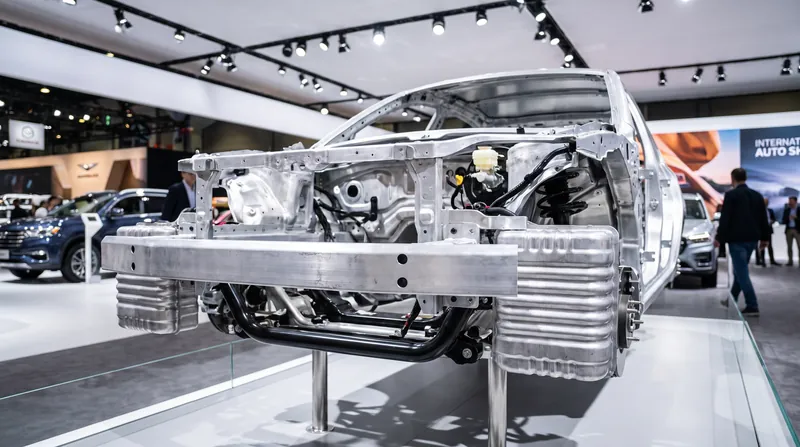
Beneath the sheet metal, these two classes of SUVs utilize fundamentally different architectures. The rugged off-roaders rely on body-on-frame construction, a century-old method where the vehicle's cabin is literally bolted onto a heavy steel ladder chassis. The family haulers, conversely, utilize unibody construction, where the frame and body are welded together into a single, integrated structural shell.[3][4]
For the average buyer commuting to work, dropping kids at school, or navigating crowded grocery store parking lots, this hidden engineering choice dictates completely different daily driving experiences, maintenance costs, and safety profiles. Choosing the wrong architecture for your actual driving habits means paying a permanent, daily penalty for capabilities you may never use.[5]
The most immediate difference a driver will notice behind the wheel is the vehicle's Noise, Vibration, and Harshness (NVH) profile. Because a unibody shell acts as a single stressed member, it possesses immense torsional rigidity. It resists twisting and bending when driven over potholes or uneven pavement.[3]
This stiffness allows automotive engineers to tune the suspension with incredible precision. The shock absorbers and springs can do their job without the underlying chassis flexing beneath them. The result is a ride that feels planted, quiet, and car-like. The steering is responsive, and the cabin remains isolated from the jittery vibrations of the road.
A body-on-frame SUV, by contrast, inherently allows for more flex between the heavy steel ladder frame and the body bolted above it. While modern engineering has masked some of this with advanced bushings and adaptive dampers, the fundamental physics remain. The vehicle will always feel slightly disconnected from the road, exhibiting more body roll in corners and a heavier, more ponderous steering response.[4]
But the most quantifiable penalty of the body-on-frame architecture is paid at the fuel pump. The heavy steel rails required to build a ladder frame add hundreds of pounds of curb weight to the vehicle. Combined with the typically blocky, less aerodynamic styling of off-road SUVs, this weight creates a massive drag on efficiency.[4]
The data provides a stark comparison. According to TrueCar market data, a 2026 Ford Explorer equipped with a 2.3-liter turbocharged engine achieves an EPA-estimated 29 miles per gallon on the highway. A 2026 Ford Bronco, utilizing the exact same 2.3-liter engine but riding on a heavy ladder frame, manages only 21 miles per gallon on the highway.[1]
That 27 percent penalty in highway fuel efficiency is a permanent operating cost. Over a typical year of driving, the owner of the body-on-frame SUV will spend hundreds of dollars more on fuel, simply to carry around a heavy steel chassis that, for many suburban buyers, will never see a dirt trail.[1][5]
The architectural divide also creates a paradox regarding vehicle safety. Many buyers intuitively assume that a heavier, truck-like body-on-frame SUV is inherently safer in a collision. The sheer mass of the vehicle feels protective. However, crash dynamics rely on energy dissipation, not just mass.[2][4]
A unibody structure is meticulously engineered to fold like an accordion during an impact. The front rails, firewall, and floor pan act as a unified safety cage, absorbing and redirecting the kinetic energy of the crash away from the passenger cabin. A rigid ladder frame, conversely, does not crumple as effectively, transferring more of the violent deceleration forces directly into the cabin and its occupants.[4]
A comprehensive study by the National Institutes of Health analyzed multi-vehicle crashes and found a significant safety gap. The research concluded that occupants of passenger vehicles crashing with compact unibody SUVs faced an 18 percent lower risk of death compared to those crashing with body-on-frame SUVs. The unibody's ability to manage crash energy makes it safer not just for its own occupants, but for everyone else on the road.[2]
Given the overwhelming advantages in fuel economy, ride comfort, and crash safety, why do automakers continue to build body-on-frame SUVs at all? The answer lies in the extreme limits of utility: heavy towing and severe off-road articulation.[3]
When a vehicle is tasked with towing a 9,000-pound boat or a massive travel trailer, the physics change entirely. A unibody shell, while excellent at absorbing distributed crash forces, struggles with the concentrated point loads generated by a heavy trailer hitch. Under extreme towing stress, a unibody can literally tear apart. A traditional ladder frame, with its massive steel rails, handles these concentrated loads effortlessly.[3][4]
Ultimately, the decision between a unibody and a body-on-frame SUV should be dictated by honest self-assessment. If the vehicle is primarily a daily commuter and family hauler, the unibody architecture delivers superior comfort, safety, and efficiency. The body-on-frame SUV remains a purpose-built tool—unrivaled at its specific job, but fundamentally compromised as a daily driver.[5]
How we did this
- Method
- A cross-platform normalisation and comparison of structural efficiency metrics, isolating the daily operating and safety costs of body-on-frame architecture by comparing two representative SUVs with identical engine displacements.
- What we found
- Choosing a body-on-frame architecture for its aesthetic imposes a permanent 27% penalty on highway fuel efficiency and an 18% increase in fatality risk for other motorists, quantifying the daily operating cost of unused off-road capability.
- What we worked from
- Unibody highway fuel economy (Ford Explorer 2.3L): 29 MPG — TrueCar
- Body-on-frame highway fuel economy (Ford Bronco 2.3L): 21 MPG — TrueCar
- Fatality risk reduction in multi-vehicle crashes: 18% — National Institutes of Health
- Limits of this analysis
- This comparison relies on representative models (Ford Explorer vs. Bronco) with identical engine displacements; specific aerodynamic profiles, hybrid powertrains, and tire choices also contribute to the efficiency gap.
Where opinion splits
The Unibody Commuter Case
The argument that integrated architectures are the only logical choice for pavement-bound daily drivers.
For the vast majority of buyers whose daily routine consists of highway commuting and suburban errands, the unibody architecture presents an overwhelming mathematical advantage. By integrating the frame and body into a single stressed shell, automakers shed hundreds of pounds of curb weight while dramatically increasing torsional rigidity. This translates directly to the driver's wallet and well-being: a unibody SUV like the Ford Explorer achieves 29 MPG on the highway, compared to just 21 MPG for its body-on-frame Bronco counterpart with the exact same engine. Furthermore, the unibody's ability to crumple like an accordion in a collision actively dissipates kinetic energy, resulting in an 18% lower fatality risk in multi-vehicle crashes. For these buyers, choosing a ladder-frame vehicle means paying a daily penalty in fuel, handling, and safety for capabilities they will never use.
The Body-on-Frame Utility Case
The argument that separate ladder frames remain essential for heavy towing and severe off-road articulation.
When the pavement ends or the payload exceeds two tons, the unibody's advantages evaporate. A unibody shell, while excellent at absorbing distributed crash forces, struggles with the concentrated point loads generated by a heavy trailer. Attempting to tow 9,000 pounds with a unibody crossover risks tearing the mounting hardware straight through the floorpan. A traditional body-on-frame chassis, utilizing massive steel rails running the length of the vehicle, handles these stresses effortlessly. Additionally, the separation of body and frame allows the chassis to flex independently over uneven terrain, keeping tires planted on the dirt while isolating the cabin from the most violent impacts. For boat owners, RV haulers, and off-road enthusiasts, the ladder frame is not an aesthetic choice—it is a structural requirement.
- Unibody Advocates
- Engineers and safety researchers who prioritize fuel efficiency, crash-energy dissipation, and on-road comfort for the vast majority of passenger miles.
- Body-on-Frame Traditionalists
- Off-road enthusiasts and heavy-duty users who require the structural durability and towing capacity of a separate ladder chassis.
Perspectives this story doesn't cover
- Automotive repair technicians handling unibody structural damage
- Insurance actuaries pricing collision premiums for different architectures
Sources
Source coverage
5 outlets
2 viewpoints surfaced





- [1]TrueCarBody-on-Frame Traditionalists
Ford Bronco vs. Ford Explorer
Read on TrueCar → - [2]National Institutes of HealthUnibody Advocates
Differences in crashworthiness between unibody and body-on-frame SUVs
Read on National Institutes of Health → - [3]TZR MetalBody-on-Frame Traditionalists
Unibody vs Body on Frame: Which is Better?
Read on TZR Metal → - [4]CJ Pony PartsBody-on-Frame Traditionalists
Unibody vs. Body-on-Frame
Read on CJ Pony Parts → - [5]Factlen Editorial TeamUnibody Advocates
Synthesis by Factlen editorial team
Read on Factlen Editorial Team →

More in Automotive & Transportation
See all →Engine Lubrication
Decoding the SAE J300 Standard: How Oil Viscosity Numbers Dictate Engine Wear and Fuel Economy
6 sources

Crash Structures
Sacrificial Metal: How Crush Cans and Load Paths Dictate Vehicle Survival and Repair Costs
8 sources
Powertrain Choice
The 750-Mile Road Trip Test: Quantifying the Trade-Offs of EV, Hybrid, and Gas Travel
5 sources

Suspension Geometry
Camber, Caster, and Toe: How Wheel Alignment Angles Dictate Tire Wear and Handling
9 sources
Comments
Every angle. Every day.
Get Automotive & Transportation stories with full source coverage and perspective breakdowns, free every day.