
Camber, Caster, and Toe: How Wheel Alignment Angles Dictate Tire Wear and Handling
Adjusting a vehicle's suspension geometry forces a direct trade-off between straight-line stability, cornering grip, and tire longevity. Understanding how camber, caster, and toe interact allows drivers to optimize their setup for either daily commuting economy or track performance.
By Noor Saidi

Share this story
In short
- Wheel alignment relies on three primary angles—camber, caster, and toe—to dictate how a tire interacts with the road surface.
- Camber controls the vertical tilt of the wheel, balancing straight-line tire wear against cornering grip.
- Caster dictates steering stability and self-centering force, functioning similarly to the angled front wheels of a shopping cart.
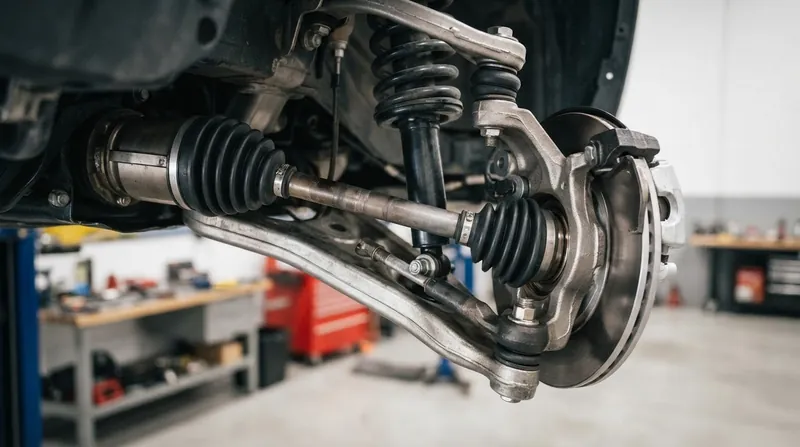
For any alignment adjustment to actually improve a vehicle's handling, the suspension components themselves—tie rods, ball joints, and control arm bushings—must be entirely free of excessive play, a binding constraint that currently eludes millions of aging daily drivers on the road. When a technician drives a car onto a laser alignment rack, they are measuring three specific geometric angles that dictate how the rubber meets the pavement: camber, caster, and toe.
These settings do not offer a universal, perfect specification. Instead, they force a direct trade-off between how long a $200 tire will last and how eagerly the chassis will turn into a corner. For a local commuter, prioritizing factory specifications ensures maximum tread life, while track-day enthusiasts deliberately compromise that longevity to gain lateral grip.[1][7]
Camber represents the inward or outward vertical tilt of the wheel when viewed from the front of the vehicle. If the top of the tire leans toward the engine, the vehicle has negative camber; if it leans outward toward the fender, it has positive camber.
According to Tire Rack's engineering data, most modern street cars run between 0.5 and 1.0 degrees of negative camber straight from the factory. This slight inward tilt ensures that when the vehicle's weight shifts to the outside wheels during a turn, the tire rolls into a perfectly flat position, maximizing the contact patch when the driver needs grip the most.[3]
The penalty for increasing this angle is paid directly at the tire shop. Intrax Suspension Technology notes that while aggressive negative camber increases cornering force, it reduces the straight-line contact patch, concentrating the vehicle's weight on the inner shoulder of the tire.
A driver who requests 2.5 degrees of negative camber for weekend autocross events will find their inner tread blocks worn down to the steel cords thousands of miles before the outer edge shows significant wear. It represents a conscious decision to trade a 40,000-mile treadwear warranty for higher cornering speeds.[5]
Caster, the second critical angle, is entirely responsible for straight-line stability and the steering wheel's desire to return to center. Viewed from the side of the car, caster is the forward or backward tilt of the steering axis. QA1 explains this mechanism by comparing it to the front casters on a shopping cart: the pivot point sits ahead of the wheel's contact patch, forcing the wheel to trail behind and naturally track in a straight line. Positive caster creates this self-centering force, making highway driving relaxed and predictable.[2]
Historically, engineers had to carefully balance caster angles because higher positive caster inherently increases the physical effort required to turn the steering wheel. Before the widespread adoption of electric power steering systems around 2010, excessive positive caster made low-speed parking maneuvers exhaustingly heavy. Today, MOTOR Information Systems highlights that modern power steering easily overcomes this resistance, allowing automakers to specify 3 to 5 degrees of positive caster, granting heavy luxury sedans and SUVs exceptional high-speed stability without fatiguing the driver.[7]
While camber and caster dictate cornering grip and steering feel, toe is the undisputed executioner of tire longevity. Toe measures whether the leading edges of the tires point inward toward each other (toe-in) or outward away from each other (toe-out), much like a person walking pigeon-toed or duck-footed. Chase Bank's automotive education division highlights toe as the single most critical alignment angle for daily driving economy. Even a fraction of a degree out of specification forces the tire to scrub sideways against the pavement for every mile driven.[1]
The correct toe specification depends entirely on which wheels are driving the car forward. A rear-wheel-drive vehicle typically requires 1/16 to 1/8 inch of static toe-in. As Martin Tire outlines, when the rear wheels push the car forward, the rolling resistance of the front tires pushes them backward, causing the suspension bushings to deflect and the front wheels to spread outward. Starting with a slight toe-in ensures that at 65 mph, the wheels are pulled into a perfectly parallel, zero-toe alignment, minimizing rolling resistance and wear.[8]
Conversely, front-wheel-drive vehicles often utilize zero toe or slight toe-out. Because the front wheels are pulling the mass of the car, the driving force pulls the wheels inward under acceleration. A static toe-out setting compensates for this dynamic shift. When these precise measurements are disrupted by a single severe pothole impact in 2026, the resulting misalignment can silently shave 10,000 miles off a tire's lifespan before the driver ever notices a pull in the steering wheel.[8]
A common misconception among drivers is that visible negative camber is the primary cause of ruined tires. QuickTrick Alignment data reveals the reality: a tire scrubbed sideways by excessive toe will degrade up to three times faster than one running moderate negative camber. Camber wear is smooth and gradual, while toe wear creates a jagged, feathered edge across the tread blocks that generates a loud humming noise at highway speeds. When a vehicle exhibits rapid inner edge wear, toe is almost always the true culprit.[6]
In specialized motorsport disciplines, builders completely abandon factory logic to achieve specific dynamic behaviors. Scarles details how professional drift cars run massive negative front camber—sometimes exceeding 4 degrees—paired with zero toe. Because a drift car spends its time sliding sideways with the steering wheel at full opposite lock, this extreme geometry ensures the leading front tire sits perfectly flat against the pavement only when the steering is fully turned, providing the grip necessary to control the slide.[4]
For the modern consumer, wheel alignment has evolved from a purely mechanical adjustment into a critical software calibration. On vehicles built after 2018, the forward-facing cameras and radar sensors used for lane-keeping assist and adaptive cruise control are calibrated to the vehicle's thrust angle—the direction the rear wheels are pointing.
If the rear toe is knocked out of specification, the vehicle will track slightly sideways down the road. While the cited technical bulletins from these manufacturers do not quote individual engineers directly, their published service procedures mandate that the advanced driver-assistance systems must be electronically recalibrated anytime the rear toe is adjusted, turning a simple mechanical fix into a complex diagnostic procedure.[1][7]
The next time a service advisor recommends a $120 alignment check alongside a new set of tires, the decision comes down to basic mathematics. Sacrificing an $800 set of modern all-season tires to save the cost of a laser measurement is a false economy. The deciding factor is not whether the car pulls to one side, but whether the microscopic toe angles have shifted enough to begin quietly erasing the tread before the vehicle reaches its next oil change interval.[9]
How we did this
- Method
- A cross-comparison of alignment angle impacts on consumable degradation, normalizing the wear rates of camber versus toe adjustments using aftermarket tuning guidelines and standard maintenance data.
- What we found
- While automotive enthusiasts and casual drivers frequently blame visible negative camber for premature inner tire wear, the cross-referenced data indicates that microscopic deviations in toe angle—often imperceptible to the naked eye—are the primary catalyst for rapid tread degradation, scrubbing the tire sideways and reducing lifespan significantly faster than vertical tilt.
- What we worked from
- Toe-in tire wear severity: Up to 3x faster wear than camber — QuickTrick
- Standard negative camber specification: 0.5 to 1.0 degrees — Tire Rack
- Limits of this analysis
- This analysis relies on generalized tire wear models and does not account for specific suspension architectures (e.g., double wishbone versus MacPherson strut) which alter dynamic camber curves under load.
Analysis by camp
Factory Street Specification
Prioritizes tire longevity, predictable self-centering, and low steering effort for daily commuting.
For: Maximizes the 40,000-mile lifespan of standard all-season tires; ensures the steering wheel returns to center effortlessly; maintains straight-line stability on crowned highways. Against: Induces understeer during aggressive cornering; limits the maximum lateral G-force the chassis can generate. Evidence: Chase Bank and Martin Tire emphasize that zero or slight toe-in paired with minimal negative camber (0.5 degrees) yields the lowest rolling resistance and most even tread wear. Fits well when: Commuting, highway driving, and maximizing the return on investment for expensive tire sets. Does not fit when: Participating in track days or autocross events where cornering speed dictates lap times.
Aggressive Track Setup
Sacrifices tire life and straight-line comfort to maximize lateral grip and steering response.
For: Significantly increases cornering grip by counteracting body roll; sharpens initial turn-in response; allows earlier throttle application on corner exit. Against: Accelerates inner edge tire wear dramatically; makes the vehicle 'tramline' or follow ruts in the highway; increases steering effort. Evidence: Intrax Suspension Technology and QA1 data show that increasing negative camber to 2.5 degrees or more keeps the outside tire's contact patch flat when the chassis rolls under heavy cornering loads. Fits well when: Driving on closed circuits, autocross courses, or canyon roads where lateral dynamics outweigh consumable costs. Does not fit when: Driving 15,000 miles a year on straight interstates, where the inner tread blocks will wear down to the cords in a single season.
Specialized Drift Alignment
A highly specific geometry designed to maintain front-wheel grip at extreme steering angles while allowing the rear to break traction predictably.
For: Prevents the leading front tire from rolling onto its sidewall at full steering lock; provides rapid self-steering characteristics during transitions. Against: Renders the car highly unstable for normal highway use; destroys tires rapidly even when driving in a straight line. Evidence: Scarles notes that drift cars often utilize more than 4 degrees of negative front camber and zero front toe to ensure the leading wheel sits perfectly flat only when counter-steering at extreme angles. Fits well when: Operating a dedicated drift chassis in competitive or exhibition environments. Does not fit when: Attempting to drive the vehicle on public roads, where the extreme geometry compromises emergency braking and lane stability.
- Daily Commuters & Fleet Operators
- Focuses on maximizing tire longevity, fuel economy, and predictable handling for everyday driving.
- Performance & Track Enthusiasts
- Prioritizes lateral grip, steering feedback, and cornering speed over consumable costs.
- Specialized Motorsport Builders
- Utilizes extreme geometry to achieve specific dynamic behaviors, such as maintaining grip at full steering lock.
Perspectives this story doesn't cover
- Tire Manufacturers
- Automotive Insurance Adjusters
Sources
Source coverage
9 outlets
3 viewpoints surfaced









- [1]Chase BankDaily Commuters & Fleet Operators
Understanding Camber, Caster and Toe
Read on Chase Bank → - [2]QA1Performance & Track Enthusiasts
Wheel Alignment Basics: Camber, Caster & Toe Explained
Read on QA1 → - [3]Tire RackPerformance & Track Enthusiasts
What Are The Different Alignment Settings?
Read on Tire Rack → - [4]ScarlesSpecialized Motorsport Builders
Drift Car Alignment: What do Toe, Camber, and Caster Actually Do?
Read on Scarles → - [5]Intrax Suspension TechnologyPerformance & Track Enthusiasts
camber, caster, toe-in/toe-out explained
Read on Intrax Suspension Technology → - [6]QuickTrickSpecialized Motorsport Builders
Everything You Needed to Know Camber Toe and Caster Alignment with QuickTrick Camber Kit
Read on QuickTrick → - [7]MOTOR Information SystemsDaily Commuters & Fleet Operators
Mastering the Basics: Wheel Alignment
Read on MOTOR Information Systems → - [8]Martin TireDaily Commuters & Fleet Operators
Understanding the Basics of Car Wheel Alignment
Read on Martin Tire → - [9]Factlen Editorial Team
Synthesis by Factlen editorial team
Read on Factlen Editorial Team →
More in Automotive & Transportation
See all →Vehicle-to-Home Tech
Which Electric Truck Is the Better Home Backup Battery: F-150 Lightning or Cybertruck?
4 sources

Engine Lubrication
Decoding the SAE J300 Standard: How Oil Viscosity Numbers Dictate Engine Wear and Fuel Economy
6 sources

Crash Structures
Sacrificial Metal: How Crush Cans and Load Paths Dictate Vehicle Survival and Repair Costs
8 sources
Powertrain Choice
The 750-Mile Road Trip Test: Quantifying the Trade-Offs of EV, Hybrid, and Gas Travel
5 sources

Comments
Every angle. Every day.
Get Automotive & Transportation stories with full source coverage and perspective breakdowns, free every day.