
SpaceX Launches the World's First Commercial Nuclear-Powered Satellite
The BOHR CubeSat successfully reached orbit carrying a NanoTritium betavoltaic battery, demonstrating a safe, long-lasting power alternative to solar panels for deep-space missions.

Share this story
SpaceX's Falcon 9 rocket roared to life early Tuesday morning, lifting off from California's Vandenberg Space Force Base to deliver a massive haul of 81 diverse payloads into low Earth orbit. The launch, designated as the Transporter-17 rideshare mission, successfully executed a complex deployment sequence, scattering a wide array of commercial, academic, and military satellites into their designated orbital slots.
The mission also saw the successful return and landing of the rocket's first stage on a drone ship stationed in the Pacific Ocean, marking the 11th flight for this particular booster and further cementing SpaceX's dominance in reusable launch architecture.
While the Transporter-17 manifest carried everything from advanced Earth observation tools to military technology demonstrators, one specific payload tucked inside a standardized CubeSat marked a quiet but historic milestone for the aerospace industry. Amidst the routine deployments of communication relays and weather monitors, the mission successfully placed the world's first commercial nuclear-powered spacecraft into orbit. This technical achievement highlights the evolving nature of the commercial space sector, which is increasingly taking on complex engineering challenges that were once the exclusive domain of heavily funded national space agencies.[2]
Built by Miami-based City Labs, the Betavoltaic Orbital High-Reliability (BOHR) satellite represents a fundamental shift in how private companies approach spacecraft energy systems. The BOHR mission is designed to prove that a privately built nuclear micropower source can survive the intense acoustic vibrations of launch, operate safely in the harsh vacuum of space, and successfully navigate the rigorous federal regulatory system.
By flying this demonstration payload, City Labs aims to establish a proven flight heritage for its technology, signaling to the broader industry that commercial nuclear power is ready for routine deployment.[1]
To understand why commercial space companies are looking toward nuclear energy, one must look at the inherent limitations of the industry's default power source: the sun. Solar panels are highly effective and economical for satellites operating in standard low Earth orbit, where sunlight is abundant and predictable. However, these arrays become entirely useless when a spacecraft slips into the Earth's shadow, enters a permanently dark lunar crater, or drifts into the deep space environments far beyond the inner solar system.
While chemical batteries can bridge the gap during temporary orbital eclipses, they eventually degrade and die over thousands of charge cycles. This degradation leaves autonomous sensor networks, lunar rovers, and deep-space probes without a reliable lifeline, strictly limiting the lifespan and operational scope of missions that venture away from direct sunlight. As NASA's Artemis program targets sustained lunar exploration and commercial entities eye long-duration missions past Earth orbit, the demand for a power source that does not rely on the sun has become a critical engineering bottleneck.
The BOHR satellite addresses this vulnerability by utilizing City Labs' proprietary NanoTritium betavoltaic power system, which generates electricity entirely independent of solar energy. Unlike the large, heat-generating radiothermal generators that power flagship deep-space probes like Voyager 2 or the Mars rovers using decaying plutonium, the NanoTritium system does not rely on thermal dynamics. Instead, the betavoltaic technology generates an electrical current directly from the natural beta decay of its radioactive fuel source, offering a much smaller and highly scalable energy solution for modern miniaturized spacecraft.
The battery runs on tritium, a naturally occurring and relatively stable radioactive isotope of hydrogen. As the tritium undergoes its natural decay process, it emits beta particles, which are essentially high-energy electrons. These emitted electrons strike a specialized semiconductor p-n junction housed within the battery, creating electron-hole pairs that generate a steady, continuous electrical current. While the total wattage produced by this microscopic process is relatively low, it is highly consistent and perfectly suited for powering autonomous sensors and critical avionics systems.
The true advantage of the betavoltaic system lies in its extraordinary longevity. Because the tritium isotope has a half-life of 12.3 years, the NanoTritium battery can provide uninterrupted, maintenance-free power for more than two decades. This continuous energy generation allows spacecraft to maintain critical functions, keep sensors active, and preserve communication links during decades-long missions into the darkest and coldest regions of the solar system, long after traditional chemical batteries would have frozen or depleted their charge.[2]
For this initial demonstration flight, the BOHR spacecraft is not relying entirely on its nuclear payload. The main satellite bus still utilizes traditional solar panels to conduct its routine flight operations, maintain its basic orbital trajectory, and handle primary communications with ground control. The NanoTritium system is dedicated exclusively to powering an independent demonstration payload within the CubeSat, allowing engineers to isolate the battery's performance data and verify its steady power output without risking the overall survival of the host satellite.
Launching any form of radioactive material into orbit requires clearing immense regulatory hurdles, and BOHR's journey to the launchpad was as much a legal triumph as an engineering one. The mission is the first commercial endeavor to successfully navigate the Federal Aviation Administration's specific regulatory pathway for nuclear space launches. The FAA officially approved the launch in September 2025, following a rigorous, multi-year safety analysis led by City Labs and extensively reviewed by experts at Sandia National Laboratories to ensure total compliance with federal safety mandates.
Safety was the paramount concern for regulators, but the betavoltaic system is inherently secure by design. Unlike highly penetrating gamma radiation, the beta particles emitted by decaying tritium are incredibly weak and cannot even penetrate human skin, making the material exceptionally safe to handle during ground processing. Furthermore, the tritium gas is securely bound within a solid metal hydride foil and encased in a protective shell, effectively eliminating the danger of radioactive leakage or explosive contamination even in the catastrophic event of a launch vehicle failure.
If BOHR's orbital demonstration proves successful over the coming months, it could fundamentally alter the architecture of future space missions. By proving that safe, compact, and regulatory-approved nuclear power systems are ready for routine commercial deployment, City Labs is paving the way for a new era of space exploration. This capability promises to enable persistent, always-on payload operations for future Moon bases, asteroid mining operations, and deep-space commercial ventures that are no longer tethered to the constraints of sunlight or battery life.
Key points
- SpaceX's Transporter-17 mission successfully deployed 81 payloads, including the historic BOHR satellite.
- Built by City Labs, BOHR is the first commercial satellite to carry a nuclear-powered payload into orbit.
- The satellite uses a NanoTritium betavoltaic system that generates electricity directly from the decay of radioactive hydrogen.
- The technology provides over 20 years of continuous power, solving the limitations of solar panels in dark space environments.
What we don’t know
- How the NanoTritium battery's power output will hold up against the extreme temperature fluctuations and radiation of actual orbital conditions over its 20-year lifespan.
- Whether the FAA's approval process for this small-scale betavoltaic device will smoothly scale up to larger commercial nuclear systems required for Moon bases.
How we got here
September 2025
The FAA officially approves the specific regulatory pathway for BOHR's commercial nuclear launch.
July 7, 2026
SpaceX's Falcon 9 rocket lifts off from Vandenberg Space Force Base carrying the BOHR satellite and 80 other payloads.
July 8, 2026
The BOHR satellite successfully deploys into orbit, marking the first commercial nuclear payload in space.
- Commercial Space Innovators
- Companies like City Labs and SpaceX view nuclear micropower as the key to unlocking continuous, unconstrained operations in deep space.
- Nuclear Technology Advocates
- Proponents of nuclear energy emphasize the safety and reliability of betavoltaic systems compared to historical space nuclear applications.
- Aerospace & Defense Observers
- Industry watchers focus on the regulatory milestones and the broader implications for national security and commercial rideshare models.
Perspectives this story doesn't cover
- Environmental Watchdogs
- International Space Regulators
Sources
Source coverage
2 outlets
3 viewpoints surfaced


- [1]ZME ScienceCommercial Space Innovators
SpaceX Launches the First Commercial Nuclear-Powered Satellite
Read on ZME Science → - [2]NucNetNuclear Technology Advocates
US Company Launches First Commercial Nuclear Satellite on SpaceX Mission
Read on NucNet →

More in Transportation
See all →Orbital Mechanics
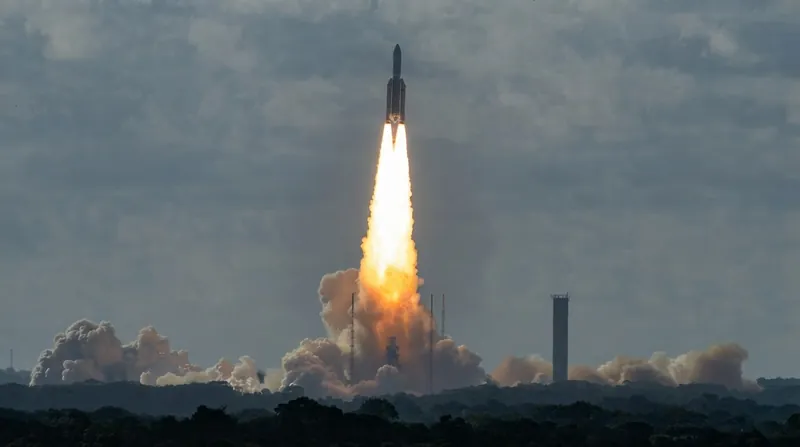
Eastward Launch Trajectories Exploit Earth's Equatorial Rotational Speed to Save 460 m/s of Delta-V
5 sources
Flow Separation
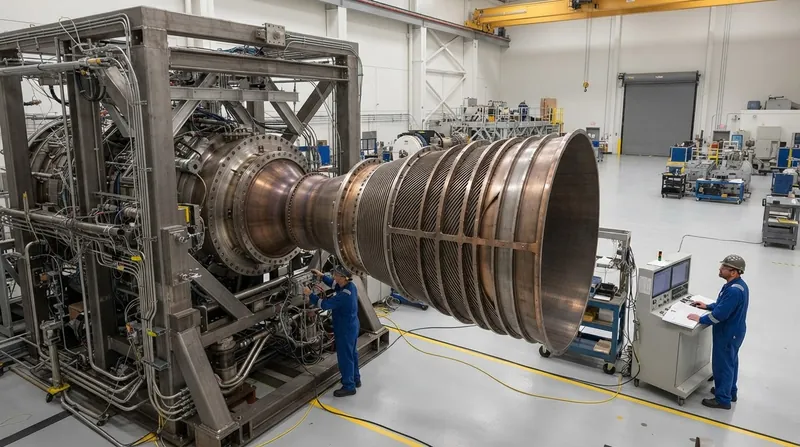
How Atmospheric Pressure and Flow Separation Tear Vacuum Rocket Nozzles Apart at Sea Level
7 sources
Rocket Propulsion
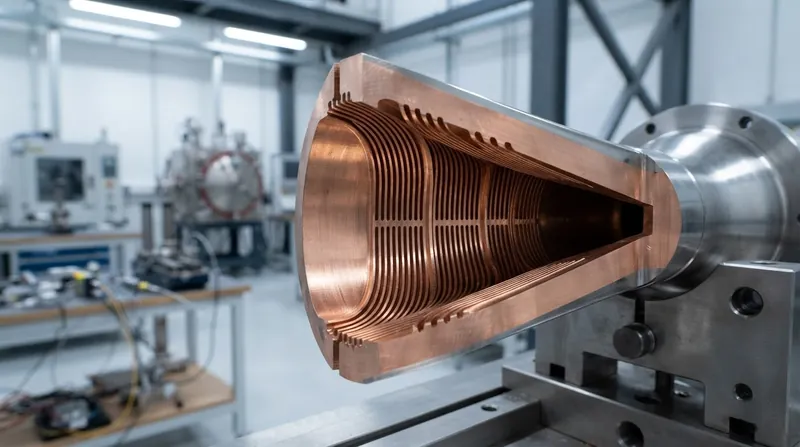
How Cryogenic Fuel and Milled Channels Keep Rocket Nozzles From Melting at 3,000°C
3 sources
Aerospace Engineering
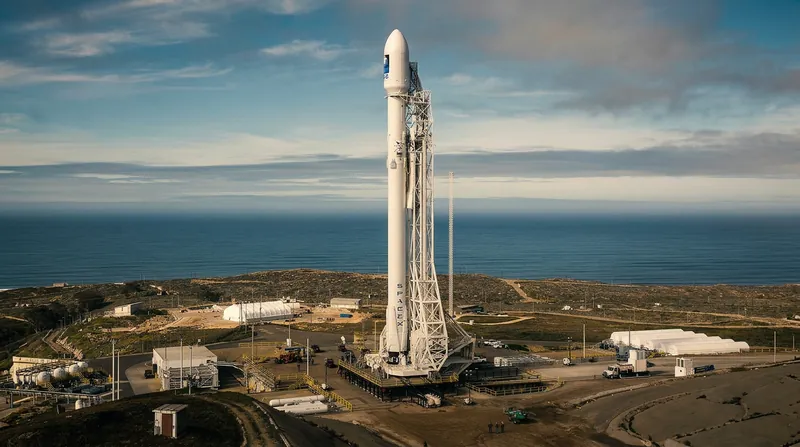
Why Rockets Throttle Down Mid-Ascent to Survive Max Q
3 sources
Comments
Every angle. Every day.
Get Transportation stories with full source coverage and perspective breakdowns, free every day.