
Eastward Launch Trajectories Exploit Earth's Equatorial Rotational Speed to Save 460 m/s of Delta-V
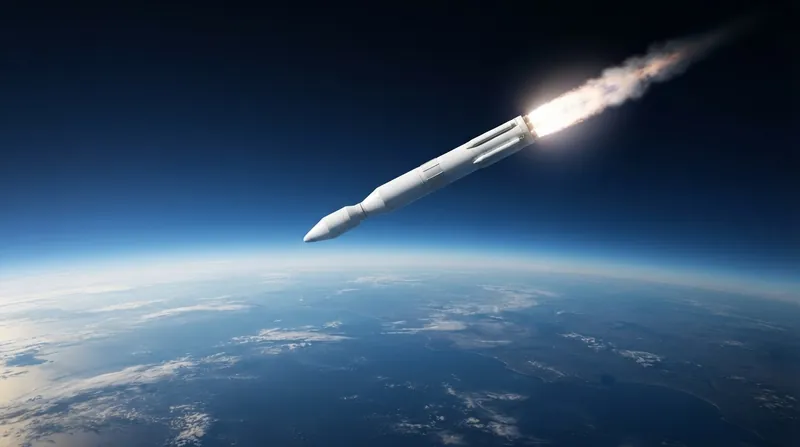
By launching eastward from sites near the equator, space agencies harness the planet's natural rotation to gain a free velocity boost. This 460-meter-per-second head start drastically reduces the propellant required to reach orbit, allowing rockets to carry significantly heavier payloads.

Share this story
In short
- Earth's surface rotates eastward at roughly 465 meters per second at the equator, providing a free velocity boost to rockets launching in the same direction.
- This rotational head start covers about 5 percent of the delta-v required to reach low Earth orbit, exponentially increasing the payload a rocket can carry.
- Launch sites at higher latitudes, such as Florida or Kazakhstan, receive a smaller rotational boost and must burn additional propellant to make up the deficit.
Before its engines even ignite, a rocket sitting on the launch pad at the Guiana Space Centre in South America is already traveling at 463 meters per second. The European spaceport sits just 5.2 degrees north of the equator, where the Earth's surface spins eastward at its maximum speed.[3]
This hidden momentum acts as a massive, free velocity boost for every vehicle launched toward the Atlantic Ocean. Operational since 1968, the Guiana Space Centre was deliberately placed near the equator to maximize this physical advantage for heavy-lift missions.[3]
"As a byword for excellence and reliability, Europe's Spaceport in French Guiana now ranks among the most modern space facilities in the world," the European Space Agency notes regarding its primary launch site. The facility's geography transforms a planetary quirk into a commercial edge.
To understand the value of this equatorial placement, one must look at the mechanics of reaching orbit. Reaching the altitude of space is relatively simple, but staying there requires a spacecraft to accelerate to a horizontal speed of roughly 7,800 meters per second.[1]
When accounting for the energy lost to gravity and atmospheric drag during ascent, the total velocity change required to reach low Earth orbit climbs to nearly 10,000 meters per second. In astrodynamics, this total required effort is known as the delta-v budget.[1]
Generating that velocity requires an immense volume of heavy chemical propellant. Delta-v is produced by reaction engines, and the total output remains strictly proportional to the thrust per unit mass and the duration of the engine burn.[1]
By launching eastward from the equator, space agencies harness the planet's 465-meter-per-second rotation to cover the first fraction of that delta-v budget without burning a single drop of fuel. While 465 meters per second represents less than 5 percent of the orbital requirement, the physics of rocketry magnifies its value.[4]
The Tyranny of the Rocket Equation
Because rockets must carry the fuel required to lift their unburned fuel, any reduction in the total delta-v requirement yields an exponential increase in payload capacity. The mathematics governing this relationship dictate that saving velocity at the end of a flight strips massive weight from the launch pad.[1]
The 465-meter-per-second head start allows an equatorial launch vehicle to carry significantly heavier satellites or reserve more propellant for deep-space maneuvers. For commercial operators, this translates directly into higher profit margins, as a single rocket can deploy more hardware into orbit per flight.[5]
The rotational boost degrades rapidly as launch sites move away from the equator. The Earth's surface velocity decreases with the cosine of the geographic latitude, meaning rockets launched from higher latitudes start with a progressively smaller eastward advantage.[4]
At NASA's Kennedy Space Center in Florida, located at 28.5 degrees north latitude, the Earth's rotation provides a boost of approximately 409 meters per second. The 56-meter-per-second deficit compared to an equatorial launch forces the rocket to burn additional propellant to make up the difference.[2][5]
The Latitude Penalty
The penalty grows steeper for high-latitude facilities built far from the equator. A rocket launched from Russia's Baikonur Cosmodrome, situated at 46 degrees north, receives a rotational boost of just 323 meters per second from the spinning planet.[5]
To place an identical payload into the same orbit, a vehicle launching from Kazakhstan must generate 142 meters per second more delta-v than one launching from French Guiana. This physical reality forces high-latitude operators to build larger rockets to achieve the same orbital results.[5]
To capture this free velocity, rockets must launch in the direction of the Earth's rotation. Launching westward—or retrograde—forces the vehicle to fight the planet's spin, requiring it to burn 465 meters per second of delta-v just to cancel out its starting momentum.[4]
The rotational advantage also dictates the specific orbits a launch site can efficiently reach. A rocket launched due east enters an orbital plane with an inclination exactly equal to the geographic latitude of its launch pad.[5]
Orbital Planes and Doglegs
Reaching an orbit with a lower inclination than the launch site requires a fuel-expensive dogleg maneuver in the vacuum of space. The rocket must fire its engines sideways to change its orbital plane, consuming delta-v that could otherwise be used to carry payload.[5]
This geometric constraint makes equatorial spaceports uniquely valuable for geostationary transfer orbits, which require a zero-degree inclination to match the Earth's equator. From its position at 5.2 degrees north, the Guiana Space Centre requires almost no plane change during ascent.[3]
This minimal inclination adjustment gives European rockets a massive mass advantage over vehicles launching from Florida or Kazakhstan. A rocket flying from the United States must burn significant propellant to drag its trajectory down from 28.5 degrees to the equator.[3]
However, the equatorial advantage disappears entirely for specific mission profiles. When a satellite requires a polar orbit—flying north to south over the Earth's poles—the eastward rotational boost provides absolutely no benefit to the launch vehicle.[5]
For these high-inclination missions, space agencies rely on high-latitude facilities that offer safe, overland launch corridors. The physical reality of the spinning Earth dictates that humanity must maintain a diverse geography of spaceports to access every orbital regime.[2]
The Economics of Geography
The interplay between latitude and delta-v ultimately shapes the economics of the global launch industry. Commercial operators fiercely compete to secure launch manifests at sites that offer the most favorable physics for their specific payloads.[5]
As the demand for heavy geostationary communications satellites continues to drive the market, the 460-meter-per-second equatorial boost remains one of the most valuable invisible assets in aerospace engineering. The Earth itself provides the first stage of propulsion.[4]
How we did this
- Method
- Trigonometric derivation of rotational velocity bonuses across launch latitudes
- What we found
- Applying the cosine of the latitude to the equatorial baseline reveals that Florida's Kennedy Space Center surrenders 56 m/s of the maximum rotational boost, while a launch from 46° N drops it to just 323 m/s—a deficit that must be entirely replaced by burning additional propellant.
- What we worked from
- Equatorial rotational velocity baseline: 465 m/s — Factlen Editorial Team
- Guiana Space Centre latitude: 5.2° N — Wikipedia
- Kennedy Space Center latitude: 28.5° N — Wikipedia
- Limits of this analysis
- This geometric derivation isolates the rotational velocity vector but does not account for atmospheric drag differences, gravity losses during ascent, or the specific impulse of the launch vehicles used at these sites.
Key terms
- Delta-v
- The total change in velocity a spacecraft must generate to perform a maneuver, serving as the fundamental energy budget for a mission.
- Low Earth Orbit (LEO)
- An orbit relatively close to the Earth's surface, requiring a horizontal velocity of roughly 7,800 meters per second to maintain.
- Geostationary Transfer Orbit (GTO)
- An elliptical orbit used to transfer a spacecraft from low Earth orbit to a geostationary position over the equator.
- Inclination
- The angle at which a spacecraft's orbit crosses the Earth's equator, dictated largely by the latitude of its launch site.
- Dogleg maneuver
- A fuel-intensive turn executed during powered flight to change a rocket's orbital inclination.
Frequently asked
Why don't rockets launch westward?
Launching westward forces a rocket to fight the Earth's rotation. The vehicle must burn enough propellant to cancel out its 465-meter-per-second eastward starting momentum before it can begin building the 7,800 meters per second of velocity required to reach orbit.
Do polar launches benefit from the Earth's rotation?
No. Because polar orbits require a spacecraft to travel north or south over the poles, the eastward rotational boost provides no advantage. Rockets targeting polar orbits often launch from higher latitudes where they have safe overland trajectories.
Why not launch from the top of a tall mountain?
While a mountain provides a slightly thinner atmosphere and a tiny altitude head start, reaching space is a matter of horizontal speed, not just vertical height. The logistical costs of building a launch pad on a mountain far outweigh the marginal aerodynamic benefits.
Viewpoints in depth
Equatorial Launch Operators
Space agencies operating near the equator prioritize the rotational velocity boost to maximize payload mass for geostationary orbits.
For operators like the European Space Agency, the equatorial advantage is a core economic driver. By launching from French Guiana, rockets like the Ariane series capture nearly the entire 465-meter-per-second rotational boost. This free velocity, combined with the minimal plane change required to reach a zero-degree geostationary transfer orbit, allows these vehicles to carry significantly heavier commercial satellites than identical rockets launching from higher latitudes. The geographic placement transforms a physical quirk of the Earth's rotation into a direct competitive advantage in the commercial launch market.
High-Latitude Operators
Agencies launching from higher latitudes accept the rotational penalty in exchange for domestic overland safety and access to high-inclination orbits.
Launch providers operating from the continental United States or Russia cannot fully exploit the equatorial boost, but their locations serve different strategic needs. NASA's Kennedy Space Center surrenders a portion of the rotational velocity but provides a safe, eastward launch corridor over the open Atlantic Ocean. Furthermore, the rotational boost is entirely useless for polar orbits, which require a spacecraft to fly north or south. For these high-inclination missions, the equatorial advantage disappears, making high-latitude or west-coast facilities equally viable.
- Equatorial Launch Operators
- Space agencies operating near the equator prioritize the rotational velocity boost to maximize payload mass for geostationary orbits.
- High-Latitude Operators
- Agencies launching from higher latitudes accept the rotational penalty in exchange for domestic overland safety and access to high-inclination orbits.
- Orbital Mechanics Analysts
- Physicists and engineers focus on the exponential fuel savings dictated by the rocket equation when delta-v requirements are reduced.
Perspectives this story doesn't cover
- Commercial Megaconstellation Providers
Sources
Source coverage
5 outlets
3 viewpoints surfaced



- [1]WikipediaEquatorial Launch Operators
Delta-v
Read on Wikipedia → - [2]BritannicaHigh-Latitude Operators
Kennedy Space Center
Read on Britannica → - [3]WikipediaEquatorial Launch Operators
Guiana Space Centre
Read on Wikipedia → - [4]WikipediaEquatorial Launch Operators
Escape velocity
Read on Wikipedia → - [5]Factlen Editorial TeamOrbital Mechanics Analysts
Synthesis by Factlen editorial team
Read on Factlen Editorial Team →
More in Transportation
See all →Spacecraft Engineering
How Angular Momentum Storage and Conservation Maintain Spacecraft Orientation
7 sources
Orbital Mechanics
Auxiliary Ullage Motors Fire Before Upper-Stage Restarts to Settle Free-Floating Propellant and Prevent Turbopump Cavitation
3 sources
Orbital Mechanics
Graveyard Orbits Require Just 11 m/s of Delta-V Compared With the 1,500 m/s Needed to Deorbit From Geostationary Altitude
4 sources
Orbital Mechanics
Why Orbital Rockets Must Achieve 7.8 km/s Horizontal Velocity and Execute Zero-Lift Gravity Turns
4 sources
Comments
Every angle. Every day.
Get Transportation stories with full source coverage and perspective breakdowns, free every day.