
Ariane 6 Launches with Upgraded Boosters, Setting a New European Payload Record
Europe's heavy-lift rocket successfully deployed 36 satellites using its new P160C solid rocket boosters, delivering a record 22 tonnes to low Earth orbit.
By Marina Lopez

Share this story
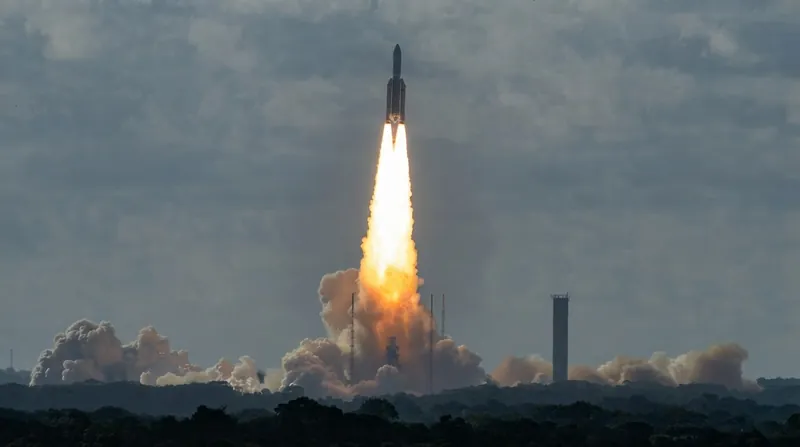
On June 17, 2026, the jungle surrounding Europe's Spaceport in Kourou, French Guiana, shook with unprecedented force. Ariane 6 flight VA269 roared off the launch pad, propelled by four massive solid rocket boosters that burned brighter and longer than any previously used in the program. The launch marked the eighth consecutive successful mission for Europe's newest heavy-lift vehicle, but the visual spectacle belied a much more significant engineering milestone.
This was the debut of the Ariane 6 Block 2 configuration, a highly anticipated upgrade designed to maximize the rocket's lifting power. As the vehicle pierced the atmosphere and vanished into the clouds, it carried the hopes of a European space sector eager to prove it could adapt rapidly to the demands of the modern commercial satellite market.[1][3]
The primary achievement of flight VA269 was written in the sheer mass of its cargo. Approximately an hour and a half after liftoff, the rocket's upper stage successfully deployed its payload into low Earth orbit, delivering a staggering 22 tonnes of hardware into the vacuum of space. This shattered the previous European single-launch cargo record, which had stood for more than a decade.
The former benchmark was set in 2013 by the venerable Ariane 5 rocket, which carried the 20-tonne ATV Albert Einstein supply vessel to the International Space Station. By surpassing that legacy milestone, the Ariane 6 program definitively demonstrated that it has not only replaced its predecessor but significantly exceeded its capabilities.[1]
The record-breaking cargo consisted of 36 broadband internet satellites destined for Amazon's Kuiper constellation. This payload configuration represented a direct, measurable leap in operational efficiency for the launch provider, Arianespace. During previous flights of the heavy-lift Ariane 64 variant earlier in the year, the rocket was capped at carrying 32 of the Kuiper satellites per mission.
The ability to add four additional satellites to a single manifest dramatically alters the unit economics of deploying mega-constellations. For companies racing to blanket the globe with low-latency internet coverage, every additional node deployed per launch translates to millions of dollars saved and months shaved off their deployment schedules.
The mechanism enabling this leap in performance is the newly upgraded P160C solid-propellant rocket motor. In the modular architecture of the Ariane 6, these motors are strapped to the sides of the liquid-fueled central core to provide the immense initial thrust required to escape Earth's gravity well.
Previous iterations of the rocket utilized the P120C motor, which was already a formidable piece of engineering. The transition to the P160C represents a calculated, iterative enhancement rather than a ground-up redesign, perfectly illustrating the European Space Agency's strategy of continuous improvement. By stretching the physical dimensions of the booster casing, engineers were able to pack significantly more energy into the vehicle's first stage.[1][2]
The physical specifications of the new P160C boosters highlight the scale of the upgrade. Each motor stands 14.5 meters tall—exactly one meter taller than the outgoing P120C model. Inside that extended carbon-composite casing, the booster holds 156 tonnes of highly volatile solid propellant. This represents an addition of 14 tonnes of fuel per booster.
When multiplied across the four boosters utilized in the Ariane 64 configuration, the rocket benefits from an extra 56 tonnes of solid propellant at liftoff. This massive injection of chemical energy translates directly into the vehicle's ability to push heavier payloads through the thickest, most resistant layers of the Earth's atmosphere.[1]
In orbital mechanics, extra fuel at the bottom of the rocket pays massive dividends at the top. The European Space Agency calculates that the transition to the P160C boosters increases the overall payload performance of the Ariane 6 by 10 to 15 percent, depending on the target orbit.
For low Earth orbit missions like the Amazon Kuiper deployment, this translates to roughly two additional tonnes of absolute cargo capacity. This performance boost is not just a technical curiosity; it is a vital commercial lever. It allows Arianespace to offer more competitive pricing per kilogram to orbit, a metric that dictates the flow of billions of dollars in commercial launch contracts.[2]
Perhaps the most impressive aspect of the P160C upgrade is how seamlessly it was integrated into the existing launch infrastructure. Despite the boosters being a full meter taller, the additional height was accommodated entirely within the aerodynamic fairing that caps the motor.
This meant that the critical physical connections—the struts and explosive bolts that attach the boosters to the rocket's central core—did not have to be redesigned or relocated. Furthermore, the overall height of the integrated booster assembly remained identical, ensuring that the mobile gantry, launch pad umbilicals, and ground support equipment at the Guiana Space Centre required zero modifications to handle the more powerful rocket.[1]
The role of these solid rocket boosters is brief but violently essential. For the first 130 seconds of flight, the four P160C motors provide the overwhelming majority of the thrust, pushing the 860-tonne vehicle off the pad and accelerating it to supersonic speeds. Solid propellant is favored for this phase because it offers unmatched thrust-to-weight ratios, delivering a raw, brute-force punch that liquid engines struggle to match at sea level.
Once their 156 tonnes of fuel are exhausted, the empty composite casings are jettisoned, falling safely into the Atlantic Ocean. This sheds dead weight, allowing the liquid hydrogen and liquid oxygen-powered Vulcain 2.1 engine on the central core to efficiently carry the vehicle the rest of the way to space.[3]
Once the central core finishes its burn and separates, the delicate work of orbital insertion falls to the rocket's upper stage, powered by the Vinci engine. Unlike the brute force of the boosters, the Vinci engine is an instrument of precision. Crucially, it is re-ignitable, capable of firing up to four times in the vacuum of space.
This allows the upper stage to act as an orbital bus driver, coasting across the globe and firing its engine to drop off clusters of satellites at different altitudes and inclinations. For the Amazon Kuiper mission, this re-ignitability ensured that all 36 satellites were placed into their precise orbital slots, minimizing the fuel the satellites themselves must expend to reach their final operational stations.[3]
The success of the P160C boosters validates the foundational philosophy of the Ariane 6 program: modularity. The rocket is designed to fly in two distinct configurations. The Ariane 62, equipped with just two boosters, is optimized for lighter scientific payloads and institutional missions. The Ariane 64, utilizing four boosters, is the heavy-lift workhorse designed for massive commercial constellations.
By designing a single central core that can accept different booster configurations, the European Space Agency has created a highly flexible launch system. This modularity allows Arianespace to tailor the rocket's performance—and its price tag—to the specific needs of each customer, avoiding the inefficiency of using a massive rocket for a small payload.
The economic strategy behind the P160C extends far beyond the Ariane 6 program itself. In a masterstroke of supply chain optimization, the exact same solid rocket motor is utilized as the first stage for Europe's smaller, light-lift Vega-C rocket. By sharing this massive component across two entirely different launch vehicles, the European space sector achieves vital economies of scale.
The economic strategy behind the P160C extends far beyond the Ariane 6 program itself.
Manufacturing a higher volume of identical motors drives down the unit cost for both the Ariane 6 and the Vega-C. This shared architecture ensures that factories across Italy, France, and Germany maintain a steady, predictable cadence of production, stabilizing the highly specialized aerospace workforce required to build them.[1]
Beyond commercial economics, the record-breaking flight carries profound geopolitical weight for the European Union. Following the retirement of the Ariane 5 in 2023 and the delayed introduction of the Ariane 6, Europe faced a highly uncomfortable gap in its ability to access space independently. For a brief period, European scientific and navigation satellites had to rely on American launch providers.
The successful deployment of the Block 2 configuration definitively closes that gap. It proves that Europe possesses the sovereign capability to launch its heaviest, most critical national security and communications assets without relying on foreign commercial entities or navigating the geopolitical complexities of international launch agreements.[1][2]
In the broader global launch market, the upgraded Ariane 64 positions Arianespace as a vital counterweight to the dominance of SpaceX. While SpaceX's Falcon 9 and Falcon Heavy rockets benefit from the cost savings of reusability, the commercial satellite industry is deeply wary of a monopoly.
Operators like Amazon are actively seeking to diversify their launch providers to ensure supply chain resilience and maintain competitive pricing. The Ariane 6, while fully expendable, offers a highly optimized, reliable, and politically neutral alternative. The ability to lift 22 tonnes in a single flight makes it one of the few vehicles globally capable of meeting the voracious launch demands of modern mega-constellations.[3]
Looking ahead, the challenge for the Ariane 6 program shifts from engineering performance to manufacturing velocity. With the rocket's capabilities now proven, the European Space Agency is aggressively exploring ways to increase the vehicle's launch cadence.
The current nominal target is nine launches per year, but ESA Director General Josef Aschbacher has indicated that studies are underway to potentially raise that rate to 15 or even 20 flights annually. Achieving this would require significant investments in manufacturing infrastructure and a streamlining of the complex, multi-national supply chain that feeds the Guiana Space Centre.[2]
Scaling up production is no small feat for a program that relies on an industrial network of several hundred companies spread across 13 European countries. Every component, from the carbon-composite booster casings manufactured in Italy to the liquid hydrogen tanks built in Germany, must arrive at the launch site in perfect synchronization.
Increasing the launch cadence to 20 flights a year would require a paradigm shift in European aerospace manufacturing, moving from bespoke, artisanal production methods to a more industrialized, assembly-line approach. The success of the VA269 flight provides the political and commercial momentum necessary to justify these sweeping industrial investments.[2]
Ultimately, the June 2026 launch of the Ariane 6 Block 2 will be remembered as the moment Europe's next-generation space architecture fully matured. By successfully integrating the more powerful P160C boosters and shattering a decade-old payload record, the program proved that its iterative, modular design philosophy works in practice.
It delivered on the promise of heavy-lift capability, secured lucrative commercial contracts, and reaffirmed Europe's status as a top-tier space power. As the global economy becomes increasingly reliant on orbital infrastructure, the Ariane 6 stands ready to ensure that Europe remains a primary architect of the final frontier.[1]
Key points
- Ariane 6 flight VA269 successfully launched 36 Amazon satellites into low Earth orbit.
- The mission delivered 22 tonnes of cargo, setting a new single-launch payload record for Europe.
- The rocket utilized four upgraded P160C solid rocket boosters, which hold significantly more propellant.
- The successful flight proves the viability of Europe's modular launch vehicle architecture.
What we don’t know
- Whether the European supply chain can successfully scale to meet the proposed cadence of 15 to 20 launches per year.
- How the unit cost of the upgraded Ariane 64 will ultimately compare to fully reusable super-heavy launch vehicles currently in development.
How we got here
July 2024
The Ariane 6 program completes its inaugural flight using the lighter, two-booster Ariane 62 configuration.
February 2026
Arianespace launches the first heavy-lift Ariane 64 variant, equipped with four standard P120C boosters.
June 17, 2026
Flight VA269 debuts the upgraded P160C boosters, setting a new European payload record by delivering 22 tonnes to orbit.
- European Space Sector
- Views the launch as a triumph of strategic autonomy and modular engineering.
- Commercial Satellite Operators
- Values the increased capacity as a vital tool for breaking launch monopolies.
- Global Launch Competitors
- Acknowledges the payload milestone but questions the long-term viability of expendable rockets.
Perspectives this story doesn't cover
- Environmental advocates monitoring the atmospheric impact of increased solid rocket booster emissions.
- Taxpayers in ESA member states funding the €3.7 billion development cost.
Sources
Source coverage
3 outlets
3 viewpoints surfaced



- [1]European Space AgencyEuropean Space Sector
Ariane 6 launches with more powerful boosters: a new record for Europe
Read on European Space Agency → - [2]Space and DefenseGlobal Launch Competitors
Ariane 6 launches with more powerful boosters, setting a new European payload record
Read on Space and Defense → - [3]Space.comCommercial Satellite Operators
Ariane 6 rocket launches record-breaking payload for Amazon
Read on Space.com →

More in Transportation
See all →Orbital Mechanics
Eastward Launch Trajectories Exploit Earth's Equatorial Rotational Speed to Save 460 m/s of Delta-V
5 sources
Flow Separation
How Atmospheric Pressure and Flow Separation Tear Vacuum Rocket Nozzles Apart at Sea Level
7 sources
Rocket Propulsion
How Cryogenic Fuel and Milled Channels Keep Rocket Nozzles From Melting at 3,000°C
3 sources
Aerospace Engineering
Why Rockets Throttle Down Mid-Ascent to Survive Max Q
3 sources
Comments
Every angle. Every day.
Get Transportation stories with full source coverage and perspective breakdowns, free every day.