
Russian Ballistic Missiles Destroy Ukraine's Three Remaining Major Steel Plants, Eliminating 90% of National Output
A coordinated Russian ballistic missile strike has disabled Ukraine's last three major steelmaking facilities, effectively halting 90% of the country's domestic metallurgical production. The attack severs a critical economic artery and forces Kyiv to rely entirely on imported steel for its defense and reconstruction efforts.

- Ukrainian Industrial Sector
- Emphasizes the economic devastation and the urgent need for international material assistance to sustain defense manufacturing.
- Russian Strategic Command
- Frames the destruction of heavy industry as a necessary step to demilitarize the adversary and sever its internal supply lines.
- Global Commodities Analysts
- Focuses on the market data, production drop-offs, and the logistical realities of replacing the lost capacity.
Perspectives this story doesn't cover
- European steel manufacturers who will now be tasked with supplying Ukraine's defense sector.
- Ukrainian rail and logistics operators responsible for transporting imported heavy materials.
Why this matters
The elimination of Ukraine's domestic steel production severs a foundational pillar of its wartime economy, forcing Kyiv to rely entirely on vulnerable cross-border imports to build fortifications, repair armored vehicles, and manufacture ammunition.
Despite recent assessments from Western defense analysts that Ukraine's dispersed air defense network could adequately protect its remaining heavy industry, a coordinated barrage of Russian ballistic missiles has systematically dismantled the country's last three major steel plants. The strikes, executed over the weekend of September 19-20, 2026, have effectively eliminated 90% of Ukraine's national steel output, severing a foundational pillar of its wartime economy and defense industrial base.[1][2]
The attacks targeted facilities in the central and eastern industrial corridors, including the massive Zaporizhstal complex. According to reports from Hromadske and the Kyiv Post, the strikes utilized a mix of high-velocity ballistic missiles that successfully bypassed local interception layers. "The scale of the destruction is unprecedented for a single operational window," noted a preliminary damage assessment circulated by Hamer Intel.[1][2][5]
Prior to this weekend, Ukraine's metallurgical sector was already operating at a fraction of its pre-2022 capacity, yet it still managed to produce millions of tons annually to supply domestic arms manufacturing and generate export revenue. SteelRadar data indicates that production has now plummeted to the lowest level recorded this year, with operations at the three targeted sites completely halted.[3]
The immediate downstream consequence is a sudden, severe material deficit for Ukraine's defense sector. Domestic steel is the primary input for armored vehicle repair, artillery shell casings, and the construction of fortified defensive lines. Without these facilities, Kyiv must pivot to importing heavy metallurgical products via constrained rail and road networks from Poland and Romania.[1][2]
The immediate downstream consequence is a sudden, severe material deficit for Ukraine's defense sector.
Russian state-aligned media characterized the strikes as a decisive blow against Ukraine's military logistics. The outlet Военное дело reported the shutdowns as a successful operation to degrade the "military-industrial potential of the adversary," emphasizing that the targeted plants were directly supplying the Ukrainian armed forces with raw materials for weapons production.[4]
The success of the Russian strike package highlights a critical vulnerability in Ukraine's current air defense architecture. As noted in previous chapters of this air campaign, a severe shortage of advanced interceptors has forced Ukrainian commanders to ration their most capable systems, leaving large static infrastructure targets exposed to high-velocity ballistic threats.[1][5]
Beyond the immediate military supply chain, the economic shockwaves are substantial. Steel exports historically accounted for a significant percentage of Ukraine's foreign exchange earnings. The sudden elimination of 90% of this capacity removes a vital source of sovereign revenue at a time when international financial assistance is facing increased political friction in Western capitals.[2]
Recovery timelines for the targeted plants remain undefined, but structural engineers cited by the Kyiv Post suggest that rebuilding the specialized blast furnaces and rolling mills will take years, not months. In the interim, the Ukrainian Ministry of Economy is expected to formally request emergency material assistance from the European Union to bridge the sudden gap in industrial inputs.[1]
Key points
- Russian ballistic missiles have destroyed Ukraine's three remaining major steel plants.
- The coordinated strikes have effectively eliminated 90% of the country's national steel output.
- Ukraine must now pivot to importing heavy metallurgical products to sustain its defense sector.
- The loss of steel exports removes a critical source of foreign exchange revenue for Kyiv.
Sources
Source coverage
5 outlets
3 viewpoints surfaced





- [1]Kyiv PostUkrainian Industrial Sector
Russian Strikes Stop 90% of Ukraine's Steel Output
Read on Kyiv Post → - [2]HromadskeUkrainian Industrial Sector
Plants producing 90% of Ukraine's steel halted after Russian strikes - FT
Read on Hromadske → - [3]SteelRadarGlobal Commodities Analysts
Ukraine's steel production declines to the lowest level of the year following the Zaporizhstal attack
Read on SteelRadar → - [4]Военное делоRussian Strategic Command
Ukraine Steel Industry Hit as Major Plants Shut Down
Read on Военное дело → - [5]AlertGlobal Commodities Analysts
Reports: Russia Wipes Out Ukraine's Last Major Steel…
Read on Alert →
Comments

More in Defense & Security
See all →Naval Aviation
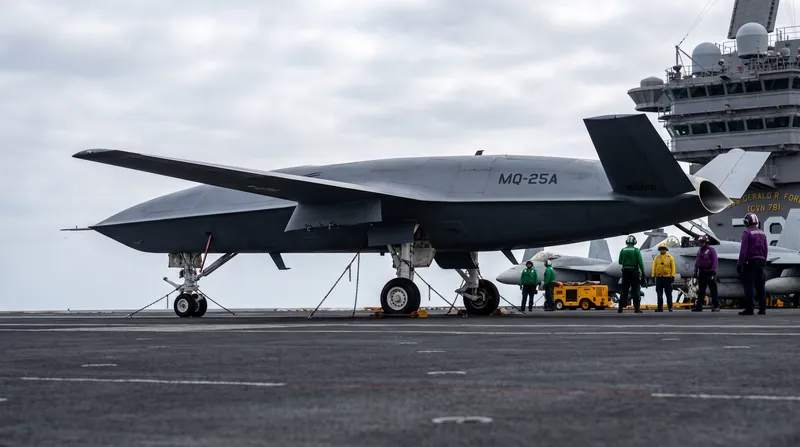
U.S. Navy Awards Boeing $562 Million Production Contract for MQ-25A Stingray Carrier Drones
8 sources
Military Doctrine
The Find, Fix, Track, Target, Engage, and Assess Sequence: How the Military Executes the Joint Targeting Cycle
6 sources

Nuclear Deterrence
The Bus, the Post-Boost Vehicle, and the Reentry Vehicles: How a MIRV System Delivers Multiple Warheads to Separate Targets
6 sources

Force Generation
Ukraine Intelligence Warns Russia Could Open New Northern Front by February 2027 After Mobilization
8 sources

Every angle. Every day.
Get Defense & Security stories with full source coverage and perspective breakdowns delivered to your inbox.