
Lockheed Martin Expands Production of Tailless 'Vectis' Stealth Drone Prototypes
Lockheed Martin's Skunk Works is self-funding the production of five Vectis Collaborative Combat Aircraft prototypes, accelerating the timeline for autonomous robotic wingmen. The tailless, stealth-focused drones are scheduled to begin flight testing by the end of 2027.

- Aerospace Manufacturers
- Defense primes argue that internal funding and rapid prototyping are necessary to meet the military's demand for affordable, autonomous mass.
- Air Power Strategists
- Military theorists emphasize that tailless, survivable drones fundamentally change the cost-exchange ratio of modern air combat.
- Procurement Realists
- Acquisition experts caution that target airframe costs often exclude the expensive sensors and software required for actual combat capability.
Perspectives this story doesn't cover
- International Defense Customers
- Human Rights Advocates on Autonomous Weapons
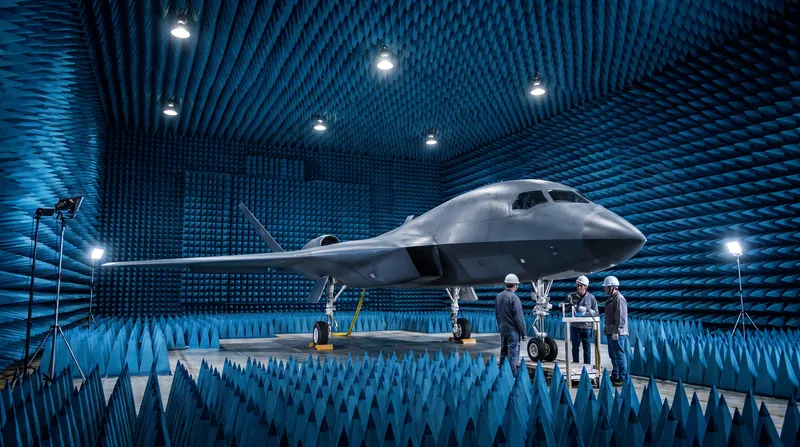
The architecture of American air combat has permanently decoupled from the human body. By committing to build five prototypes of the tailless Vectis drone before the first one has even flown, Lockheed Martin’s Skunk Works has locked the defense industrial base into a future where autonomous robotic wingmen absorb the primary risks of aerial warfare. The September 14 announcement shifts the Collaborative Combat Aircraft (CCA) concept from theoretical renders to active manufacturing lines. [1][2] Rather than waiting for a government contract to fund the research, the defense contractor is utilizing internal capital to force the pace of autonomous aviation. The move guarantees that the next generation of air superiority will rely on distributed, expendable mass rather than a small fleet of exquisite, crew-heavy platforms. [4][1][2][4]
Ron Fehlen, vice president and general manager of Skunk Works, confirmed that the company is doubling down on its internal investments, expanding the initial single-prototype run to a fleet of five identical test vehicles. [1] The first Vectis airframe is scheduled to fly by the end of 2027, with the subsequent four vehicles accelerating the testing and validation of mass-production processes. [1][2] "Development work on those additional aircraft is already underway, and we'll have more specifics to share soon," Fehlen noted, emphasizing that the expanded fleet will allow engineers to test multiple configurations simultaneously. [1] The primary objective of this accelerated production schedule is to hit the U.S. Air Force's target price for the CCA program, which aims for a unit cost of approximately $20 million. [1][1][2]
The physical dimensions and weight classifications of the Vectis platform place it squarely in the heavy-duty tier of uncrewed systems. The aircraft is classified as a Group 5 drone, a military designation for systems that weigh more than 1,320 pounds and operate at altitudes above 18,000 feet. [1] Its physical footprint mirrors existing, well-known assets: the aircraft measures roughly 34 feet in length with a 38-foot wingspan. [1][2] This geometry places its fuselage length on par with the MQ-9 Reaper, while its wingspan matches that of the F-35 it is designed to escort into contested airspace. [1] By matching the dimensions of existing fighters, Vectis can utilize the same hardened aircraft shelters and runway infrastructure currently supporting the crewed tactical fleet. [4][1][2][4]
The most significant engineering departure in the Vectis design is its tailless, lambda-wing configuration. [2] In aeronautics, a tailless aircraft eliminates the horizontal and vertical stabilizers, incorporating all aerodynamic control and stabilization functions directly into the main wing. [3] By removing these traditional tail surfaces, Skunk Works has eliminated the structures that typically generate the largest radar cross-sections, significantly improving the aircraft's stealth profile. [2][3] To manage engine airflow without compromising this low-observable signature, Vectis utilizes a deeply recessed, "submerged" dorsal inlet mounted on the top of the fuselage. [1][2] Fehlen explained that this dorsal placement serves a dual purpose: it reduces frontal aerodynamic drag, and it prevents the engine from ingesting rocks and debris when operating from austere, unpaved runways. [1][1][2][3]
The most significant engineering departure in the Vectis design is its tailless, lambda-wing configuration.
Propulsion and payload limits dictate the operational envelope of the new drone. While the specific engine model for the production variant remains unconfirmed by Lockheed, the aircraft is designed for highly efficient subsonic cruising performance to keep pace with crewed fighters over long distances. [2] The exact payload capacity remains partially classified, though the airframe relies entirely on an internal weapons bay to carry its munitions. [2] This internal carriage is a strict requirement for maintaining the aircraft's stealth profile, as externally mounted missiles or sensor pods would immediately reflect radar waves and reveal the drone's position to enemy air defenses. [3][4][2][3][4]
The software governing Vectis is designed for semi-autonomous operation, allowing a single pilot in an accompanying crewed fighter to direct multiple drone units simultaneously. [4] Rather than flying the drones with a traditional stick and throttle, the human pilot will issue high-level commands, leaving the onboard autonomy software to handle the micro-adjustments of flight control, aerodynamic stability, and threat avoidance. [3][4] "It is designed, as you can likely see, to be both survivable and affordable and flexible across the range of missions that our customers need," Fehlen stated, pointing to the platform's ability to seamlessly switch between air-to-air combat, electronic warfare, and reconnaissance tasks. [2][2][3][4]
Lockheed's aggressive internal funding of the Vectis program represents a strategic pivot following the company's exclusion from the first increment of the Air Force's CCA program. [1] By self-funding a fleet of five prototypes, Lockheed aims to dominate the subsequent increments of the planned uncrewed fleet. [1][4] The corporate strategy relies on proving that advanced stealth and survivability can be manufactured at a price point that allows the military to accept combat losses without crippling the defense budget. [2][4] If Skunk Works can deliver a highly survivable, tailless stealth platform at the CCA target price, it will fundamentally alter the cost-exchange ratio of modern air warfare, forcing adversaries to expend multimillion-dollar interceptors on relatively inexpensive robotic targets. [4][1][2][4]
Despite the rapid manufacturing timeline, the limits of the current evidence require transparent acknowledgment. While the physical mockups and supply-chain orders establish the reality of the airframe, the operational effectiveness of the autonomy software in a heavily contested, GPS-denied electronic warfare environment remains unproven. [4] Furthermore, the baseline unit cost target explicitly excludes the price of specialized sensors, electronic warfare pods, and mission payloads, meaning the fully equipped combat price will inevitably be higher. [1][4] The definitive test of the program's viability will occur in late 2027, when the first Vectis prototype must demonstrate that a tailless, autonomous platform can maintain aerodynamic stability and integrate seamlessly with crewed fighters without human intervention. [1][2][1][2][4]
What we don’t know
- The exact payload capacity and specific sensor suites the Vectis will carry in its internal weapons bay.
- How effectively the autonomy software will perform in a GPS-denied, heavily jammed electronic warfare environment.
- The fully burdened cost of the aircraft once mission systems, weapons, and advanced sensors are integrated.
- Why broader mainstream media coverage of this specific manufacturing expansion remains thin, with reporting largely confined to specialized defense and aerospace trade publications.
Sources
Source coverage
4 outlets
3 viewpoints surfaced




- [1]Breaking DefenseAerospace Manufacturers
Lockheed boosts bet on Skunk Works’ Vectis stealth drone
Read on Breaking Defense → - [2]The War Zone (TWZ)Air Power Strategists
Everything We Just Learned About The Vectis Collaborative Combat Aircraft From The Skunk Works
Read on The War Zone (TWZ) → - [3]WikipediaProcurement Realists
Tailless aircraft
Read on Wikipedia → - [4]Factlen Editorial TeamProcurement Realists
Synthesis by Factlen editorial team
Read on Factlen Editorial Team →
Comments

More in Defense & Security
See all →Stealth Engineering
The Four Mechanisms of Radar Cross-Section Reduction: Shaping, Materials, Cancellation, and Emission Control
7 sources
Iran Airspace
Declassified Footage Reveals Iranian MANPADS Downed U.S. F-15E in April
6 sources
Defense Budgeting
The Four Phases of the PPBE Process: How Planning, Programming, Budgeting, and Execution Dictate U.S. Defense Spending
6 sources

Missile Defense
Evidence Pack: The Architecture, Economics, and Feasibility of the Golden Dome Missile Defense System
4 sources

Every angle. Every day.
Get Defense & Security stories with full source coverage and perspective breakdowns delivered to your inbox.