
Why Water Density Stops Runaway Chain Reactions in Light-Water Reactors
The fundamental physics of water density creates an inherent safety mechanism in light-water reactors, automatically choking off the fission chain reaction if temperatures rise. This thermodynamic feedback loop ensures that commercial nuclear plants self-regulate power output without requiring active mechanical intervention.

Share this story
In short
- Light-water reactors use ordinary water as both the coolant and the neutron moderator.
- As reactor temperature rises, the water expands and becomes less dense, reducing its ability to moderate neutrons.
- This loss of moderation automatically slows the fission chain reaction, creating a self-regulating thermodynamic loop.
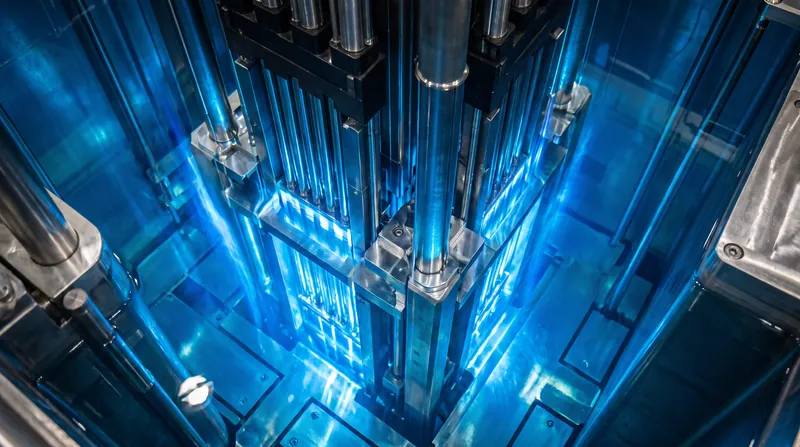
Anti-nuclear advocacy groups and popular media frequently characterize commercial light-water reactors as inherently unstable systems straining toward runaway meltdowns, requiring constant mechanical intervention to prevent disaster. The physical reality of the global nuclear fleet operates in exact reverse. Rather than relying solely on human operators, redundant software algorithms, or emergency diesel generators to arrest a sudden power excursion, light-water reactors are governed by the fundamental thermodynamics of water density. This physical barrier actively chokes off the fission chain reaction long before catastrophic temperatures are reached, serving as the ultimate fail-safe.[4]
This self-regulating physical phenomenon is known as the negative temperature coefficient of reactivity. In the architecture of a typical 1,000-megawatt light-water reactor, ordinary water serves two simultaneous, non-negotiable roles within the core: it acts as the primary coolant that removes thermal heat from the uranium fuel rods, and it acts as the neutron moderator that physically sustains the nuclear chain reaction. The entire safety case of the reactor relies on these two functions being inextricably linked by the same physical fluid.[6]
When a uranium-235 atom splits inside the fuel assembly, it releases roughly 200 megaelectron-volts (MeV) of energy alongside fast neutrons traveling at roughly 14,000 kilometers per second. At this extreme velocity, the neutrons are moving too quickly to be easily absorbed by other uranium atoms to continue the chain reaction.
The water surrounding the fuel rods acts as a necessary brake. As fast neutrons collide with hydrogen atoms in the water, they lose kinetic energy and slow down to roughly 2.2 kilometers per second, becoming 'thermal neutrons' that can efficiently trigger further fissions.[1]
The inherent safety of the system emerges directly from how water behaves as it heats up. As the temperature of the reactor core increases, the water expands, causing its physical density to drop. In a pressurized water reactor (PWR) operating at roughly 315 degrees Celsius and 155 bar of pressure, the water remains in a liquid state but becomes significantly less dense than it is at room temperature. This thermal expansion is a continuous, unavoidable physical response to any increase in reactor power.[1]
Because the heated water is less dense, there are fewer hydrogen atoms present in a given volume of the core to collide with the fast neutrons. Consequently, fewer neutrons are slowed down to thermal speeds, and fewer subsequent fissions occur in the uranium fuel. "The temperature coefficient of reactivity is defined as the change in reactivity per degree change in temperature," notes the European Nuclear Society. When this coefficient is engineered to be negative, an increase in temperature physically forces an immediate decrease in reactor power.[3]
This creates a closed, self-balancing thermodynamic loop that operates entirely independent of the plant's control systems. If reactor power inadvertently spikes, the uranium fuel heats up, which immediately transfers heat to the surrounding water. The water expands, neutron moderation drops, and the fission rate plummets, pulling the power level back down without a single control rod moving. The reactor is physically incapable of sustaining a high-power state if the water becomes too hot to effectively moderate the neutrons.[4]
Boiling water reactors (BWRs) take this physical limitation a step further through a mechanism known as the void coefficient. In a standard BWR architecture, such as the GE BWR/4, the water is intentionally allowed to boil into steam within the upper portion of the reactor core.
Steam is vastly less dense than liquid water and provides almost zero neutron moderation. As power increases and generates more steam bubbles—referred to in reactor physics as voids—the sudden loss of liquid water instantly stifles the local chain reaction, providing a massive negative reactivity insertion.[7]
According to technical documentation for the GE BWR/4 reactor design, the presence of steam voids introduces a powerful negative reactivity feedback that dominates the core's behavior. If power increases and generates more steam, the sudden loss of liquid water instantly stifles the chain reaction.
This void feedback is so dominant and reliable that BWR operators actually use the water circulation rate, rather than control rods, to make routine adjustments to the reactor's power output, increasing flow to sweep away voids and raise power, or decreasing flow to let voids build up and lower power.[7]
Maintaining a negative moderator temperature coefficient (MTC) is a strict regulatory requirement for commercial operations worldwide. The United States Nuclear Regulatory Commission and international oversight bodies mandate that light-water reactors must be designed so that the net power coefficient of reactivity remains negative across the entire operating range. The MTC is typically measured in units of pcm/°C (percent mille per degree Celsius), with operational safety limits often requiring values more negative than -40 pcm/°C at full power to ensure stability.[6]
The physics of the MTC requires careful management during the beginning of a fuel cycle in a pressurized water reactor. Fresh uranium fuel, typically enriched to between 3% and 5% uranium-235, is highly reactive, so operators dissolve boron—a neutron-absorbing chemical—into the cooling water to keep the reaction balanced. However, as the water heats up and expands, it pushes some of the dissolved boron out of the core, which removes a neutron absorber and adds positive reactivity to the system.[5]
Reactor physicists must ensure that the negative reactivity from the loss of water density always overpowers the positive reactivity from the loss of boron concentration. The International Atomic Energy Agency (IAEA) curates extensive studies on these reactivity temperature coefficients to ensure that the net MTC remains negative under all operational conditions. Plant operators physically verify this coefficient during every reactor startup, conducting precise temperature and reactivity measurements before the reactor is permitted to ascend to full commercial power.[2]
The catastrophic accident on April 26, 1986, at the Chernobyl nuclear plant perfectly illustrates the danger of ignoring these physical laws. The Soviet RBMK reactor design used solid graphite blocks as the primary neutron moderator and water only as a coolant. When the water boiled into steam, it stopped absorbing neutrons, but the solid graphite continued moderating them efficiently. This created a positive void coefficient—meaning a power increase caused more boiling, which caused a further power increase, leading directly to a runaway thermal explosion.[4]
Modern commercial light-water reactors eliminate this specific failure mode entirely by combining the coolant and the moderator into the exact same physical substance. If the coolant is lost through a pipe break or boils away entirely, the moderator is simultaneously lost, and the fission chain reaction physically cannot continue. While residual decay heat from fission products must still be managed by emergency cooling systems to prevent the fuel rods from melting, the primary nuclear chain reaction itself is inherently shut down by the fundamental laws of physics.[4]
Modern commercial light-water reactors eliminate this specific failure mode entirely by combining the coolant and the moderator into the exact same physical substance.
As the global energy grid transitions toward zero-carbon baseload power to meet climate targets, understanding this inherent physical safety is critical for policymakers and the public. The modern nuclear reactor is not a precarious machine held back from disaster solely by complex software and vigilant operators; it is a self-regulating node in the infrastructure chain, strictly constrained by the fundamental thermodynamics of water. Recognizing this physical reality shifts the paradigm of nuclear safety from engineered prevention to inherent thermodynamic limitation.[8]
Key terms
- Moderator Temperature Coefficient (MTC)
- A measure of how a nuclear reactor's power level changes in response to a change in the temperature of its water moderator.
- Thermal Neutron
- A neutron that has been slowed down by a moderator to a speed where it is highly likely to be absorbed by a uranium atom and cause fission.
- Reactivity
- A measurement of the state of a nuclear chain reaction; positive reactivity means power is increasing, while negative reactivity means power is decreasing.
- Void Coefficient
- The change in a reactor's reactivity that occurs when the liquid water moderator boils into steam bubbles, or 'voids'.
Frequently asked
What happens if a light-water reactor gets too hot?
As the water in the reactor heats up, it expands and becomes less dense. This lower density reduces the water's ability to slow down neutrons, which naturally chokes off the fission chain reaction and lowers the reactor's power.
How did Chernobyl bypass this safety feature?
The Chernobyl reactor used solid graphite to moderate neutrons and water only to cool them. When the water boiled away, the graphite kept the chain reaction going, leading to a runaway power spike—a design flaw impossible in modern light-water reactors.
Do operators need to manually trigger this shutdown?
No. The negative temperature coefficient is an inherent physical property of the water inside the core. It operates automatically based on the laws of thermodynamics, independent of human action or computer software.
Viewpoints in depth
Reactor Physicists
Focus on the mathematical certainty of negative reactivity feedback loops.
For reactor physicists, the safety of a light-water reactor is not a question of mechanical reliability, but of mathematical certainty. The cross-sections of uranium-235 dictate that fast neutrons simply cannot sustain a commercial chain reaction without being thermalized by a dense moderator. By intentionally designing the core so that the moderator is also the coolant, physicists ensure that any thermal excursion inherently destroys the conditions necessary for the excursion to continue. This is viewed not as a safety feature, but as a fundamental physical barrier.
Nuclear Regulators
Prioritize the strict measurement and operational enforcement of negative temperature coefficients.
Regulatory bodies like the NRC do not take inherent safety for granted; they require it to be mathematically proven for every fuel cycle. Because the addition of soluble boron in pressurized water reactors can push the moderator temperature coefficient toward positive territory at the beginning of a fuel cycle, regulators mandate strict operational limits. Plants are required to conduct low-power physics testing after every refueling outage to empirically verify that the MTC remains sufficiently negative before the reactor is legally permitted to generate commercial power.
Safety Systems Engineers
Emphasize the distinction between inherent physical safety and engineered safety systems.
Safety engineers draw a sharp line between the reactor's inherent ability to stop the fission chain reaction and the engineered systems required to manage the aftermath. While the negative temperature coefficient guarantees that the primary nuclear reaction will shut itself down if temperatures spike, the radioactive byproducts inside the fuel rods continue to generate 'decay heat' even after fission stops. Engineers stress that while thermodynamics prevents a runaway power explosion, active cooling systems are still required to remove this residual heat and prevent the fuel cladding from melting.
- Reactor Physicists
- Focus on the mathematical and thermodynamic certainty of negative reactivity feedback loops as the primary safety mechanism of light-water reactors.
- Nuclear Regulators
- Prioritize the strict measurement, standardization, and operational enforcement of negative temperature coefficients across all commercial plants.
- Safety Systems Engineers
- Emphasize the distinction between inherent physical safety (thermodynamics) and engineered safety (backup cooling systems) in preventing core damage.
Perspectives this story doesn't cover
- Fossil Fuel Competitors
- Decommissioning Contractors
Sources
Source coverage
8 outlets
3 viewpoints surfaced






- [1]Nuclear PowerReactor Physicists
Moderator Temperature Coefficient – MTC
Read on Nuclear Power → - [2]INIS-IAEAReactor Physicists
Studies of the reactivity temperature coefficient in light water reactors
Read on INIS-IAEA → - [3]European Nuclear SocietyReactor Physicists
Temperature coefficient of reactivity
Read on European Nuclear Society → - [4]Indian Academy of SciencesSafety Systems Engineers
Inherent safety concepts in nuclear power reactors
Read on Indian Academy of Sciences → - [5]OSTINuclear Regulators
Development of a Standard for Calculation and Measurement of the Moderator Temperature Coefficient of Reactivity in Water-Moderated Power Reactors
Read on OSTI → - [6]Nuclear Regulatory CommissionNuclear Regulators
Full-Text Glossary
Read on Nuclear Regulatory Commission → - [7]GE BWR_4 TechnologyReactor Physicists
0518 - R304B - GE BWR_4 Technology - 1.7 Reactor Physics
Read on GE BWR_4 Technology → - [8]Factlen Editorial Team
Synthesis by Factlen editorial team
Read on Factlen Editorial Team →
More in Energy
See all →Reactor Physics
The Physics of Decay Heat: Why Nuclear Reactors Require Cooling Long After the Chain Reaction Stops
7 sources
Reactor Physics
The 20% to 30% Power Reduction That Defines the Xenon-135 Reactor Poisoning Problem
6 sources
Reactor Physics
Moderating Ratios Determine Whether Reactors Require Enriched Uranium
5 sources
Reactor Physics
The 0.65% Fraction of Delayed Neutrons That Makes a Nuclear Chain Reaction Controllable
8 sources
Comments
Every angle. Every day.
Get Energy stories with full source coverage and perspective breakdowns, free every day.