
How Biometric Airport Security Actually Works (and Protects Your Data)
As airports worldwide roll out facial recognition and e-gates in 2026, understanding the technology can help travelers navigate terminals faster and with less anxiety.
By Kabir Mehra

In short
- Over 50% of travelers now use some form of biometric identification at airports.
- Facial recognition algorithms match a live photo against an existing passport or ID database.
- Biometric gates reduce processing times and eliminate the need for manual document checks.
Picture the traditional airport security experience: a winding line, the frantic search for a driver's license at the bottom of a carry-on, and the anxiety of handing over paper documents to a hurried agent. In 2026, that friction is rapidly disappearing. Airports worldwide are undergoing a massive digital transformation, replacing manual document checks with seamless biometric identification systems.[1][3]
The shift is driven by sheer necessity. Global passenger traffic rebounded to 9.4 billion in 2024, pushing aging airport infrastructure to its limits. To prevent terminal gridlock, aviation authorities and security vendors have accelerated the deployment of smart security lanes and automated border control kiosks. Today, more than half of all travelers utilize some form of biometric identification during their journey.[1][2]
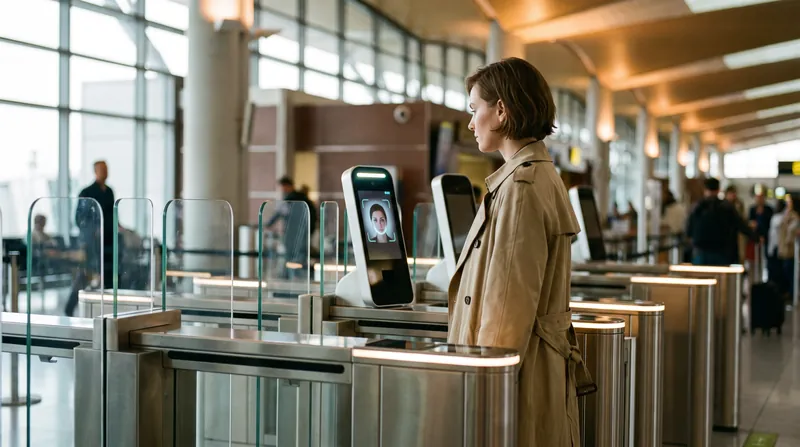
But what exactly happens when you step up to a biometric e-gate? At its core, biometric screening uses unique physical characteristics—most commonly facial recognition, though iris and fingerprint scans are also used—to create a digital footprint. This footprint is then linked directly to your verified travel credentials, such as your passport or digital ID.[1]
The mechanism is surprisingly straightforward. When you approach a biometric checkpoint, a high-definition camera captures a live image of your face. Within milliseconds, artificial intelligence algorithms map your facial geometry and compare it against a secure, pre-existing database. If the live image matches the photo on file, the gate automatically opens, allowing you to proceed without ever breaking stride.[2]
This touchless process eliminates the "ID panic" that plagues so many travelers. By removing the need to repeatedly present physical boarding passes and identification cards, biometric gates significantly reduce processing times. Frequent flyers and business travelers are finding that what used to be a stop-start ordeal is now a continuous, hands-free glide from the terminal entrance to the aircraft cabin.[1]
Beyond mere convenience, biometrics represent a substantial upgrade in actual security. Human agents, no matter how well-trained, are susceptible to fatigue and error when comparing thousands of faces to decade-old passport photos. Automated facial recognition algorithms offer a much higher degree of accuracy, effectively reducing the risk of identity fraud and ensuring that only authorized individuals access restricted areas.[1]
Despite these benefits, the rapid rollout of facial recognition has sparked understandable privacy concerns. The most common myth surrounding airport biometrics is that governments or private airlines are indiscriminately "stealing" faces to build permanent surveillance tracking databases. In reality, the architecture of these systems is designed with strict data minimization principles.[3]
When you use a biometric gate, the system is typically not creating a new, permanent record of your face. Instead, it is performing a temporary verification against a photo you have already provided to the government—such as your passport or trusted traveler profile. Once your identity is verified and your flight departs, the live photo captured at the gate is usually purged from the local system within hours.[3]
Because airports are shifting to these digital-first operations, cybersecurity has become a paramount focus. The transmission of biometric data between the e-gate and the verification database is heavily encrypted. Security vendors are continuously deploying predictive threat intelligence and AI-powered monitoring to protect these networks from breaches, ensuring that passenger data remains siloed and secure.[2]
Of course, biometric gates are only one component of modern travel safety. While the airport handles your physical identity, cybersecurity experts emphasize that travelers must take active steps to protect their digital identity while abroad. The convenience of a frictionless airport experience can be quickly undermined if a traveler connects to an unsecured public Wi-Fi network in the departure lounge.
Travel safety in 2026 requires a hybrid approach. Experts advise using Virtual Private Networks (VPNs) when accessing airport or hotel Wi-Fi, avoiding public USB charging ports which can be compromised by hackers, and enabling two-factor authentication on all critical accounts. A seamless physical journey should be matched by rigorous digital hygiene.
Furthermore, the efficiency of biometrics works best when paired with traditional situational awareness. A traveler who glides through security in seconds but leaves their smartphone unattended at a terminal café is still vulnerable. Keeping valuables secured in cross-body bags and sharing itineraries with trusted contacts remain foundational safety practices, even in the age of AI.
Looking ahead, the technology will only become more integrated. Next-generation airport security gates promise even better interoperability, potentially allowing a single biometric enrollment to serve a traveler across multiple airlines, international borders, and transit systems. The goal is a globally connected, fully contactless travel ecosystem.[2]
For now, the era of the stressed-out traveler is steadily coming to an end. By understanding how biometric systems work, what data they actually retain, and how they enhance overall security, travelers can confidently embrace the technology. The future of travel is not just faster—it is fundamentally more secure.[1][3]
Terms to know
- Biometric Footprint
- A digital representation of unique physical characteristics, such as facial geometry, used to verify a person's identity.
- Automated Border Control (ABC) Kiosk
- Self-service barriers at immigration checkpoints that use facial or iris scans to match a traveler to their e-passport.
- Smart Security Lanes (SSL)
- Advanced airport checkpoints that integrate AI scanning, automated tray returns, and biometrics to speed up passenger flow.
- Data Minimization
- The privacy principle of collecting only the exact amount of personal data needed for a specific task, and deleting it immediately afterward.
Questions readers ask
Do I have to use biometric screening at the airport?
No. In most countries, biometric screening remains opt-in. Travelers can request a standard manual document check by a human agent, though this process may take longer.
Does the airport keep my facial scan forever?
Generally, no. Systems are designed to use the live photo for a temporary match against your existing ID profile, and the image is typically purged shortly after your flight departs.
What happens if the scanner doesn't recognize me?
If the biometric system fails to match your face due to lighting, glasses, or a technical glitch, you simply proceed to a manual check with a security agent.
Is biometric screening more secure than a human check?
Yes. Advanced facial recognition algorithms are statistically much more accurate at matching identities than human agents, significantly reducing the risk of identity fraud.
Different angles
Aviation Security Experts
Focus on the operational efficiency and enhanced threat detection capabilities of automated systems.
For airport operators and security agencies, biometrics solve a critical math problem: processing a surging volume of passengers without compromising safety. Experts argue that AI-driven facial recognition is objectively superior to human agents at matching identities, eliminating the fatigue and cognitive bias that plague manual document checks. By automating routine verification, airports can reallocate human security personnel to focus on behavioral analysis, complex threat detection, and assisting passengers who require manual screening.
Privacy Advocates
Emphasize the need for transparent data retention policies and robust cybersecurity safeguards.
While acknowledging the convenience, privacy watchdogs caution against the normalization of mass biometric scanning. Their primary concern is not the immediate gate-check, but the potential for 'function creep'—where data collected for travel facilitation is eventually repurposed for broader surveillance. Advocates push for strict, legally binding data-retention limits, ensuring that live photos are purged immediately after use. They also stress that biometric systems must remain strictly opt-in, preserving a manual alternative for travelers who do not wish to digitize their physical identity.
Frequent Travelers
Value the frictionless experience that eliminates the stress of traditional security bottlenecks.
For road warriors and frequent business flyers, the adoption of biometrics is overwhelmingly positive. This camp views the technology as a massive quality-of-life upgrade that reclaims lost hours and reduces the cognitive load of travel. By eliminating the need to constantly produce paper documents or physical IDs, travelers experience a smoother, more predictable journey. For this group, the trade-off of a temporary facial scan is well worth the elimination of the traditional, anxiety-inducing security queue.
- Aviation Security Experts
- Prioritize the speed, accuracy, and enhanced threat detection that automated systems provide.
- Privacy Advocates
- Demand strict data retention limits and transparent opt-out policies to prevent surveillance overreach.
- Frequent Travelers
- Embrace the technology for its ability to eliminate friction and reduce airport anxiety.
Perspectives this story doesn't cover
- Civil liberties organizations focused specifically on algorithmic bias in facial recognition.
- Frontline airport workers whose daily roles are shifting from document checking to behavioral monitoring.
Sources
Source coverage
3 outlets
3 viewpoints surfaced



- [1]Booking.com for BusinessFrequent Travelers
Benefits of Airport Biometrics for Frequent Business Travellers
Read on Booking.com for Business → - [2]Research and MarketsAviation Security Experts
Airport Security Solutions, Global, 2025-2030
Read on Research and Markets → - [3]Factlen Editorial TeamPrivacy Advocates
Synthesis by Factlen editorial team
Read on Factlen Editorial Team →
More in Travel
See all →Aviation Economics
The Mechanics of the Global Fuel Crisis: How Doubled Jet Fuel Prices Are Forcing Airlines to Hike Fares and Cut Service
3 sources

Typhoon Preparedness
The Mechanics of Coastal Evacuation: How China and Taiwan Are Securing Tourist Sites Ahead of Super Typhoon Bavi
2 sources

Aviation Security
ICAO Adopts Sweeping New Global Aviation Security Plan to Combat Drone, Cyber, and GNSS Jamming Threats
3 sources
Aviation Security
CDC and DHS Implement Enhanced Ebola Screening at US Airports Following May 2026 Outbreak
3 sources
Comments
Every angle. Every day.
Get Travel stories with full source coverage and perspective breakdowns, free every day.