
TSA CAT-2 Biometric E-Gates: Facial Recognition Matching, Delays, and Opt-Out Rights
As the TSA activates its new automated biometric e-gates at major US airports, travelers are navigating a learning curve of new procedures and unexpected delays. Here is how the facial recognition technology works, why the agency is deploying it, and the exact steps to exercise your legal right to opt out.

Share this story
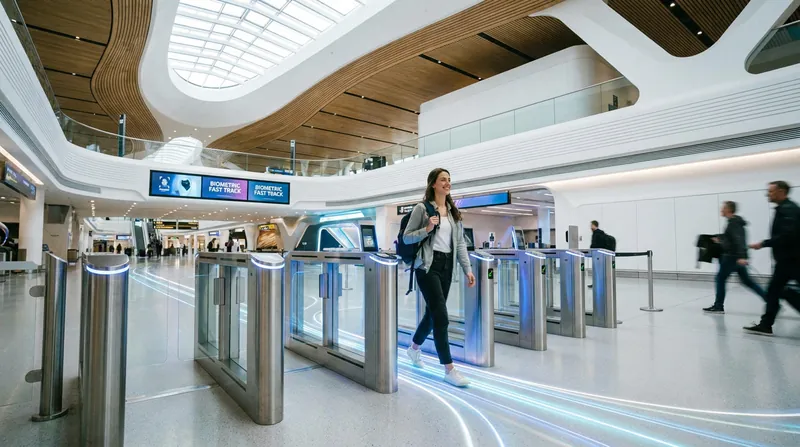
The summer travel season of 2026 has introduced a new, glowing chokepoint at hundreds of American airports: the biometric e-gate. As passengers approach the Transportation Security Administration (TSA) checkpoint, they are increasingly greeted not by a human officer asking for a boarding pass, but by an automated pod equipped with an iPad-sized camera and an ID slot.[2][3]
This hardware represents the nationwide activation of the TSA’s Credential Authentication Technology, specifically the second generation known as CAT-2. The agency has spent recent years procuring and installing these units, which are designed to automate the identity verification process and eventually reduce the labor costs associated with manual document checking.[1][4]
The mechanism itself is straightforward. A passenger inserts their physical driver's license or passport into the machine. The camera then captures a live photo of the traveler's face and performs a "1:1 match" against the secure photo stored on the ID's microchip or the state database. If the geometry matches, the gate opens, and the passenger proceeds to the physical screening area.[1]
However, the transition from human interaction to automated biometric screening has not been entirely frictionless. Airports across the country are reporting localized bottlenecks as the traveling public encounters the technology at scale for the first time. The delays are largely driven by a steep learning curve.[2][3]
Travelers frequently struggle with the physical requirements of the scan. Passengers wearing heavy glasses, hats, or face masks must remove them for the camera to register a match. Others look down at their phones or away from the lens, prompting the machine to time out and requiring a TSA officer to intervene and manually reset the process.[2]
The aviation industry views these delays as a temporary growing pain. The US Travel Association argues that biometric verification is a necessary step toward a "seamless" travel future, where physical documents can remain in a traveler's pocket from the curb to the gate. Proponents point to international hubs in Europe and Asia where mature biometric systems process passengers significantly faster than manual checks.[4]
Beyond the immediate logistical hurdles, the CAT-2 rollout has ignited a fierce debate over data privacy and the normalization of facial recognition technology. Civil liberties organizations have raised alarms about the rapid deployment of biometric capture devices in public transit hubs, questioning the long-term security of the data being collected.
The TSA maintains strict official boundaries regarding data retention. According to the agency's published policy, the live photos captured at the checkpoint are not saved to a permanent database. The system is designed to overwrite the images within 12 hours, and the agency explicitly states that the scanners are not connected to external law enforcement databases to search for outstanding warrants.[1]
Privacy advocates, however, argue that these internal policies are subject to change. The Electronic Frontier Foundation and the ACLU warn of "mission creep," noting that once the physical infrastructure for mass facial recognition is installed nationwide, the temptation for future administrations to expand its use—such as cross-referencing live feeds with federal watchlists—will be immense.
This tension brings into focus the most critical, yet least understood, aspect of the TSA's biometric program: participation is entirely voluntary. Every passenger traveling through a US airport has the legal right to opt out of the facial recognition scan without facing any punitive measures or loss of privileges.[1]
The primary friction point for consumers is that this right is rarely advertised. Opt-out signage at the checkpoints is often small, poorly placed, or obscured by the crowds. Furthermore, because the automated gates are designed to be the default pathway, TSA officers frequently direct all passengers toward the cameras without mentioning the alternative.
Exercising the opt-out right requires specific, proactive steps from the traveler. As you approach the podium, do not insert your ID into the machine. Instead, hand your physical identification directly to the TSA officer standing nearby and state clearly, "I am opting out of the biometric scan."
The officer is trained to accept this request. They will take your ID, manually verify your identity against your boarding pass, and allow you to proceed. Crucially, opting out does not affect your flight status, nor does it revoke your eligibility for expedited screening programs like TSA PreCheck or CLEAR.[1]
As the 2026 travel season progresses, the initial bottlenecks at the e-gates are expected to subside as frequent flyers adapt to the new routine. Until the technology becomes entirely frictionless, travelers are empowered to choose their preferred method of verification, balancing the promise of automated speed against their personal comfort with biometric data collection.[2][3]
Key points
- The TSA has activated biometric e-gates at hundreds of US airports, replacing manual ID checks with automated facial recognition.
- The system performs a 1:1 match, comparing a live photo taken at the gate against the photo stored on a passenger's physical ID.
- Initial deployment has caused checkpoint delays due to passenger unfamiliarity, such as failing to remove glasses or masks.
- Participation in the biometric scan is legally voluntary, though the right to opt out is rarely advertised at the checkpoint.
Open questions
- Whether the TSA or Congress will eventually attempt to mandate biometric screening for all passengers, removing the opt-out provision.
- How long the current checkpoint bottlenecks will persist as the traveling public adapts to the new hardware.
- The exact error rates for the newest generation of scanners across different demographic groups in real-world, high-volume conditions.
Timeline
2019
The TSA begins initial pilot testing of biometric facial recognition technology at select airport gates.
2023
The agency announces the widespread procurement of Credential Authentication Technology (CAT-2) units.
2025
Installation of automated e-gates accelerates across major US hub airports, replacing older podiums.
Summer 2026
The system goes fully live nationwide, triggering a wave of procedural delays and renewed privacy debates.
- Aviation Security Officials
- Argue that biometrics are essential for modernizing checkpoints, reducing human error, and eventually speeding up lines.
- Privacy Advocates
- Warn that normalizing facial recognition creates infrastructure for future surveillance and criticize the lack of clear opt-out signage.
- Travel Consumers
- Focused on the immediate practical impacts, such as checkpoint delays, and the desire for clear, frictionless travel procedures.
Perspectives this story doesn't cover
- Frontline TSA officers managing the new hardware and passenger frustrations.
- Non-US citizens who may face different biometric processing requirements at the border.
Sources
Source coverage
4 outlets
3 viewpoints surfaced




- [1]TSAAviation Security Officials
Facial Recognition Technology and Credential Authentication
Read on TSA → - [2]The Washington PostTravel Consumers
TSA's new biometric gates are here. Expect a learning curve.
Read on The Washington Post → - [3]ReutersTravel Consumers
US airports see summer bottlenecks as TSA activates automated ID gates
Read on Reuters → - [4]Wall Street JournalTravel Consumers
The $1.2 Billion Tech Upgrade Changing the Airport Security Line
Read on Wall Street Journal →
More in Travel
See all →Travel Alerts
Worldwide Caution: Why the State Department Alert Does Not Mean Canceling Trips
6 sources
Aviation Economics
Why the Strait of Hormuz Closure Doubled Jet Fuel Prices and Lifted Airfares 20%
2 sources
Aviation Security
ICAO Adopts Sweeping New Global Aviation Security Plan to Combat Drone, Cyber, and GNSS Jamming Threats
3 sources
Aviation Security
CDC and DHS Implement Enhanced Ebola Screening at US Airports Following May 2026 Outbreak
3 sources
Comments
Every angle. Every day.
Get Travel stories with full source coverage and perspective breakdowns, free every day.