
full timeline
US–ICC sanctions dispute
Japanese Prime Minister Sanae Takaichi has pledged to deliver Tokyo’s full 2027 contribution to the International Criminal Court by the end of December.
Follow US–ICC sanctions dispute in the Factlen app and get an alert when there is news. Get the app
Share this story
Latest report
Japan Accelerates ICC Funding to Offset US Sanctions Following Tokyo Meeting
Japanese Prime Minister Sanae Takaichi has pledged to deliver Tokyo’s full 2027 contribution to the International Criminal Court by the end of December. The early payment aims to secure the tribunal's finances before sweeping United States sanctions take full effect next April.
- Japan will deliver its full 2027 financial contribution to the International Criminal Court by the end of December 2026.
- The accelerated payment is designed to provide the court with a cash buffer before sweeping US financial sanctions take full effect in April 2027.
- Japan is the court's largest single donor, providing approximately 15 percent of its annual operating budget.
- The US sanctions target the court over its ongoing investigations into alleged war crimes involving American personnel and allied officials.
Japanese Prime Minister Sanae Takaichi committed on Tuesday to advancing Tokyo’s full 2027 financial contribution to the International Criminal Court, delivering the funds by the end of December. The unprecedented move is designed to shield the tribunal from the crippling impact of sweeping United States sanctions scheduled to take full effect in April 2027.[1][2][3]
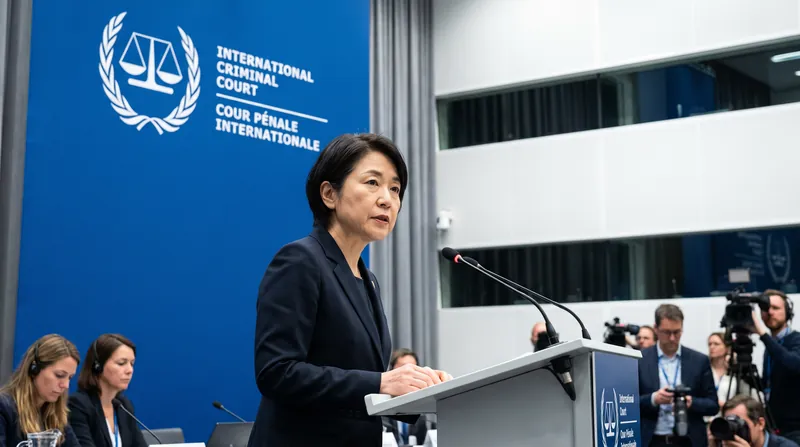
The decision followed a high-stakes meeting in Tokyo between Takaichi and ICC President Tomoko Akane, a Japanese national who was personally sanctioned by the American government in August. Akane had specifically requested the accelerated funding to ensure the court maintains sufficient liquidity before the American financial blockade hardens and restricts its banking access.[1][3]
Japan currently serves as the court's largest single financial contributor, providing approximately 15 percent of the institution's annual operating budget. In 2026, Tokyo contributed 4.6 billion yen, or roughly $28.8 million, a figure that anchors the tribunal's ability to conduct global investigations and maintain its extensive legal infrastructure.[1][3][4]
"I am extremely grateful," Akane told reporters following her meeting at the Prime Minister's Office, acknowledging the critical nature of the early disbursement. "We will make sure to spend the money wisely, for ICC to survive and to pay salaries for our staff."[1][3]
The American Financial Blockade
The accelerated funding arrives as Washington intensifies a coordinated pressure campaign aimed at dismantling the global tribunal entirely. The conflict escalated sharply in August 2026, when US Secretary of State Marco Rubio announced targeted sanctions against Akane and Abdoulaye Seye, a senior trial lawyer from Senegal, citing their roles in unauthorized investigations.[5][6][8]
Those initial measures barred the officials from entering the United States and froze any assets they held within American jurisdictions. More severely, the sanctions prohibited American citizens and businesses from conducting any financial transactions with the targeted individuals, effectively severing their access to the global dollar system and basic consumer services.[5][8]
In October, the Trump administration expanded the offensive, designating the International Criminal Court as a whole under the sanctions regime. The administration explicitly stated that the campaign is intended to neutralize what it describes as a fundamental threat to American sovereignty and the legal protections afforded to its military personnel.[1][3][4][8]
The core of the dispute centers on the court's assertion of jurisdiction over citizens of non-member states. Washington has fiercely opposed the tribunal's ongoing investigations into alleged war crimes involving American personnel during the conflict in Afghanistan, as well as its scrutiny of allied officials, most notably from Israel.[1][3][6]
The practical effects of the sanctions on court personnel have been immediate and highly disruptive to their daily lives. Akane previously disclosed in an interview that her personal Visa credit cards, including those issued by Japanese banks, were rendered unusable, and her personal Google accounts were abruptly disabled by the tech giant.[7]
Past rounds of American sanctions against the court have demonstrated the extensive reach of these financial weapons. When Canadian judge Kimberly Prost was targeted during a previous administration, she lost access to basic banking services and even consumer technology platforms like Amazon's Alexa, illustrating how deeply the restrictions penetrate personal infrastructure.[8]
Tokyo's Diplomatic Balancing Act
Japan's decision to advance its payment places Takaichi in a delicate diplomatic position, forcing a balance between Tokyo's role as a vocal champion of international law and its foundational security alliance with Washington. The prime minister has invested heavily in cultivating a strong, cooperative relationship with the incoming American administration.[6]
Despite that strategic priority, Tokyo has chosen to prioritize the survival of the international tribunal over strict alignment with American foreign policy. Following the Tuesday meeting, Takaichi reiterated her government's position on social media, stating plainly that "Japan has consistently supported the ICC and will continue to do so."[1][3]
The Japanese foreign ministry issued a parallel statement confirming the government's intent to enable the court to fulfill its original mandate without interference. However, Japanese diplomats have carefully avoided issuing direct, inflammatory condemnations of the American sanctions, describing them previously in measured diplomatic terms as merely "very unfortunate."[4][6][8]
Domestic pressure within Japan has played a significant role in stiffening the government's resolve to protect the institution. A national signature campaign calling for the defense of the court and the withdrawal of the sanctions recently gathered more than 60,000 supporters, demonstrating deep public backing for Akane and the rule of law.[7]
The Court's Survival Strategy
The December payment deadline is critical because it provides the court with a substantial cash buffer before the American sanctions reach their maximum enforcement phase in April 2027. This window allows the institution to secure its payroll and fund ongoing field investigations without facing an immediate, paralyzing liquidity crisis.[1][3][4]
Beyond securing early funding, the court has been systematically shifting its digital and financial infrastructure away from American corporate providers. Akane noted that the institution had already begun migrating its sensitive data from Microsoft servers to European-based systems to prevent catastrophic operational disruptions if tech services are suddenly severed.[7]
Banking remains the most severe vulnerability, as global financial institutions are notoriously risk-averse regarding American sanctions exposure. While several European banks have continued to process salaries and arrange travel for court staff, the looming threat of secondary sanctions casts a shadow over those vital financial relationships.[7]
To counter this vulnerability, the tribunal has formally requested that the European Union invoke its "blocking statute" to protect the court's financial lifelines. This legal mechanism is designed to nullify third-country sanctions within the European bloc and shield European companies that continue to provide essential services to the targeted entity.[7]
A Test for International Law
The success of the court's survival strategy will likely depend on whether other major financial backers follow Tokyo's precedent and accelerate their own funding. Germany, France, Britain, Italy, South Korea, and Canada represent the next largest contributors, and their willingness to advance payments could ultimately determine the institution's long-term viability.[4]
The International Criminal Court was established in 2002 as a court of last resort, mandated to prosecute war crimes, crimes against humanity, and genocide when national governments are unwilling or unable to do so. The United States participated in the drafting of its founding treaty but ultimately refused to ratify the agreement.[1][3]
For the court's leadership, the current crisis represents an existential threat to the fundamental concept of global accountability. Akane has repeatedly warned that attempting to disable the tribunal through financial coercion constitutes a direct, unprecedented attack on judicial independence that threatens the entire international legal order.[7]
"If a mechanism were established to shield companies from US sanctions, it would encourage them to continue providing services to the ICC," Akane argued in a recent interview. She emphasized that without such robust protections, the global legal framework risks fragmentation under the weight of unilateral pressure.[7]
The coming months will test whether the international community can sustain a multilateral institution against the active, coordinated opposition of the world's primary financial superpower. The court must now navigate a complex web of compliance departments, legal risks, and alternative banking channels to keep its doors open.[6][7]
Ultimately, the December transfer of 4.6 billion yen from Tokyo will buy the tribunal crucial time to adapt to its new reality. The deciding factor will be whether that time is sufficient to construct a resilient financial architecture that operates entirely outside the reach of the American dollar.[1][3]
Sources
- [1]AP News — ICC president thanks Japan for early 2027 payment as US sanctions squeeze the court Read on AP News →
- [2]The Japan Times — Takaichi moves up ICC financial support in first meeting with court chief since U.S. sanctions Read on The Japan Times →
- [3]The Washington Post — ICC president thanks Japan for early 2027 payment as US sanctions squeeze the court Read on The Washington Post →
- [4]Daily Maverick — Japan accelerates ICC funding as US sanctions threaten court Read on Daily Maverick →
- [5]Human Rights Watch — US Sanctions ICC President Tomoko Akane Read on Human Rights Watch →
- [6]Just Security — Japan Is Key for Trump Administration “Dismantling” Campaign Read on Just Security →
- [7]Japan Forward — ICC President Tomoko Akane Speaks Out on US Sanctions Read on Japan Forward →
- [8]The Guardian — US sanctions ICC president and senior lawyer Read on The Guardian →
What to watch
- Sweeping United States financial sanctions against the court are scheduled to take full effect in April 2027.
Timeline
November 2026
Japan Accelerates ICC Funding to Offset US Sanctions Following Tokyo Meeting

August 2026
ICC President Vows to Resist US Campaign to Dismantle International Court
How the story developed
The United States initiated a sanctions campaign aimed at dismantling the International Criminal Court over its ongoing investigations into alleged war crimes involving American personnel and allied Israeli officials. As part of this effort, Washington imposed financial and travel restrictions on ICC President Tomoko Akane and a senior prosecutor.
Alongside the direct restrictions on court officials, Washington began actively pressuring the tribunal's 125 member states to withdraw their funding and participation from the institution. The International Criminal Court condemned the sanctions, describing them as a flagrant attack on the independence of the global judicial system.
On August 27, Akane vowed to resist the United States' campaign and urged member states to defend the institution's independence.
During her appeal, Akane specifically called on Japan to use its diplomatic influence to counter the pressure from the United States. Japan is the court's largest single donor, providing approximately 15 percent of its annual operating budget.