full timeline
Nepal glacier collapse disaster
A rapid attribution study concludes that decades of warming, permafrost thaw, and glacial thinning preconditioned the Langtang Lirung mountain for the catastrophic rock and ice collapse that killed…
Follow Nepal glacier collapse disaster in the Factlen app and get an alert when there is news. Get the app
Share this story
Latest report
Climate Change Intensified Himalayan Slope Instability That Caused Deadly Nepal Floods
A rapid attribution study concludes that decades of warming, permafrost thaw, and glacial thinning preconditioned the Langtang Lirung mountain for the catastrophic rock and ice collapse that killed over 1,300 people in August 2026.
- A World Weather Attribution study concluded that climate change preconditioned the Langtang Lirung mountain for its catastrophic August 2026 collapse.
- Warming temperatures have pushed the Himalayan freezing threshold up by 100 meters per decade, thawing the permafrost that binds mountain bedrock.
- The Langtang Lirung glacier has retreated half a kilometer since the 1990s, removing crucial physical support for the steep rock walls.
- The resulting rock and ice avalanche liquefied into a massive debris flow, killing over 1,300 people and leaving 5,000 missing.
- Scientists noted the disaster was a compound event, with the 2015 Gorkha earthquake likely fracturing the bedrock years before the collapse.
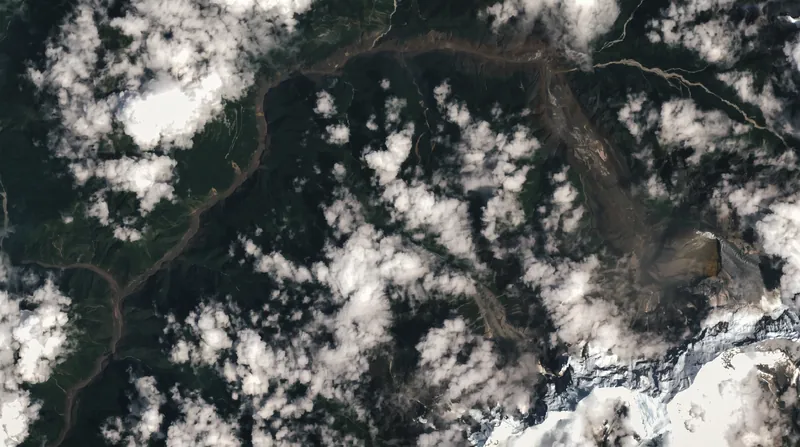
The freezing threshold in the Himalayas has permanently shifted upward, destabilizing the bedrock that holds the world's highest peaks together and turning previously stable mountain slopes into active flood hazards. That structural degradation, driven by decades of atmospheric warming, was the primary precondition for the August 26 collapse of Langtang Lirung mountain in Nepal, which sent a massive torrent of rock, ice, and mud down the Trishuli River corridor and killed more than 1,300 people.[1][5]
A rapid attribution study released on September 17 by the World Weather Attribution (WWA) initiative concluded that the disaster was not the result of a single extreme weather event, but rather a compounded hazard chain.
"This disaster was not an extreme weather event, but the fingerprints of climate change are still clear to see in long-term changes," said Ben Clarke, a climate researcher at Imperial College London who worked on the analysis. Researchers found that human-induced climate change has pushed the altitude at which the ground remains consistently frozen upward by roughly 100 meters (328 feet) per decade.[1][2][5]
This upward shift exposes rock at increasingly high elevations to longer periods above freezing. For millennia, permafrost has acted as a cryospheric glue, binding the fractured rocks and soils of the high Himalayas together. As temperatures rise, this deep ice melts, allowing warm meltwater to flow into the bedrock cracks and exert enormous hydraulic pressure on the mountain's structural integrity.[2][4][5][6]
The Langtang Lirung glacier itself has also retreated by about half a kilometer (0.3 miles) since the 1990s, thinning at a rate of more than half a meter (1.6 feet) per year. The removal of this massive ice weight eliminates the physical buttressing that previously supported the steep rock walls. When the slope finally failed in late August, an enormous mass of rock and ice detached from the mountain's face.[1][2][5][6]
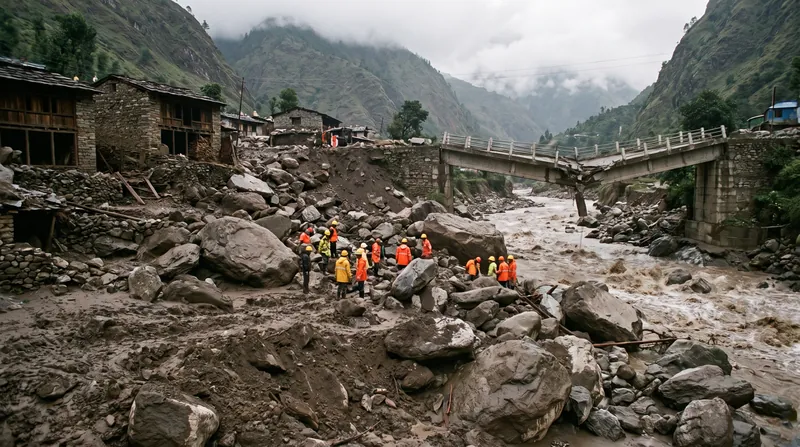
The collapsing mass plummeted to the valley floor, where the grinding friction of the descent instantly liquefied much of the ice. This combined with the rock and sediment to form a debris flow that accelerated to extreme speeds. The resulting flood wave obliterated towns, bridges, and hydroelectric infrastructure across more than 20 miles of the narrow river valleys.[2][5][6]
While the WWA study definitively links the slope's vulnerability to global warming, it also highlights the complexity of mountain geophysics. The weeks before the collapse were unusually warm, accelerating immediate melting. Additionally, researchers noted that changes in precipitation patterns have added excess water volume to the high-altitude system.[1][2][4]
Scientists also point to the lingering effects of the magnitude 7.8 earthquake that struck Nepal in April 2015. The seismic shaking from that event likely fractured the Langtang Lirung bedrock years before the collapse, preconditioning the slope for failure. However, researchers emphasize that without the subsequent permafrost thaw and glacial retreat, the mountain would have been far less likely to disintegrate so catastrophically.[1][2][4][5]
The disaster leaves over 5,000 people still missing and has caused billions of dollars in economic damages across the region. For communities nestled in narrow Himalayan river valleys, the findings confirm that climate change is no longer just altering weather patterns, but fundamentally transforming the geological stability of the mountains above them.[1][5]
Sources
- [1]WSLS 10 — Climate change made deadly Nepal glacier and rock collapse more likely, according to analysis Read on WSLS 10 →
- [2]Ratopati — Scientists Conclude Devastating Flood Not Caused by Single Event Read on Ratopati →
- [3]Deccan Chronicle — Climate Change Helped Cause Nepal Glacier Collapse, Scientists Say Read on Deccan Chronicle →
- [4]Phys.org — Climate change contributing to permafrost thawing and glacial thinning Read on Phys.org →
- [5]PBS NewsHour — Climate change made deadly Nepal glacier and rock collapse more likely, analysis finds Read on PBS NewsHour →
- [6]Factlen Editorial Team — Synthesis by Factlen editorial team Read on Factlen Editorial Team →
Charts, maps and images
Timeline
September 2026
Climate Change Intensified Himalayan Slope Instability That Caused Deadly Nepal Floods
AIDeath Toll Passes 1,300 in Nepal as Himalayan Glacier Collapse Exposes Flaws in Border Early Warning Systems
AI