
US Army Declares First Dark Eagle Hypersonic Weapon Battery Fully Fielded
The United States Army has officially fielded its first Long-Range Hypersonic Weapon battery, closing a critical development gap after years of testing delays. The deployment provides ground forces with a conventional boost-glide system capable of striking high-value targets at speeds exceeding Mach 5.
By Hunter Cole

Share this story
The United States Army has officially transitioned its first Long-Range Hypersonic Weapon battery from a developmental prototype to a fully fielded combat system. The milestone marks the service's formal entry into the hypersonic strike domain after a protracted testing phase.[1][2]
Army acquisition officials confirmed the deployment this week, noting that the Dark Eagle system is now ready for global operations. The announcement concludes a fielding process that originally targeted completion in late 2023 but was extended to resolve critical subsystem integration issues.[1][8]
While the exact timeline of the final handover remains classified, a senior official acknowledged the battery has achieved its fully fielded status. The declaration means the unit possesses all necessary hardware, software, and trained personnel to execute combat launches if directed.[1][7]
The Dark Eagle system provides ground commanders with a conventional, prompt-strike capability designed to defeat high-value, time-critical targets. By flying at speeds exceeding Mach 5 and maneuvering unpredictably in the upper atmosphere, the weapon bypasses traditional ballistic missile defense architectures.[3][4]
This deployment represents a structural shift in how the Army plans to operate in contested theaters, particularly the Indo-Pacific. Ground-launched hypersonic missiles introduce a highly survivable node into the joint force's long-range precision fires portfolio.[2][6]
Overcoming Development Hurdles
The path to fielding Dark Eagle required the Army to navigate a series of complex engineering challenges that repeatedly delayed the program's initial operational capability. Early flight tests exposed vulnerabilities in the missile's automated pre-flight checks and launcher integration.[1][8]
Throughout 2023, the service was forced to scrub multiple scheduled test launches at the Cape Canaveral Space Force Station. Engineers traced the anomalies to the battery's ground support equipment rather than the hypersonic glide body itself, prompting a comprehensive redesign of the launch sequence.[4][6]
The Army and its industry partners spent the subsequent two years refining the software interface between the Transporter Erector Launcher and the missile canister. Subsequent end-to-end tests validated these corrections, demonstrating the system's ability to receive targeting data and execute a launch command under operational conditions.[2][7]
The exact date of the final equipment handover remains classified. "Though the three-star would not share when the first battery was fully fielded," the Breaking Defense report noted, "the news comes after the program has faced years of delays."[1]
The 5th Battalion, 3rd Field Artillery Regiment, stationed at Joint Base Lewis-McChord in Washington state, has served as the experimental unit for the system since 2021. Soldiers from the battalion have spent years conducting dry runs and developing the tactical doctrine that will govern Dark Eagle operations.[3][5]
System Architecture and Capabilities
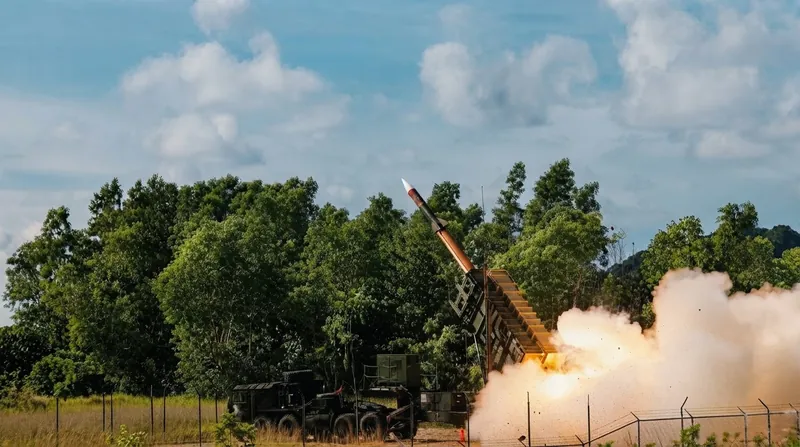
Dark Eagle operates as a boost-glide weapon, a distinct class of hypersonic technology that relies on a large rocket motor to reach optimal altitude and velocity. Once the booster is spent, it releases an unpowered glide vehicle that surfs the upper atmosphere toward its target.[2][4]
The system is built around the Common Hypersonic Glide Body, a joint development effort managed by the United States Navy. While the Navy intends to deploy the glide body on Zumwalt-class destroyers and Virginia-class submarines, the Army adapted it for mobile ground launch.[3][6]
A standard Dark Eagle battery consists of four Transporter Erector Launchers mounted on modified heavy expanded mobility tactical trucks. Each launcher carries two missile canisters, giving a single battery a total payload of eight ready-to-fire hypersonic weapons.[4][5]
The battery is commanded from a Battery Operations Center, which integrates directly into the Army's Advanced Field Artillery Tactical Data System. This network connectivity allows the unit to receive targeting coordinates from joint sensors across the battlespace, including satellites and forward-deployed radar.[2][8]
Unclassified Army documents indicate the weapon has an operational range exceeding 1,725 miles, or roughly 2,775 kilometers. This standoff distance allows the battery to hold adversarial command nodes and air defense radars at risk while remaining safely outside the range of most retaliatory tactical fires.[3][7]
Strategic Implications in the Pacific
The fielding of Dark Eagle directly addresses a capability gap that United States Indo-Pacific Command has highlighted in its annual posture assessments. For years, regional commanders have requested land-based, survivable strike assets to counter the dense anti-access and area-denial networks deployed by near-peer competitors.[1][6]
China has operated its own ground-launched hypersonic boost-glide vehicle, the DF-17, since 2019, while Russia has deployed the air-launched Kinzhal and silo-based Avangard systems. The operational status of Dark Eagle provides the Pentagon with a symmetrical conventional deterrent in the theater.[3][4]
Ground-launched systems offer distinct tactical advantages over air- or sea-launched alternatives. A mobile battery can disperse across remote island chains, utilizing natural terrain for camouflage and frequently relocating to complicate adversarial targeting cycles.[2][5]
The Army's Multi-Domain Task Forces are expected to serve as the primary organizational structure for these hypersonic batteries. These specialized formations are designed to penetrate enemy defensive bubbles, creating localized windows of superiority that allow follow-on naval and air forces to operate freely.[6][8]
Deploying these batteries to allied nations in the Pacific will require complex diplomatic negotiations, as host countries must weigh the deterrence value against the risk of hosting high-priority military targets. The system's transportability via C-17 cargo aircraft allows for rapid expeditionary deployment during a crisis without requiring permanent forward basing.[3][7]
Future Procurement and Scaling
With the first battery now fully fielded, the Army's Rapid Capabilities and Critical Technologies Office is shifting its focus toward scaling production and reducing unit costs. Establishing a robust domestic supply chain for high-temperature materials and precision guidance components remains a primary objective.[1][2]
The defense industrial base has historically struggled to produce hypersonic components at scale, relying heavily on specialized manufacturing processes that are difficult to automate. The transition from low-rate initial production to sustained procurement will test the capacity of prime contractors Lockheed Martin and Dynetics.[4][8]
Funding for subsequent batteries will compete with other modernization priorities within the Army's precision fires portfolio, including the Precision Strike Missile and the Typhon mid-range capability. Service leaders must balance the unique capabilities of Dark Eagle against its significantly higher cost per round.[5][6]
The joint nature of the Common Hypersonic Glide Body program provides some economies of scale, as the Army and Navy share the development and production costs of the core vehicle. However, the distinct launch platforms require separate testing and integration pipelines, maintaining a high baseline cost for both services.[3][7]
As the 5th Battalion, 3rd Field Artillery Regiment integrates the system into routine training cycles, the Army will gather critical data on the logistical footprint and maintenance requirements of hypersonic weapons. These operational lessons will inform the structure and deployment doctrine of future batteries as the program matures.[1][8]
The fielding declaration also triggers a shift in how the Army manages the weapon's lifecycle, moving responsibility from the rapid prototyping office to a traditional program executive office. This bureaucratic transition signifies that Dark Eagle is no longer an experimental project, but a permanent fixture in the service's arsenal.[2][4]
This bureaucratic transition signifies that Dark Eagle is no longer an experimental project, but a permanent fixture in the service's arsenal.
Ultimately, the success of the Dark Eagle program will be measured not just by its flight performance, but by its ability to integrate seamlessly into the broader joint targeting architecture. The weapon's speed is only tactically useful if the sensor-to-shooter network can identify and transmit target coordinates before the operational window closes.[6][7]
Key points
- The US Army has officially fielded its first Dark Eagle Long-Range Hypersonic Weapon battery, concluding a development phase that faced years of delays.
- The system utilizes a boost-glide vehicle capable of speeds exceeding Mach 5 and an operational range of more than 1,725 miles.
- A standard battery consists of four mobile launchers carrying a total of eight missiles, commanded through an integrated Battery Operations Center.
- The deployment provides US Indo-Pacific Command with a survivable, ground-based conventional deterrent to counter adversarial anti-access networks.
What we don’t know
- The exact date the final hardware was handed over to the 5th Battalion, 3rd Field Artillery Regiment.
- Which allied nations in the Indo-Pacific have agreed to host rotational deployments of the Dark Eagle system.
- The finalized unit cost per missile as the program transitions from prototyping to low-rate initial production.
How we got here
2019
The US Army and Navy initiate the joint Common Hypersonic Glide Body program to accelerate development.
March 2021
The 5th Battalion, 3rd Field Artillery Regiment receives its initial training equipment and inert canisters.
2023
Multiple scheduled test launches are scrubbed due to anomalies in the battery's ground support equipment.
November 2026
Army acquisition officials declare the first Dark Eagle battery fully fielded and ready for deployment.
- US Military Planners
- Commanders view ground-launched hypersonics as essential for penetrating adversarial defensive networks in the Pacific.
- Defense Industry Analysts
- Procurement experts emphasize the manufacturing bottlenecks that could limit the system's scale and drive up unit costs.
- Geopolitical Observers
- International analysts focus on how the deployment alters the conventional deterrence balance against near-peer competitors.
Perspectives this story doesn't cover
- Local populations in potential Pacific host nations
- Arms control and non-proliferation advocates
Sources
Source coverage
8 outlets
3 viewpoints surfaced








- [1]Breaking DefenseUS Military Planners
First Dark Eagle hypersonic battery ‘fully fielded,’ Lozano says
Read on Breaking Defense → - [2]Army RecognitionDefense Industry Analysts
US Army Declares First Dark Eagle Hypersonic Missile Battery Ready for Global Deployment
Read on Army Recognition → - [3]Defence BlogDefense Industry Analysts
U.S. Army says first Dark Eagle hypersonic battery is ready
Read on Defence Blog → - [4]The EurAsian TimesGeopolitical Observers
First U.S. Long-Range Hypersonic Weapon Is Now “Fully Fielded” — Dark Eagle Ready for Global Deployment
Read on The EurAsian Times → - [5]MilitarnyiGeopolitical Observers
U.S. Army Deploys First Battery of Dark Eagle Hypersonic Missiles
Read on Militarnyi → - [6]APAGeopolitical Observers
US Army officially fields first hypersonic missile battery
Read on APA → - [7]Defense War RoomUS Military Planners
US Army Fields First Dark Eagle Hypersonic Battery Three Years Late, Breaking Defense Reports
Read on Defense War Room → - [8]MLQ.aiUS Military Planners
Army's first Dark Eagle hypersonic missile battery is fully fielded, acquisition chief says
Read on MLQ.ai →
More in Defense & Security
See all →Defense Procurement
US Navy Awards Raytheon $24.4 Billion Contract to Quadruple Standard Missile-6 Production
7 sources

Hypersonic Weapons
South Korea Conducts First Flight Test of Domestically Developed Hypersonic Glide Vehicle
5 sources

Autonomous Aviation
Turkey Inducts Baykar Kizilelma Uncrewed Jet Fighter Into Military Service
5 sources

Naval Modernization
China Nears Completion of Fourth Aircraft Carrier Featuring Nuclear Propulsion
5 sources

Comments
Every angle. Every day.
Get Defense & Security stories with full source coverage and perspective breakdowns, free every day.