
The Architecture of Electric Propulsion: How Hall-Effect Thrusters Enable Deep Space Transit
By trading immediate thrust for extreme propellant efficiency, Hall-effect thrusters have fundamentally altered the economics of satellite station-keeping and deep space exploration. This explainer breaks down the physics of ionizing noble gases to achieve specific impulses impossible with chemical rockets.
By Hao Li

Share this story
Hall-effect thrusters move spacecraft not by burning fuel, but by using electricity to accelerate charged atoms out of an exhaust nozzle at extreme velocities. They produce very little thrust at any given moment—often equivalent to the weight of a piece of paper resting on a hand—but they can fire continuously for years. By trading immediate power for extreme propellant efficiency, these systems ultimately achieve terminal speeds impossible for traditional chemical rockets.[1]
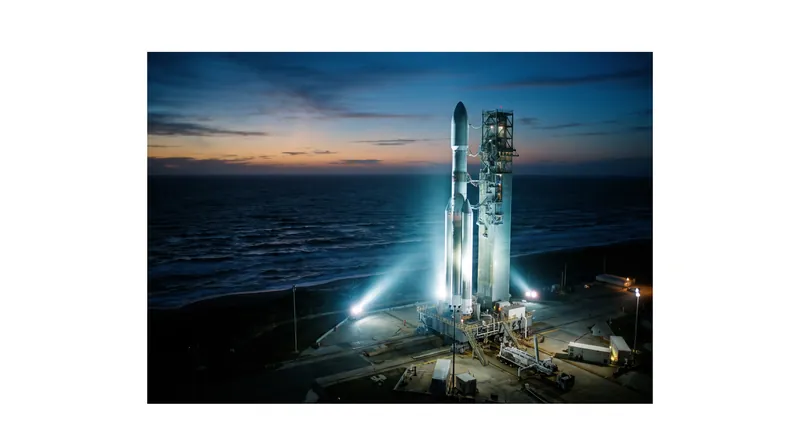
The fundamental bottleneck of space transportation is the rocket equation, which dictates that carrying more fuel requires even more fuel to lift that initial mass. Chemical rockets, which rely on the explosive combustion of propellants like liquid hydrogen and oxygen, are physically capped by the energy density of those chemical bonds. They provide massive immediate thrust to escape Earth's gravity, but they burn through their propellant supply in minutes.[1]
Once a spacecraft is in the vacuum of orbit, however, immediate thrust is no longer a strict requirement. This is where electric propulsion, and specifically the Hall-effect thruster, changes the architectural calculus of spaceflight. Instead of relying on chemical energy, these engines use electrical power—harvested from solar panels or generated by nuclear systems—to ionize a noble gas and accelerate it electromagnetically.
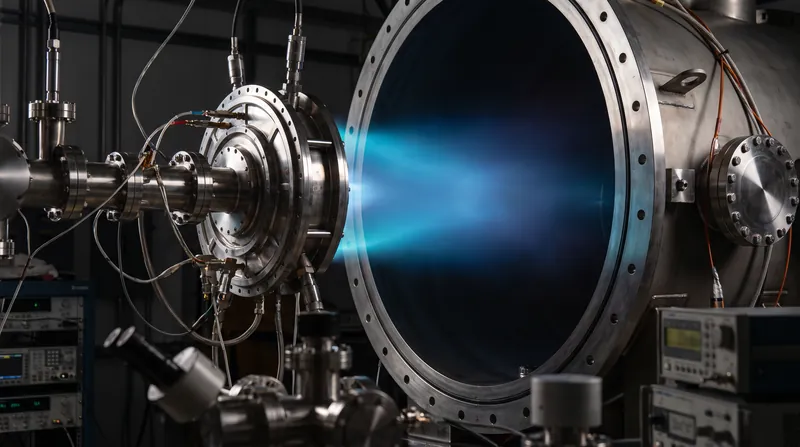
The mechanism begins in a circular channel at the base of the thruster. A cathode emits electrons, while a magnetic field traps them in a continuous radial loop inside the channel. When a neutral propellant gas, traditionally xenon, is injected into this ring of trapped electrons, high-speed collisions strip electrons from the xenon atoms, turning them into positively charged ions.[1][2]
Once ionized, the xenon atoms are subjected to a powerful electric field generated between the channel and the external cathode. Because the ions are positively charged, this field accelerates them out of the thruster at velocities exceeding 15 to 30 kilometers per second—roughly ten times faster than the exhaust velocity of the most advanced chemical rockets.
This exhaust velocity translates directly to specific impulse, the standard metric for propellant efficiency. While the best chemical engines peak at a specific impulse of roughly 450 seconds, modern Hall-effect thrusters routinely operate between 1,500 and 3,000 seconds. This means they extract significantly more momentum from every kilogram of propellant they carry, fundamentally altering the mass constraints of mission planning.[1][2]
The trade-off for this extreme efficiency is thrust. Because the mass of the ionized gas being expelled is so small, the physical push exerted on the spacecraft is minuscule. A typical commercial Hall thruster generates less than a Newton of thrust. If activated on Earth's surface, it could not lift its own weight against gravity.
In the frictionless environment of space, however, continuous micro-thrust accumulates into massive velocity changes over time. A chemical rocket might execute a five-minute burn to alter its trajectory, coasting for the rest of the journey. A spacecraft equipped with a Hall-effect thruster will fire its engine continuously for months or even years, slowly but relentlessly accelerating to speeds that would require an impossible amount of chemical fuel.[1][3]
This architectural shift has profound implications for commercial satellite constellations. Historically, communications satellites required heavy tanks of toxic hydrazine propellant just to maintain their orbital positions over a 15-year lifespan. By transitioning to Hall-effect thrusters, manufacturers have slashed propellant mass by up to 80 percent.
This architectural shift has profound implications for commercial satellite constellations.
That mass reduction cascades through the entire launch system. A lighter satellite can be launched on a smaller, cheaper rocket, or multiple satellites can be stacked onto a single heavy-lift vehicle. The rapid deployment of mega-constellations in low Earth orbit relies heavily on electric propulsion; without the mass savings of Hall thrusters, launching thousands of satellites would be economically unfeasible.[2][3]
For deep space exploration, the technology enables missions that were previously constrained by orbital mechanics. NASA's Psyche mission, currently en route to a metal-rich asteroid, relies on Hall-effect thrusters to spiral outward through the solar system. A chemical propulsion system for the same mission profile would have required a launch vehicle significantly larger than any currently in operation.[1]
The primary limitation of electric propulsion is its absolute dependence on electrical power. A Hall thruster's performance scales directly with the kilowatts fed into it. In the inner solar system, large solar arrays provide abundant energy. But as a spacecraft travels outward toward Jupiter and beyond, solar irradiance drops precipitously, starving the thrusters of power.[2]
To push electric propulsion deeper into the solar system, aerospace engineers are increasingly looking toward nuclear fission reactors. A space-rated reactor could provide the continuous megawatts of power necessary to drive scaled-up Hall thrusters, decoupling the propulsion system from solar proximity and enabling rapid transit to the outer planets.[2][3]
Material degradation also limits operational lifespans. The high-speed ions that provide thrust also slowly erode the walls of the thruster channel through sputtering. While magnetic shielding techniques have dramatically reduced this wear, extending thruster life from thousands to tens of thousands of hours, channel erosion remains a hard engineering constraint for multi-decade missions.[1][2]
Ultimately, the Hall-effect thruster represents a maturation of space transportation infrastructure. By decoupling the energy source from the reaction mass, aerospace engineers have bypassed the chemical limits of traditional rocketry, establishing a new baseline for how humanity navigates the vacuum of space.[3]
Different angles
Deep Space Mission Planners
Value the extreme delta-v capabilities for missions to asteroids and outer planets, accepting the longer transit times as a necessary trade-off.
For scientists designing missions to the asteroid belt or the outer planets, the primary constraint is the sheer amount of velocity change (delta-v) required to match orbits with distant bodies. Chemical rockets simply cannot carry enough fuel to perform these maneuvers without relying on complex, time-consuming gravity assists from other planets. Mission planners view electric propulsion as an enabling technology that opens up direct trajectories to targets that were previously unreachable, accepting that the low thrust means the spacecraft will take months or years to slowly spiral outward to its destination.
Commercial Satellite Operators
Focus on the mass savings for station-keeping, which allows for cheaper launches or heavier communication payloads.
In the commercial sector, the calculus is entirely economic. Every kilogram of propellant required to keep a satellite in its proper orbit is a kilogram that cannot be used for revenue-generating transponders or sensors. By switching to Hall-effect thrusters, operators can drastically reduce the launch weight of their satellites. This allows them to either launch on smaller, less expensive rockets, or to pack multiple satellites onto a single launch vehicle, a strategy that has been fundamental to the economic viability of modern low Earth orbit mega-constellations.
Advanced Propulsion Researchers
Argue that solar-electric propulsion faces hard limits in the outer solar system, pushing for nuclear fission to power scaled-up thrusters.
While Hall-effect thrusters are highly efficient, researchers focused on the next generation of spaceflight point out that their reliance on solar power creates a hard boundary. Beyond the orbit of Mars, sunlight becomes too weak to generate the kilowatts needed to drive the thrusters effectively. These engineers advocate for pairing electric propulsion with space-rated nuclear fission reactors, which could provide continuous, high-megawatt power regardless of the spacecraft's distance from the sun, potentially reducing transit times to the outer planets by years.
- Deep Space Mission Planners
- Value the extreme delta-v capabilities for missions to asteroids and outer planets, accepting the longer transit times as a necessary trade-off.
- Commercial Satellite Operators
- Focus on the mass savings for station-keeping, which allows for cheaper launches or heavier communication payloads.
- Advanced Propulsion Researchers
- Argue that solar-electric propulsion faces hard limits in the outer solar system, pushing for nuclear fission to power scaled-up thrusters.
Sources
Source coverage
3 outlets
3 viewpoints surfaced



- [1]NASA Glenn Research CenterDeep Space Mission Planners
Hall Effect Thrusters: Electric Propulsion for Spacecraft
Read on NASA Glenn Research Center → - [2]Journal of Propulsion and PowerAdvanced Propulsion Researchers
Scaling Laws and Performance Limits for Hall-Effect Thrusters
Read on Journal of Propulsion and Power → - [3]Factlen Editorial Team
Synthesis by Factlen editorial team
Read on Factlen Editorial Team →
More in Transportation
See all →Spacecraft Engineering
Starship's Ceramic Heat Shield and Belly Flop Maneuver Enable Reusable Re-entry
5 sources
Space Boundary
The 100-Kilometer Altitude Where Aerodynamic Lift Becomes Impractical for Sustained Flight
5 sources
Orbital Infrastructure
EU Announces Plan to Increase Satellite Launches Sixfold by 2034 to Challenge Starlink Dominance
3 sources
Orbital Mechanics
How Launch Azimuth and Orbital Inclination Determine the Instantaneous Launch Window
6 sources
Comments
Every angle. Every day.
Get Transportation stories with full source coverage and perspective breakdowns, free every day.