
The 2.43-Meter and 2.24-Meter Heights That Dictate the Vertical Geometry of Global Volleyball
The 19-centimeter difference between the men's and women's standard net heights shapes the biomechanics of the attack, the block, and the defensive floor coverage across every level of the sport.

- International Regulators
- Governing bodies that establish and enforce the absolute standard to ensure global competitive uniformity.
- Developmental Coaches
- Educators who rely on scaled net heights to teach proper biomechanics to youth athletes without forcing compensatory errors.
- Equipment Manufacturers
- Engineers tasked with designing pole and winch systems capable of maintaining exact tension and height across a 9.5-meter span.
Perspectives this story doesn't cover
- Professional Athletes
- Facility Managers
Before the first whistle of any sanctioned match, the first referee steps down from the stand, pulls a weighted metal chain from their pocket, and walks to the exact center of the court. They hook the chain over the top band of the net, letting the weight settle against the hardwood. For a senior men's match, that chain must pull taut at exactly 2.43 meters (7 feet, 11 5/8 inches). For a women's match, the metal stops at 2.24 meters (7 feet, 4 1/8 inches). This pre-match ritual establishes the vertical geometry that will dictate every attack, block, and defensive rotation for the next two hours.[1]
The net is not merely a barrier; it is the defining constraint of the sport's physics. The 19-centimeter differential between the men's and women's heights is the foundational rule upon which the entire tactical framework of global volleyball is built. It determines the trajectory of a jump serve, the required apex of a middle blocker's leap, and the exact angle at which an outside hitter can drive the ball into the opponent's floor.[4]
According to the newly ratified FIVB Official Volleyball Rules 2025-2028, the standard is absolute. "The height of the net is measured from the centre of the playing court," the governing document states in Rule 2.1.1. The precision required leaves almost no room for structural variance, forcing facility managers and equipment engineers to maintain extreme tension across the span of the court.[1]
However, the rulebook acknowledges the physical reality of tensioning a 9.5-meter-long cable across two steel poles. Rule 2.1.2 explicitly permits a slight sag, noting that "the two ends (over the side lines) must be at the same height from the playing surface and may not exceed the official height by more than 2 cm." If the center is exactly 2.43 meters, the tape at the antennas can sit no higher than 2.45 meters.[1]
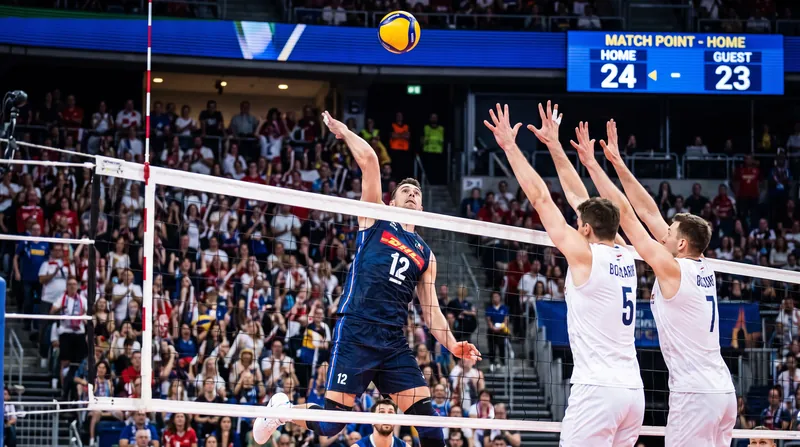
The 2.43-meter men's standard demands extraordinary biomechanical output. To execute a sharp-angled attack over a net that sits nearly eight feet off the floor, an elite male outside hitter must routinely reach contact points exceeding 3.50 meters (11 feet, 5 inches). The net height forces the offensive system to prioritize pure vertical explosion and rapid arm-swing mechanics to beat the block before gravity pulls the attacker back below the tape.[5]
In the women's game, the 2.24-meter height creates a different tactical ecosystem. While the net is lower, the relative reach of the blockers above the tape remains highly proportional to the men's game. The 19-centimeter reduction preserves the fundamental mechanics of the attack while accounting for average physiological differences in standing reach and vertical leap.[4]
This specific height differential is why the women's game often features longer, more complex rallies. Because the attack angles are slightly flatter relative to the court dimensions, floor defenders have a fraction of a second longer to read the trajectory and execute a dig. The 2.24-meter net turns women's volleyball into a high-speed chess match of block-touch deflections and relentless transition offense.[4][6]
This specific height differential is why the women's game often features longer, more complex rallies.
The transition from indoor hardwood to deep sand does not alter the vertical stakes. The FIVB Official Beach Volleyball Rules 2025-2028 mandate the exact same net heights: 2.43 meters for men and 2.24 meters for women. The dimensions remain rigid even as the playing surface completely changes the athletic equation.[2]
Maintaining that height on a shifting surface introduces severe athletic demands. Beach players must generate the same vertical clearance to attack the ball, but they must do so without the kinetic return of a rigid floor. The sand absorbs energy, meaning a beach attacker must rely more on timing, core strength, and shot placement rather than sheer bounce to defeat the 2.43-meter or 2.24-meter barrier.[2]
Below the senior international level, the governing bodies implement a strict scaling system to ensure developmental players learn proper mechanics. The USA Volleyball (USAV) 2025-2027 Indoor Rules Book outlines a precise step-down structure for youth competition, ensuring that a 12-year-old is not forced to alter their arm swing to clear an adult net.[3]
For boys competing in the 14-and-under age division, the USAV lowers the net to 2.24 meters—matching the adult women's standard. This allows young male athletes to develop the correct approach footwork and mid-air body control before they hit their primary growth spurts and transition to the 2.43-meter senior height.[3]
The scaling continues downward for younger age groups. In the 12-and-under divisions, the net drops to 2.13 meters (7 feet) for both boys and girls. For the youngest competitors in the 10-and-under brackets, the height is set at 1.98 meters (6 feet, 6 inches).[3]
The goal of these age-group modifications is to preserve the integrity of the attack. If a net is too high for a given age group, players develop compensatory habits—pushing the ball upward rather than snapping their wrist to drive it downward. Equipment manufacturers like Sports Imports design their pole systems specifically to accommodate these rapid, precise adjustments during multi-age club tournaments.[5]
The engineering required to maintain these precise heights across different facilities is substantial. Modern volleyball poles utilize internal winch systems and Kevlar-core top ropes to sustain hundreds of pounds of tension. The Western Australian Department of Creative Industries, Tourism and Sport's dimension guide emphasizes that the posts themselves must be placed 0.50 to 1.00 meter outside the sidelines to prevent the tensioning hardware from interfering with play.[6]
Every millimeter matters when the margins between a kill and an error are so thin. A net that sags by three centimeters in the middle can fundamentally alter the effectiveness of a jump serve, allowing a flatter trajectory that gives the receiving team less time to react. This is why the referee's pre-match measurement with the metal chain is not a formality, but a strict regulatory necessity.[1][7]
As the sport evolves with faster offensive systems and more athletic front-row players, the 2.43-meter and 2.24-meter standards remain the immovable anchors of the game. They are the exact altitudes where power meets precision, defining the airspace where every match is ultimately contested and decided.[7]
Key points
- The standard FIVB net height is 2.43 meters for senior men and 2.24 meters for senior women.
- The 19-centimeter difference accounts for physiological variations in vertical reach, preserving the sport's tactical geometry.
- The net is measured at the exact center of the court, with a maximum allowance of 2 centimeters of extra height at the sidelines.
- Beach volleyball utilizes the exact same net heights as the indoor game, despite the energy-absorbing sand surface.
- Youth leagues scale the net height down—reaching 1.98 meters for 10-and-under divisions—to ensure players develop proper attacking mechanics.
Key terms
- Antenna
- A flexible rod fastened to the net directly above the sideline, marking the vertical boundaries of the crossing space.
- Top Band
- The white canvas strip folded over the top of the net, through which the tensioning cable runs.
- Winch System
- The mechanical crank housed inside the volleyball post used to pull the net cable to the required tension.
- Attack Angle
- The downward trajectory a hitter creates when striking the ball over the net toward the opponent's floor.
Frequently asked
What is the official height of a men's volleyball net?
The official height for a senior men's volleyball net is 2.43 meters, which translates to 7 feet, 11 5/8 inches.
What is the official height of a women's volleyball net?
The official height for a senior women's volleyball net is 2.24 meters, or 7 feet, 4 1/8 inches.
Is the net height different for beach volleyball?
No. The FIVB mandates the exact same net heights for beach volleyball as it does for indoor: 2.43 meters for men and 2.24 meters for women.
How much is the net allowed to sag in the middle?
The net is measured at the center of the court. The ends of the net over the sidelines can be up to 2 centimeters higher than the center, but no more.
Do children play on the same height net?
No. Organizations like USA Volleyball scale the net down for youth divisions, dropping as low as 1.98 meters (6 feet, 6 inches) for the 10-and-under age group to promote proper attacking mechanics.
Sources
Source coverage
7 outlets
3 viewpoints surfaced






- [1]FIVBInternational Regulators
OFFICIAL VOLLEYBALL RULES 2025-2028
Read on FIVB → - [2]FIVBInternational Regulators
Official Beach Volleyball Rules 2025-2028
Read on FIVB → - [3]USA VolleyballInternational Regulators
2025-2027 USAV Indoor Rules Book
Read on USA Volleyball → - [4]Volleyballmag.comDevelopmental Coaches
Volleyball net height by age, gender and level of play
Read on Volleyballmag.com → - [5]Sports ImportsEquipment Manufacturers
Regulation Volleyball Net Heights Guide
Read on Sports Imports → - [6]CITS - Department of Creative Industries, Tourism and SportDevelopmental Coaches
Volleyball
Read on CITS - Department of Creative Industries, Tourism and Sport → - [7]Factlen Editorial Team
Synthesis by Factlen editorial team
Read on Factlen Editorial Team →
Comments

More in Sports
See all →Scrum Mechanics
The 'Crouch, Bind, Set' Sequence and the 1.5-Meter Push Limit That Define a Legal Rugby Scrum Engagement
5 sources

African Championship
Cameroon and Tunisia Set Up African Championship Final With LA 2028 Olympic Berth on the Line
5 sources
Power ranking
AFLW Power Rankings: Melbourne Seizes Top Spot as Hawthorn Shatters the 'Invincibles'
5 sources

Standings
Glasgow 2026 Netball Standings: Pool Draw Sets the Championship Picture for the Commonwealth Games
2 sources
Every angle. Every day.
Get Sports stories with full source coverage and perspective breakdowns delivered to your inbox.