
South Korea Launches Container Ship to Test Arctic Commercial Route, Signaling Major Global Shipping Shift
South Korea has dispatched its first commercial container ship to Europe via the Northern Sea Route, seeking an alternative to Middle Eastern shipping lanes while drawing concern from Western allies over required Russian cooperation.

The receding ice of the Arctic is frequently framed strictly as an ecological crisis, but for the world's largest export economies, it is rapidly functioning as a logistical lifeline. On Saturday, South Korea formally dispatched its first commercial container ship bound for Europe via the Northern Sea Route, pivoting away from the volatile Middle East to test the viability of a polar corridor.
The departure marks a significant milestone in global shipping, signaling that major industrial powers are increasingly willing to navigate both severe environmental concerns and intense diplomatic friction with Western allies in order to secure faster, alternative supply chains.[1][3]
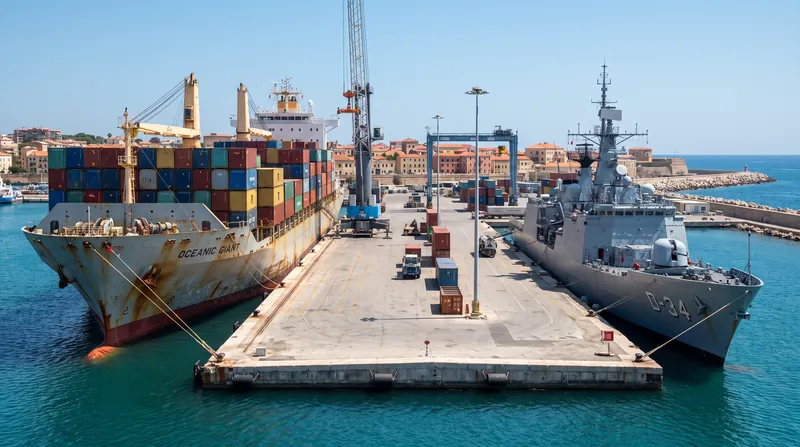
The PanStar Acro departed Busan New Port under the observation of government officials, carrying automotive parts, chemical products, and empty containers on a state-backed trial voyage to Felixstowe in the United Kingdom, Rotterdam in the Netherlands, and Gdansk in Poland.
The 40-to-45-day journey will take the 2,758-TEU vessel north along Russia's Kamchatka peninsula, across the Bering Sea, and through the Northern Sea Route before descending into European waters. The timing of the voyage is highly specific; operators scheduled the departure for late August to ensure the ship traverses the Arctic in September, the brief window when polar sea ice reaches its annual minimum and allows for safer navigation.[2][7]
This structural shift in maritime logistics is being driven by compounding international crises. Following US-Israeli strikes on Iran in February 2026, the ensuing regional conflict has severely disrupted traditional maritime traffic through the Red Sea and the Suez Canal, forcing shipping companies to absorb massive delays and rerouting costs.
South Korea's Oceans Ministry calculates that utilizing the Arctic route cuts the journey to Europe by approximately 7,000 kilometers—or 4,300 miles—and shaves up to 10 days off the standard transit time, significantly reducing fuel consumption and bypassing the geopolitical hazards of the Middle East entirely.[3][4]
South Korean officials are openly embracing the shift. 'The Arctic route is bound to become an alternative to Middle Eastern shipping lanes,' stated South Korean Vice Oceans Minister Nam Jae-hon, noting that escalating geopolitical risks and steady technological advances have made the northern corridor increasingly competitive for commercial freight.
President Lee Jae Myung has elevated Arctic shipping to a national priority, aiming to transform the southeastern port of Busan into a premier global maritime hub and establish the polar passage as a regular, normalized trade route by the end of the decade.[1][5]
However, executing this logistical pivot requires navigating a geopolitical minefield. The Northern Sea Route runs predominantly through Russia's exclusive economic zone along its vast northern coastline, requiring foreign vessels to secure transit permits from Moscow and coordinate closely with Russian maritime authorities.
Furthermore, ships attempting the passage must often rely on Russian nuclear-powered icebreakers if they encounter unexpectedly heavy ice flows, creating a direct operational dependency on a state that the West is actively attempting to isolate. Seoul has already consulted with Moscow regarding the journey, including contingency plans for potential ice entrapment, drawing immediate scrutiny from its traditional security partners.[1][5]
Western diplomats have expressed sharp disapproval of Seoul's initiative. European and American officials, intent on maintaining maximum economic pressure on Moscow over the ongoing war in Ukraine, have warned that the voyage undermines the broader sanctions regime and hands Russia a strategic victory by validating its control over a vital new trade artery.
'We want to isolate Russia, we don't want engagement with Russia,' one European diplomat stated anonymously, confirming that these concerns had been directly and forcefully communicated to South Korean authorities in the lead-up to the ship's departure. The diplomatic friction highlights the growing tension between allied security objectives and the economic imperatives of export-heavy nations.[1][6]
Shipping experts note that South Korea risks breaching international sanctions if the PanStar Acro requires direct assistance, towing, or financial transactions with sanctioned Russian maritime entities during the voyage. The legal ambiguity surrounding emergency services in Russian waters presents a significant liability for the operators.
Despite the vocal opposition from Western capitals, neither South Korea's Oceans Ministry nor Russia's Foreign Ministry have publicly commented on the specific diplomatic or financial arrangements facilitating the transit. The silence suggests a calculated gamble by Seoul, betting that the economic data gathered from the trial will ultimately outweigh the temporary diplomatic fallout with European partners who are themselves desperate for reliable supply chains.[1][6]
The environmental stakes of the new route are equally severe. While the passage is currently only navigable by standard container vessels during the late summer months, scientists and environmental advocacy groups warn that increased commercial traffic will accelerate the warming of the region.
The introduction of heavy cargo ships brings the risk of black carbon emissions settling on the ice—which absorbs sunlight and hastens melting—as well as the persistent threat of chemical spills in an ecosystem entirely unequipped to handle industrial maritime disasters. Researchers note the bitter irony that global warming has enabled the route, and utilizing the route will only accelerate global warming.[5][7]
The PanStar Acro's departure is not an isolated incident, but part of a broader rush to claim the Arctic. The South Korean voyage follows closely behind the Chinese container ship Dubai Tower, which left the eastern port city of Ningbo for Europe earlier this month via the exact same polar route.
Traffic is already compounding; last year, 88 vessels made 103 transits through the Northern Sea Route, up from 43 transits in 2022, with the overwhelming majority originating from Russia and China. South Korea's entry into the space signals that US-aligned nations are no longer willing to cede the corridor entirely to geopolitical rivals.[3][4]
As South Korea joins China in actively testing the corridor, the Northern Sea Route is rapidly transitioning from a theoretical shortcut into a normalized secondary maritime transit corridor. The success or failure of the PanStar Acro's 45-day journey will likely determine how rapidly other Asian export powers move to integrate the Arctic into their permanent supply chain architecture.
If the vessel arrives in Europe on schedule and under budget, the economic pressure to bypass the Suez Canal will only intensify. For global trade, the voyage represents a definitive pivot, forcing nations to balance the immediate demands of maintaining cargo flow against the long-term costs of environmental degradation and diplomatic friction.[3][5]
Key points
- South Korea launched its first commercial container ship, the PanStar Acro, to Europe via the Arctic's Northern Sea Route.
- The 45-day voyage aims to test the route's viability as an alternative to Middle Eastern shipping lanes disrupted by conflict.
- The Arctic passage cuts the journey by roughly 7,000 kilometers and 10 days compared to the traditional Suez Canal route.
- Western diplomats have criticized the move, warning that required cooperation with Moscow undermines efforts to isolate Russia.
- South Korean Government & Industry
- Views the Arctic route as an essential logistical alternative to the volatile Middle East.
- Western Diplomats
- Argues that utilizing the route undermines efforts to isolate Russia financially and politically.
- Environmental Advocates
- Warns that commercializing the Arctic will accelerate the destruction of polar ecosystems.
Perspectives this story doesn't cover
- Russian Maritime Authorities
- European Port Operators
Sources
Source coverage
7 outlets
3 viewpoints surfaced







- [1]The Business TimesWestern Diplomats
South Korean container ship will test Arctic route to Europe amid Western disapproval
Read on The Business Times → - [2]InquirerSouth Korean Government & Industry
South Korea plans its first trial voyage through the Arctic this week
Read on Inquirer → - [3]The StarSouth Korean Government & Industry
South Korea to send first container ship through Arctic route
Read on The Star → - [4]Korea TimesSouth Korean Government & Industry
South Korea to send first container ship through Arctic route
Read on Korea Times → - [5]Yahoo NewsWestern Diplomats
South Korean container ship will test Arctic route to Europe amid Western concern
Read on Yahoo News → - [6]The PrintWestern Diplomats
South Korean container ship will test Arctic route to Europe amid Western concern
Read on The Print → - [7]Straits TimesEnvironmental Advocates
A South Korean container ship sets sail on Saturday for Europe via the Arctic
Read on Straits Times →
More in World
See all →Global Security
UN Global Risk Report Identifies Large-Scale War as Fastest-Rising Global Threat
7 sources
African Union Law
How the African Union's Principle of Non-Indifference Reconciles Intervention with State Sovereignty
8 sources
Baltic Security
NATO Jets Down Drone Over Lithuania as Russian Warship Fires on Danish Helicopter
4 sources
Tartus Naval Base
Russian Convoy Resupplies Syrian Coastal Facilities Under New Military Memorandum
4 sources
Comments
Every angle. Every day.
Get World stories with full source coverage and perspective breakdowns, free every day.