
Scientists Discover New Type of Matter: A Room-Temperature, Rewritable 3D Weave Crystal
Researchers have observed a three-dimensional woven fabric of electric domains spontaneously forming inside a ferroelectric crystal at room temperature. The intricate structure can be locally rewritten with a laser, opening new possibilities for advanced photonic memory.
By Harper Lane

In short
- Scientists observed a 3D woven domain fabric spontaneously forming in a KTN:Li crystal.
- The structure emerges at roughly 17°C as the material cools through a phase transition.
- A focused green laser can rewrite specific sections of the weave without erasing the whole pattern.
At exactly 17 degrees Celsius, a specially engineered crystal of potassium-tantalate-niobate containing lithium (KTN:Li) did something matter is not supposed to do.[1][2]
As the crystal cooled through its phase transition, its internal electric dipoles did not simply align into the parallel domains typical of ferroelectric materials.[1]
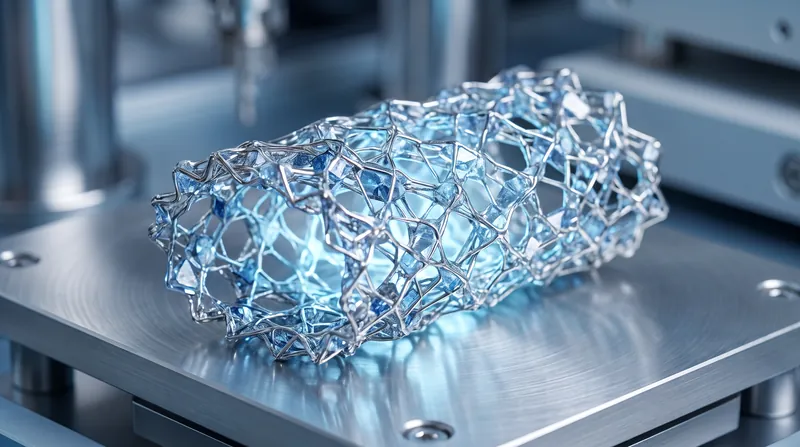
Instead, these tiny regions of positive and negative charge spontaneously arranged themselves into long strands that passed over and under each other, forming an intricate three-dimensional woven fabric.[1][2]
This phenomenon, detailed in a July 2026 paper in Light: Science & Applications, represents the first observation of a woven domain fabric emerging spontaneously inside a solid crystal.[1][2]
The evidence for this structure is robust, grounded in advanced imaging techniques. Researchers probed the crystal with polarized light and captured phase-contrast microscope images at varying depths, confirming that the interlaced pattern is genuinely three-dimensional, not merely a two-dimensional optical projection.[1][3]
The woven arrangement develops as a result of spontaneous symmetry breaking. At higher temperatures, the crystal exists in a more symmetric state. As it cools, the balance of internal forces shifts, allowing local electric polarization to emerge in this complex topological defect.[1]
The specific KTN:Li crystals used in the study were grown with periodic variations in their chemical composition, creating fine striation gratings. These variations influence the local electrical and optical properties, providing the necessary conditions for the woven fabric to form.[2]
Beyond its spontaneous formation, the woven structure exhibits a remarkable responsiveness to light. Researchers discovered that they could alter specific sections of the network using a tightly focused green laser.[1][2]
The laser light locally untangles the woven pattern, causing sections to disappear and reorganize without affecting the surrounding crystal. This site-by-site manipulation is driven by the focused beam modifying the material's local electrical and thermal conditions.[1]
The structure also possesses a unique form of memory and regeneration. If the crystal is heated above its transition temperature and then cooled again, the woven fabric returns.[2]
However, it does not return in its original configuration. Each thermal cycle generates an entirely new woven pattern, which then remains stable as long as the temperature is kept roughly constant.[2][3]
While the observations are clear, the underlying physics remain partially obscured. The exact mechanism by which competing interactions between polarization, composition, temperature, and light produce this specific elaborate structure is still an open question.[3]
The discovery suggests that matter is capable of generating forms of order far more intricate than the simple aligned domains traditionally used to describe crystals.
Researchers hypothesize that similar woven or linked topological structures might exist in other systems undergoing symmetry-breaking transitions, such as liquid crystals or quantum materials, but have simply gone unnoticed.[2]
For photonic engineers, the material offers a tantalizing glimpse into future technologies. The combination of a stable, self-organizing 3D structure and localized optical control is highly desirable for data storage.[1][3]
The braided domain structure acts as an extended topologically-protected defect with locked-in charged domain walls. These serve as activation points for the laser, introducing a new route to achieve solid-state photonic memory.[1]
Furthermore, the ability to repeatedly rewrite the fabric could inspire new approaches to reconfigurable optical devices and neuromorphic computing—hardware designed to process information in ways inspired by neural networks.[1][3]
Despite the excitement, these applications remain firmly in the realm of future potential. The current research is a small-scale laboratory study, and scaling this phenomenon into practical, room-temperature devices will require years of material optimization and engineering.[3]
Jargon, explained
- Ferroelectric crystal
- A material containing regions (domains) where electric charges are slightly separated, creating a preferred electrical orientation that can be switched by an electric field.
- Electric dipole
- A tiny region of positive and negative charge within a material.
- Spontaneous symmetry breaking
- A process where a system adopts a specific, organized state (like a woven pattern) even though the underlying physical laws remain symmetric.
- Topological defect
- A stable disruption or irregularity in the continuous order of a crystal's structure.
- Neuromorphic computing
- Computer hardware designed to process information in ways inspired by the structure and function of neural networks in the brain.
Competing readings
Materials Scientists
Focus on the fundamental physics of spontaneous symmetry breaking and the emergence of complex topological structures in solid crystals.
For materials scientists, the discovery challenges the traditional understanding of ferroelectric domains. Instead of simple parallel alignments or conventional domain walls, the dipoles in KTN:Li form an interconnected fabric. This spontaneous symmetry breaking suggests that matter can generate forms of order far more intricate than previously thought. Researchers are now questioning whether similar woven structures might exist in other systems, such as liquid crystals or superconductors, having gone unnoticed because conventional imaging methods often reduce 3D patterns to 2D projections.
Photonic Engineers
Emphasize the technological potential of the material for reconfigurable optical devices, high-density data storage, and neuromorphic computing.
From an engineering perspective, the material's responsiveness to light is its most exciting feature. The ability to use a visible laser to locally untangle and rewrite the woven pattern—without erasing the entire structure—provides a mechanism for site-by-site data manipulation. Engineers view this as a potential foundation for extended solid-state topologically-protected photonic memory. While practical applications are still distant, the concept of a crystal that naturally creates and repeatedly rewrites a 3D domain fabric could inspire new architectures for optical switching and neuromorphic computing hardware.
- Materials Scientists
- Focus on the fundamental physics of spontaneous symmetry breaking and the emergence of complex topological structures in solid crystals.
- Photonic Engineers
- Emphasize the technological potential of the material for reconfigurable optical devices, high-density data storage, and neuromorphic computing.
- Science Communicators
- Highlight the novelty of discovering a new state of matter and its broader implications for our understanding of physics.
Perspectives this story doesn't cover
- Commercial hardware manufacturers who would need to scale the material for practical computing
- Theoretical physicists focused on mathematical models of symmetry breaking
Sources
Source coverage
3 outlets
3 viewpoints surfaced



- [1]Light: Science & ApplicationsMaterials Scientists
Spontaneous formation and optical manipulation of a woven domain fabric in a ferroelectric crystal
Read on Light: Science & Applications → - [2]EurekAlertPhotonic Engineers
Never-before-seen woven structure that forms naturally inside a crystal discovered
Read on EurekAlert → - [3]Factlen Editorial TeamScience Communicators
Synthesis by Factlen editorial team
Read on Factlen Editorial Team →
More in Science
See all →Physical Chemistry
Endothermic Autoionization Shifts Pure Water's Neutral Baseline From pH 7.00 to 6.14 at 100°C
2 sources
Molecular Geometry
How Valence Electron Pair Repulsion Dictates the Three-Dimensional Shape of Molecules
5 sources
Green Hydrogen
AI-Directed Laboratory Discovers Iridium-Free Palladium Catalyst for Green Hydrogen Production
5 sources
Boron Allotropes
New Boron Allotrope Is 10 Million Times More Conductive and Flexible
5 sources
Comments
Every angle. Every day.
Get Science stories with full source coverage and perspective breakdowns, free every day.