
Quantum Fluid of Light Exhibits Simultaneous Crystal Order and Frictionless Flow at Room Temperature
Scientists have generated a bizarre quantum state known as a supersolid at room temperature by blending light and matter. The breakthrough eliminates the need for extreme cooling, paving the way for ultrafast optical computing.
By Sofia Matos

Share this story
A bizarre quantum state that allows matter to behave simultaneously as a rigid crystal and a frictionless liquid has been generated at room temperature for the first time. The breakthrough shatters a long-standing practical barrier in physics, proving that exotic quantum phenomena do not strictly require environments cooled to near absolute zero.[1][2]
The discovery, published in the journal Science Advances, centers on a phase of matter known as a supersolid. Until now, maintaining this delicate dual state required complex laser cooling systems and liquid helium to freeze atoms to a fraction of a degree above absolute zero.[1][5]
An international research team bypassed that thermal limit by abandoning atoms altogether. Instead, they built their supersolid out of exciton-polaritons—hybrid particles that blend the properties of light and matter inside a microscopic chamber.[3][4]
"Our liquid-crystal microcavities can operate even at temperatures approaching 60°C," said Professor Wiktor Piecek of Poland's Military University of Technology, whose group developed the structures used in the experiment. That thermal ceiling, roughly 140°F, sits far above the freezing conditions normally associated with quantum fluid dynamics.[1][5]
A contradictory state of matter
The concept of a supersolid challenges basic intuition about how physical materials behave in the macroscopic world. A standard crystal is defined by its rigid, periodic spatial order, while a liquid is characterized by its ability to flow, deform, and adapt to its container.[1][5]
Quantum mechanics, however, permits a state that merges both properties without contradiction. In a supersolid, the material retains the frictionless, zero-viscosity flow of a superfluid while spontaneously arranging its density into a repeating, crystal-like lattice.[3][5]
Physicists first predicted the theoretical existence of supersolids in the 1960s. For more than half a century, the concept remained an unproven mathematical curiosity, as the conditions required to test it were technologically out of reach.[5]
It was not until 2017 that researchers finally observed supersolidity in a laboratory. Those early experiments relied on ultracold atomic Bose-Einstein condensates, which required massive energy inputs to maintain temperatures hovering just above zero Kelvin.[3][5]
The extreme fragility of those ultracold systems severely limited their practical applications. Any slight introduction of ambient heat would immediately collapse the quantum state, making the technology impossible to scale for commercial or industrial use outside a laboratory.[1][2]
Swapping atoms for light
To bring the phenomenon into a room-temperature environment, the TopoLight consortium—comprising researchers from the University of Warsaw, the Military University of Technology, IBM Research Zurich, and the French National Centre for Scientific Research—took a radically different approach.[4][5]
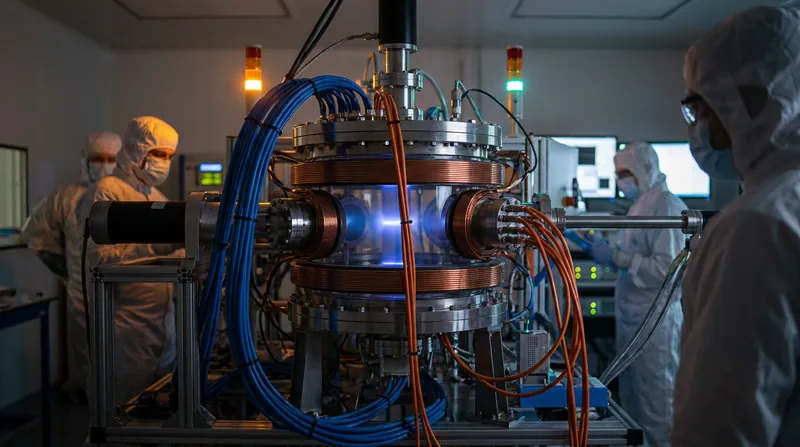
The team engineered an optical microcavity filled with a specially designed liquid crystal and coated it with an organic semiconductor. By trapping light inside this microscopic chamber, they forced photons to interact strongly with the semiconductor's electrons.[3][5]
This intense interaction birthed exciton-polaritons, hybrid quasiparticles that carry the mass of an electron but move with the speed and wave-like properties of light. Because they are incredibly light, these quasiparticles can exhibit quantum behaviors at much higher thermal thresholds than heavy atoms.[2][5]
Although an individual exciton-polariton exists for only a few picoseconds before decaying, that fleeting lifespan is sufficient for the particles to synchronize. They rapidly condense into a single macroscopic quantum state, behaving collectively as a superfluid.[3][5]
As the researchers pumped energy into the system, they observed the condensate spontaneously forming regularly spaced bright fringes of emitted light. This periodic density modulation confirmed that the frictionless fluid had simultaneously crystallized, achieving the elusive supersolid phase.[3][5]
Engineering the microcavity
The success of the experiment hinged on the unique properties of the liquid crystal housed within the microcavity. Unlike rigid solid-state materials, the liquid crystal provided an electrically tunable environment, allowing the team to manipulate the quantum fluid on demand.[4][5]
By applying a simple electrical voltage across the cavity, the researchers could alter the optical properties of the environment in real time. This control allowed them to steer the formation of the supersolid and observe shifting stripes and quantum vortices within the condensate.[3][5]
This marks the first time scientists have created an electrically tunable platform for investigating supersolid exciton-polariton condensates. The ability to control the quantum state with standard electrical signals bridges the gap between abstract physics and applied engineering.[1][5]
Previous attempts to manipulate quantum fluids required bulky magnetic coils or complex optical arrays. The new liquid-crystal approach shrinks the necessary hardware down to a microscopic scale, making it highly compatible with existing semiconductor manufacturing techniques.[2][4]
The researchers noted that the organic semiconductor used in the device, a methyl-substituted ladder-type polymer, was crucial for maintaining the strong light-matter coupling. The material's robust molecular structure prevented the quantum state from degrading under ambient thermal noise.[3]
Toward optical computing
Moving quantum phenomena out of the deep freeze opens a realistic pathway for next-generation technologies based entirely on light. Because exciton-polaritons travel at immense speeds without generating heat through electrical resistance, they are ideal candidates for data transmission.[1][2]
One immediate application lies in the development of ultrafast photonic devices. By harnessing the frictionless flow of the supersolid, engineers could design optical circuits that process information exponentially faster than current silicon-based microchips.[1][5]
The discovery also holds promise for neuromorphic computing accelerators—hardware designed to mimic the neural architecture of the human brain. The unique polarization sensitivity of the supersolid phase could allow these systems to perform complex pattern recognition with minimal energy consumption.[3][5]
Highly sensitive optical sensors represent another near-term possibility. Because the supersolid's crystalline structure is exquisitely sensitive to external disturbances, it could be deployed to detect microscopic changes in magnetic fields or chemical environments.[1][5]
While the current prototype operates reliably at room temperature, the research team is already exploring ways to extend the lifespan of the exciton-polaritons. Prolonging their existence from picoseconds to nanoseconds would allow for even more complex quantum operations.[2][3]
A shifting paradigm
The Warsaw-led experiment fundamentally alters how physicists approach the study of quantum matter. By proving that macroscopic quantum states can survive the chaotic thermal energy of a normal room, the team has expanded the boundaries of condensed matter physics.[4][5]
Historically, the requirement for liquid helium cooling has bottlenecked quantum research, restricting it to well-funded national laboratories and massive tech corporations. Room-temperature platforms democratize the field, allowing smaller institutions to experiment with quantum fluids.[1][2]
Key points
- Scientists have created a supersolid—a quantum state that is simultaneously a rigid crystal and a frictionless liquid—at room temperature.
- The breakthrough bypasses the traditional need to cool quantum experiments to near absolute zero using liquid helium.
- Researchers achieved the state by trapping hybrid light-matter particles, called exciton-polaritons, inside an electrically tunable liquid-crystal microcavity.
- Operating at temperatures up to 60°C, the platform paves the way for ultrafast, low-energy optical computing and highly sensitive sensors.
What we don’t know
- While the supersolid phase has been confirmed visually through periodic density fringes, researchers have yet to quantitatively measure the exact degree of frictionless superfluid flow within the room-temperature condensate.
- The exciton-polariton quasiparticles currently exist for only a few picoseconds, and it remains unclear how easily their lifespan can be extended to support complex, sustained computational operations.
- Quantum Physicists
- Value the fundamental expansion of condensed matter physics into room-temperature environments.
- Photonic Engineers
- Focus on the applied potential for ultrafast optical computing and neuromorphic accelerators.
- Materials Scientists
- Highlight the innovative use of liquid crystals and organic semiconductors to trap light.
Perspectives this story doesn't cover
- Commercial Semiconductor Manufacturers
- Data Center Operators
Sources
Source coverage
5 outlets
3 viewpoints surfaced





- [1]ScienceDailyPhotonic Engineers
A quantum breakthrough makes light behave like both a solid and a liquid
Read on ScienceDaily → - [2]ScienceAlertPhotonic Engineers
Finally! Physicists Create an Exotic Quantum State of Matter That Works at Room Temperature
Read on ScienceAlert → - [3]Quantum ZeitgeistMaterials Scientists
Quantum room-temperature supersolid in light-matter condensate
Read on Quantum Zeitgeist → - [4]University of WarsawQuantum Physicists
A new quantum state of matter
Read on University of Warsaw → - [5]EurekAlert!Quantum Physicists
A New Quantum State of Matter Works at Room Temperature
Read on EurekAlert! →
More in Science
See all →Deep-Sea Mining
Scientists Discover Thriving Microscopic Ecosystem Hidden Inside Deep-Sea Polymetallic Nodules
6 sources

Planetary Magnetism
Deep-Mantle Water Conductivity Explains Bizarre Off-Axis Magnetic Fields of Uranus and Neptune
3 sources

Paleontology
Fossil Remains from English Brickworks Reveal Previously Unknown Wetland Dinosaur
5 sources

Subglacial Hydrology
Hidden Antarctic Lake Drains 78 Billion Liters, Causing Deep Surface Ice Subsidence
4 sources

Comments
Every angle. Every day.
Get Science stories with full source coverage and perspective breakdowns, free every day.