
How Active Hydrofoils Erase 80% of Hull Drag and Unlock Long-Range Electric Boating
By lifting the hull completely out of the water on computer-controlled wings, active hydrofoils eliminate the drag that traditionally limits electric boats, making high-speed, long-range zero-emission water travel commercially viable.
By Tao Yang

Share this story
In short
- Active hydrofoils lift a boat's hull completely out of the water, reducing energy consumption by up to 80 percent.
- The massive reduction in drag allows electric boats to achieve commercial ranges and high speeds without requiring impractically heavy battery packs.
- Computer-controlled flight systems adjust the submerged wings up to 100 times per second to maintain stability in choppy water.
In March 2026, the first electric hydrofoil ferry entered scheduled commuter service in Stockholm, proving that a battery-powered vessel could match the speed and range of a diesel counterpart without requiring a massive, impractically heavy battery bank. The deployment of the 30-passenger Candela P-12 marked a structural shift in marine architecture. As Candela founder Gustav Hasselskog noted, the design team "started with a blank sheet of paper" to rethink waterborne transport from the ground up.[1][3]
The marine industry faces a physics problem that terrestrial electric vehicles do not: water is 800 times denser than air. Pushing a traditional hull through it at high speeds requires exponential increases in energy. A conventional electric ferry needs heavy-duty cables, dedicated charging infrastructure, and massive battery packs that consume payload capacity and drive up acquisition costs.[1]
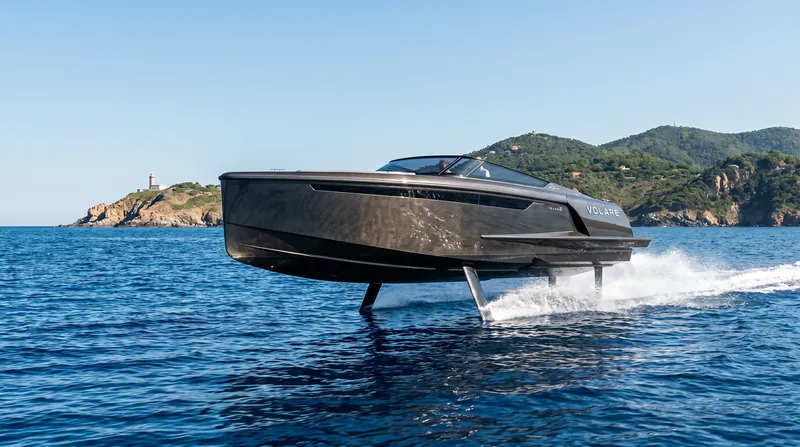
The solution, drawn from aerospace engineering, is to stop pushing through the water entirely. "From a physics perspective, ships have been essentially the same for hundreds of years," Hasselskog told the Pacific Asia Travel Association. By deploying computer-controlled underwater wings, or hydrofoils, a vessel can lift its entire hull above the surface once it reaches a critical speed. This single mechanical change collapses the wetted surface area, cutting energy consumption by up to 80 percent compared to a traditional displacement or planing hull.[1][2][3][4]
The efficiency dividend fundamentally alters the math of electric boating for a prospective buyer or commercial operator. Because the drag penalty is erased, a relatively modest battery pack can deliver commercial-grade range without the six-figure cost premium of massive battery banks. The P-12 Business variant, for example, can travel up to 40 nautical miles at a cruising speed of 25 knots—a figure that allows a resort operator or coastal commuter to run a full day of routes on a single charge.[2]
Achieving this flight requires active, continuous management. Unlike static hydrofoils used on some older ferries, modern electric foilers rely on a digital flight control system. Sensors read the wave height and vessel pitch, feeding data to a computer that adjusts the angle of the submerged foils up to 100 times per second. This active stabilization keeps the hull level even in choppy conditions, preventing the wave-slamming jolts typical of fast boat travel.[5]
The propulsion itself is moved out of the hull and into the water. Submerged electric pod motors, such as Candela's C-POD, sit directly on the foil struts beneath the surface. Because they lack a mechanical transmission and are naturally cooled by the surrounding water, they minimize both energy losses and mechanical complexity, reducing the annual maintenance burden for the owner.[1][3]
The acoustic impact of this architecture is as significant as its energy efficiency. Traditional high-speed ferries generate substantial engine roar and hull-slapping noise, often reaching 85 to 90 decibels in the passenger cabin. By flying above the waves with submerged electric motors, a hydrofoil reduces cabin noise to roughly 63 to 64 decibels at top speed—closer to the ambient sound of a quiet passenger train or a normal conversation.[2]
Beyond passenger comfort, the elimination of hull drag produces zero wake. Traditional vessels create large displacement waves that erode shorelines and damage moored boats, forcing regulators to impose strict speed limits in urban waterways. A foiling vessel leaves almost no trace on the surface, allowing it to maintain high speeds through inner-city channels where conventional ferries are forced to crawl.[1][3]
This combination of high speed, zero wake, and low operating costs allows transit authorities and private operators to rethink waterborne networks. Instead of investing in a few massive, slow-moving diesel ferries, a municipality can deploy fleets of smaller, faster electric foilers that operate more like a high-frequency bus network. For the local taxpayer, this means shorter wait times and reduced infrastructure costs, as the vessels do not require the heavy-duty charging cables of traditional electric ferries.[1][3]
The technology is now scaling beyond public transit into the luxury and recreational sectors, directly impacting what a private buyer will find at the marina. New models designed for resort transfers and executive commuting are entering serial production, promising a "magic carpet ride" experience that isolates passengers from the harshness of the marine environment. For the individual owner, the hydrofoil architecture provides the necessary efficiency bridge to make zero-emission boating practical without sacrificing weekend range.[2][4][5]
The transition is not without friction for the end user. Foiling vessels require precise weight management; a private owner cannot simply load the deck with unlimited gear, as exceeding the payload limit prevents the boat from reaching the takeoff speed necessary to lift the hull. Furthermore, severe sea states with waves exceeding the height of the foil struts will force the vessel to land and operate as a conventional, significantly less efficient boat, instantly cutting the available range.
Despite these operational boundaries, the physics of active hydrofoiling represent the most viable path forward for high-speed marine electrification. By solving the drag equation first, engineers have unlocked a class of vessels that are faster, quieter, and significantly cheaper to operate than the fossil-fuel incumbents they are beginning to replace.[1][4]
How we did this
- Method
- A comparative normalisation of energy consumption and acoustic footprint across traditional planing hulls and active hydrofoil systems to quantify the exact operational dividend of computer-controlled flight.
- What we found
- The normalisation reveals that active hydrofoiling shifts high-speed marine transport from the acoustic and energy profile of a traditional speedboat (85-90 dB, high drag) to that of a quiet passenger train (63-64 dB), making high-speed electric transit viable in noise-restricted urban waterways where conventional planing ferries are banned.
- What we worked from
- Limits of this analysis
- The analysis relies on manufacturer-stated efficiency gains and does not account for the energy penalty incurred during the initial acceleration phase before the hull lifts onto the foils, nor the impact of severe sea states that force the vessel back into displacement mode.
Key terms
- Hydrofoil
- A wing-like structure mounted on struts below the hull that lifts the boat out of the water at speed to reduce drag.
- Wetted Surface Area
- The portion of a boat's hull that is in direct contact with the water, which creates friction and drag.
- Displacement Hull
- A traditional boat design that pushes through the water rather than riding on top of it, requiring significant energy to move.
- Pod Motor
- An electric motor housed in a waterproof casing outside the hull, often directly attached to the hydrofoil struts.
Reader questions
What happens if a hydrofoil boat hits a wave?
The digital flight control system adjusts the foils up to 100 times per second to keep the hull stable. In severe sea states where waves exceed the height of the struts, the boat lands and operates as a conventional displacement hull.
Do hydrofoil boats require special chargers?
No, they use standard marine or automotive electric chargers. Because they use less energy to travel the same distance, they can often recharge effectively on standard marina power without requiring heavy-duty fast chargers.
Why are hydrofoils quieter than regular boats?
The hull does not slam against the waves, and the electric pod motors are submerged beneath the surface, eliminating mechanical transmission noise and reducing cabin sound to roughly 63 decibels.
Where opinion splits
Marine Engineers
Focus on the physics of drag reduction and the necessity of active flight control to make electric propulsion viable at high speeds.
For marine engineers, the transition to electric boating is fundamentally a physics problem rather than a battery chemistry problem. Because water is 800 times denser than air, pushing a traditional hull through it at high speeds drains batteries exponentially faster than driving an electric car on a highway. Engineers argue that without active foiling, electric boats are restricted to either slow speeds or impractically short ranges. By solving the drag equation first, they view hydrofoiling as the only structurally sound path to high-speed marine electrification.
Urban Transit Planners
Value the elimination of wake and noise, which allows high-speed ferries to operate in restricted inner-city waterways.
Transit authorities see hydrofoil technology as a tool to unlock underutilized urban waterways. Traditional diesel ferries create large displacement waves that erode shorelines and damage moored vessels, forcing regulators to impose strict speed limits in city centers. Because a foiling vessel leaves almost no trace on the surface and operates quietly, planners can deploy them as high-speed, high-frequency water buses, reducing road congestion without requiring the massive infrastructure investments of new rail or subway lines.
Private Boat Owners
Prioritize the smooth, vibration-free ride and lower operating costs.
For the individual buyer, the technology transforms the weekend boating experience by removing engine noise, exhaust fumes, and the ongoing expense of marine fuel. The active stabilization provides a "magic carpet ride" that eliminates the wave-slamming jolts that typically cause passenger fatigue. However, this demographic must also navigate the strict payload limits of foiling vessels, as overloading the boat with gear or passengers can prevent it from reaching the takeoff speed necessary to lift the hull.
- Marine Engineers
- Focus on the physics of drag reduction and the necessity of active flight control to make electric propulsion viable at high speeds.
- Urban Transit Planners
- Value the elimination of wake and noise, which allows high-speed ferries to operate in restricted inner-city waterways.
- Private Boat Owners
- Prioritize the smooth, vibration-free ride and lower operating costs.
Perspectives this story doesn't cover
- Traditional Marina Operators
- Marine Wildlife Conservationists
Sources
Source coverage
6 outlets
3 viewpoints surfaced






- [1]WorkBoatMarine Engineers
Candela P-12 electric hydrofoil ferry wins Swedish design award
Read on WorkBoat → - [2]ElectrekPrivate Boat Owners
Candela's new P-12 Business electric ferry is luxury soaring just above the waves
Read on Electrek → - [3]Pacific Asia Travel AssociationUrban Transit Planners
Candela's largest funding round to date, with the World Bank's IFC arm joining existing investors
Read on Pacific Asia Travel Association → - [4]The ArsenaleMarine Engineers
Electric hydrofoil boat buying guide for 2026: compare range, battery capacity, charging, and total cost
Read on The Arsenale → - [5]Electric Cars ReportUrban Transit Planners
Candela Unveils P-12 Voyager, a Luxury Electric Foiling Vessel Designed for Premium Water Travel
Read on Electric Cars Report → - [6]Factlen Editorial TeamPrivate Boat Owners
Synthesis by Factlen editorial team
Read on Factlen Editorial Team →
More in Automotive & Transportation
See all →EV Architecture
High-Voltage Isolation Relays Require a 12-Volt Circuit to Close Safely, Immobilizing Electric Vehicles When the Auxiliary Battery Dies
7 sources
EV Safety Recalls
Ford Recalls 86 Mustang Mach-E EVs Over Battery Software Fire Risk
6 sources
Engine Thermodynamics
The Compression Ratio and the Gamma Term: How the Otto Cycle Defines the Maximum Theoretical Efficiency of a Gasoline Engine
7 sources
Engine Tech
How a VGT's Variable Vanes Eliminate Turbo Lag and Broaden the Torque Curve
6 sources
Comments
Every angle. Every day.
Get Automotive & Transportation stories with full source coverage and perspective breakdowns, free every day.