
Euclid Telescope Discovers Record-Breaking Quasar 630 Million Years After the Big Bang
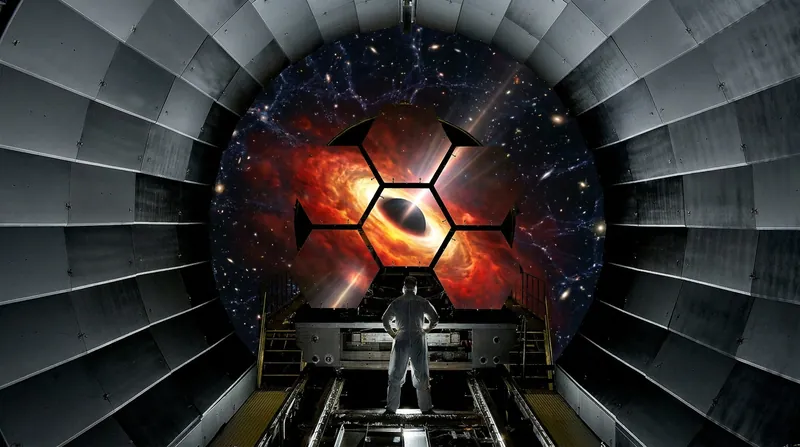
The Euclid space telescope has identified the oldest known quasar, a massive black hole actively feeding just 630 million years after the Big Bang. Its immense size and surprisingly slow growth rate challenge current models of how early galaxies formed.

Share this story
The Euclid space telescope has identified the most distant quasar ever observed, a massive black hole actively feeding just 630 million years after the Big Bang. The discovery pushes the observational frontier back by 40 million years and sets a new benchmark for early cosmic structures.[2][4]
The object, formally designated EUCL J150452.291+625224.39, contains a supermassive black hole weighing approximately 360 million solar masses. Its existence so early in cosmic history challenges current models of how such massive objects could form and grow in a relatively short timeframe.[3][5]
To reach that scale when the universe was only five percent of its current age, the black hole must have either grown from an unusually massive seed or experienced sustained, highly efficient early growth. The findings force astrophysicists to reevaluate the mechanisms driving galaxy evolution.[1][2][5]
Astronomers identified the quasar in data from the Euclid Wide Survey, which has been scanning the sky for about 18 months. The object stood out among millions of sources due to its extreme distance and distinct infrared signature.[2][6]
Pushing the Redshift Frontier
Follow-up observations with the James Webb Space Telescope and the Large Binocular Telescope confirmed its precise redshift at 8.129, with a margin of error of just 0.005. This measurement corresponds to a time roughly 13.1 billion years ago, making it the first quasar discovered beyond a redshift of 8.[2][4][5]
Redshift occurs because the expansion of the universe stretches the light emitted by distant objects, shifting it toward the red end of the electromagnetic spectrum. The higher the redshift, the further back in time astronomers are looking.[3][4]
The team nicknamed the quasar Dún Aonghasa, after a prehistoric cliff-top fort on the edge of Ireland. The name reflects its position at the current observational edge of the cosmos, illuminating the threshold of an unexplored era.[2][6]
"Finding quasars at ever-increasing distances, at the edge of the observable universe, teaches us something about how the black holes in their centres grew," said Julien Wolf, a postdoctoral researcher at the European Southern Observatory and lead author of the study.[3]
"The closer to the Big Bang we find them, the faster their black holes must have grown or the more massive they must have been at birth — or both," Wolf added.[6]
The Mechanics of a Cosmic Giant
Quasars are powered by supermassive black holes consuming surrounding gas and dust, a process known as accretion. The infalling material forms a turbulent, glowing disk that heats up to extreme temperatures, often outshining the entire host galaxy.[3][4]
To determine the properties of Dún Aonghasa, the research team relied on precise spectroscopic measurements from the Near-Infrared Spectrograph on the James Webb Space Telescope. They analyzed the broad emission lines of hydrogen and magnesium to gauge the speed of the swirling gas.[5]
The hydrogen-beta line revealed gas moving at a velocity of 3,160 kilometers per second, while the magnesium line indicated speeds of 3,740 kilometers per second. By combining these velocities with the luminosity of the quasar, astronomers calculated the central black hole's mass.[5]
Despite its immense size, Dún Aonghasa is currently consuming material at a relatively slow pace. Measurements show it operating at an Eddington ratio between 0.12 and 0.44, well below the theoretical maximum for black hole growth.[2][5]
The Eddington limit represents the point where the outward radiation pressure from the glowing accretion disk balances the inward gravitational pull of the black hole. If a black hole feeds too quickly, the intense radiation blows the surrounding gas away, choking off its food supply.[3]
The Growth Rate Puzzle
This sub-Eddington accretion rate presents a significant puzzle for astrophysicists. If the black hole had always grown this slowly, it could not have reached 360 million solar masses in the 630 million years since the Big Bang.[2][3]
The findings suggest the black hole either formed from a direct collapse of a massive gas cloud or underwent periods of rapid, super-Eddington accretion earlier in its life. Standard models, which assume black holes start from the collapsed cores of early stars, struggle to explain such rapid mass accumulation.[3][4][5]
In the direct collapse scenario, a massive, pristine gas cloud condenses entirely under its own gravity, skipping the star formation phase. This process creates an initial black hole seed of 10,000 to 100,000 solar masses, providing a significant head start.[1][3]
If future observations uncover quasars at even higher redshifts, approaching just a few hundred million years after the Big Bang, even the direct collapse scenario may become mathematically unviable.[6]
Researchers might then need to consider primordial black holes—hypothetical objects formed from density fluctuations in the first fractions of a second after the Big Bang—as the seeds for these early giants.[3][6]
Euclid's Expanding Census
The European Space Agency launched Euclid in 2023 primarily to study dark matter and dark energy. However, its wide field of view and sensitive infrared instruments make it an exceptional tool for finding rare, distant objects that other telescopes miss.[2][4]
In just 18 months of operations, the telescope has identified 31 ancient quasars. This haul includes 12 objects beyond a redshift of 7, a threshold that took astronomers 15 years to reach with previous sky surveys.[2][4]
"This highlights how quickly Euclid is expanding our census of the most distant quasars," said Silvia Belladitta, a scientist at the Max Planck Institute for Astronomy who led the crucial follow-up observations.[6]
"Each new discovery brings us closer to understanding how supermassive black holes formed and grew in the early universe," Belladitta noted, emphasizing the rapid pace of recent astronomical breakthroughs.[3]
Reevaluating Early Cosmic History
The discovery of a mature, slowly feeding quasar at redshift 8.13 implies that even more luminous or massive black holes might remain hidden in the early universe. The current census likely represents only the most visible fraction of a broader population of ancient black holes.[5]
The research, published in the journal Astronomy & Astrophysics on November 24, 2026, involved a massive international collaboration. The Euclid Consortium includes more than 2,000 scientists from 300 institutes across 15 European countries, the United States, Canada, and Japan.[2][5][6]
As Euclid continues its survey, astronomers anticipate finding tens of additional quasars beyond redshift 8. These future discoveries will provide the statistical sample needed to determine which formation model accurately describes the early universe.[2][4]
"It is unclear how far back in time these supermassive black holes powering luminous quasars exist, but Euclid has a good chance of finding out what that limit is," said Eduardo Bañados, a research group leader at the Max Planck Institute for Astronomy.[3]
The ultimate limit of quasar observation will define the timeline of the cosmic dawn, marking the exact epoch when the first supermassive black holes ignited and began transforming the dark universe into one filled with light.[2]
Key points
- The Euclid space telescope has discovered the most distant quasar on record, located 13.1 billion light-years away at a redshift of 8.13.
- The quasar, nicknamed Dún Aonghasa, contains a black hole of 360 million solar masses that existed just 630 million years after the Big Bang.
- Despite its massive size, the black hole is currently consuming matter at a relatively slow rate, well below its theoretical maximum.
- The discovery challenges standard models of black hole formation, suggesting these early giants grew from massive seeds or experienced rapid early growth spurts.
Open questions
- Whether this quasar grew from a direct-collapse gas cloud or a primordial black hole seed.
- If even older, more massive quasars exist closer to the cosmic dawn, waiting to be discovered by Euclid.
- How the black hole sustained the necessary super-Eddington accretion rates earlier in its life to reach its current mass.
Timeline
2023
The European Space Agency launches the Euclid space telescope to map the dark universe.
July 2026
Euclid discovers a quasar at redshift 7.5, setting a new distance record.
November 2026
Astronomers confirm the discovery of J1504+6252 at redshift 8.13, breaking Euclid's own record by 40 million years.
- Observational Astronomers
- Focus on expanding the census of early quasars to provide hard data on the cosmic dawn.
- Direct Collapse Theorists
- Argue that early supermassive black holes formed directly from massive gas clouds.
- Primordial Black Hole Proponents
- Suggest that the earliest black hole seeds formed immediately after the Big Bang.
Perspectives this story doesn't cover
- Theoretical physicists modeling alternative gravity theories in the early universe.
Sources
Source coverage
6 outlets
3 viewpoints surfaced






- [1]Phys.orgDirect Collapse Theorists
New quasar record tightens constraints on black hole formation scenarios
Read on Phys.org → - [2]European Space AgencyObservational Astronomers
Euclid breaks own quasar record by 40 million years
Read on European Space Agency → - [3]Max Planck SocietyObservational Astronomers
New quasar record tightens constraints on black hole formation scenarios
Read on Max Planck Society → - [4]Popular ScienceDirect Collapse Theorists
Oldest known quasar formed 630 million years after the big bang
Read on Popular Science → - [5]arXivPrimordial Black Hole Proponents
Euclid: Discovery of a quasar at z = 8.13 hosting a 360-million-solar-mass black hole
Read on arXiv → - [6]Max Planck Institute for AstronomyObservational Astronomers
New quasar record tightens constraints on black hole formation scenarios
Read on Max Planck Institute for Astronomy →
More in Science
See all →Cosmic Dawn
Closely Orbiting Ancient Quasar Pair Challenges Models of Early Black Hole Growth
6 sources
Stellar Evolution
Astronomers Detect Unseen Mass-Gap Object Orbiting a Red Giant Star
5 sources
Gravitational Lensing
JWST Catalogs 104 Magnified Stellar Events in the Distant Dragon Galaxy
5 sources
Cosmological Models
Alternative 26.7-Billion-Year Cosmological Model Passes Tests Without Dark Energy
8 sources
Comments
Every angle. Every day.
Get Science stories with full source coverage and perspective breakdowns, free every day.