
Alternative 26.7-Billion-Year Cosmological Model Passes Tests Without Dark Energy
A new theoretical framework from the University of Ottawa successfully reproduces key astronomical observations while doubling the age of the universe and eliminating dark matter.
By Logan Price

Share this story
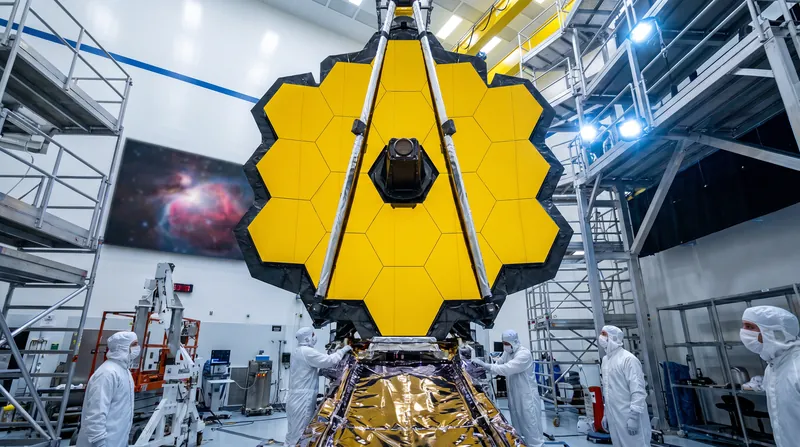
The James Webb Space Telescope continues to beam back images of massive, chemically mature galaxies from the dawn of time. Under the standard cosmological model, those structures simply lacked the time to form. Now, University of Ottawa researchers have tested an alternative framework that solves this timeline crisis by doubling the age of the universe.[1][2]
The new model, published in the journal Universe, calculates the cosmos to be 26.7 billion years old, rather than the widely accepted 13.8 billion years. Furthermore, the framework discards the two most mysterious components of modern physics. It operates entirely without dark matter and dark energy, which are currently thought to make up roughly 95 percent of reality.[1][6]
During 2025 and 2026, Rajendra Gupta, an adjunct professor of physics at the University of Ottawa, and postdoctoral researcher Nikolaos Samaras subjected the model to a battery of stringent astronomical tests. The framework, known as CCC+TL, held up against primary observational criteria that usually require dark components to function.[1][7]
"Most emerging models explain only a limited set of observations," Gupta stated in the university's release. "A new model must not conflict with the pillars of cosmology and astrophysics, and our findings meet that challenge, including the yet-to-be-published cosmic microwave background challenge."[1][6]
Evolving forces and tired light
The CCC+TL acronym stands for "covarying coupling constants plus tired light." It merges two distinct theoretical concepts to explain the phenomena astronomers currently attribute to invisible mass and repulsive energy. The first component suggests that fundamental constants of nature, such as the gravitational constant, evolve over billions of years.[1][4]
By allowing these constants to covary, the model alters how forces and particles interact across vast cosmic distances. This shifting relationship mimics the gravitational scaffolding that astrophysicists normally attribute to dark matter. It provides the extra pull needed to hold galaxies together without requiring an undetected particle.[1][2]
The second component, tired light, addresses the accelerated expansion of the universe. In the standard Lambda-CDM model, dark energy stretches the fabric of space, causing distant light to stretch toward the red end of the spectrum. The tired light hypothesis argues that photons simply lose energy as they travel, creating the identical redshift effect.[1][7]
Because the CCC+TL framework fundamentally changes the Einstein and Friedmann equations that describe gravity, the researchers could not rely on existing simulation software. For each observational test, Gupta and Samaras had to develop entirely new compliant equations and computer codes from scratch.[1][6]
Matching the primordial elements
One of the most rigorous hurdles for any new cosmological theory is Big Bang Nucleosynthesis. This process describes the formation of the universe's lightest elements—primarily hydrogen, helium, and lithium—in the first few minutes after the initial expansion. The standard model predicts the exact ratios of these primordial elements with extreme precision.[1][7]
When the Ottawa team ran their CCC+TL equations, the predictions for the amounts of hydrogen and helium formed shortly after the Big Bang matched the standard model's outputs perfectly. The framework successfully reproduced the foundational chemistry of the early universe without relying on a dark matter framework to guide the initial density fluctuations.[1][6]
The researchers then tested the model against cosmic-chronometer measurements. This technique uses the known ages of passively evolving galaxies to estimate how fast the universe has expanded at different points in its history. The CCC+TL model aligned with these chronological benchmarks, providing a consistent expansion history without invoking dark energy.[1][7]
To test the model's gravitational accuracy, the team applied it to the SPARC database, a collection of detailed rotation curves for 175 nearby galaxies. In a recent paper, they demonstrated that the covarying constants could perfectly reproduce how fast these galaxies spin, entirely eliminating the need for dark matter halos.[1][6]
Time for early galaxies to grow
The most immediate practical application of the 26.7-billion-year timeline is its resolution of the JWST early galaxy paradox. Under the standard Lambda-CDM model, the universe was only about 300 million years old during the era known as cosmic dawn. That brief window leaves massive, fully formed galaxies with a physically impossible growth rate.[1][2]
Under the CCC+TL framework, the universe would have already been 4.6 billion years old at that exact same observed redshift. This drastically expanded timeline grants primordial gas clouds and early star clusters billions of additional years to merge, ignite, and organize into mature galactic structures.[1][2]
According to the researchers' calculations, published in the journal Galaxies, these early structures come out about 12 times larger in size and mass than the standard model permits. This neatly bridges the gap between theoretical predictions and the massive infrared signatures JWST is currently detecting.[1]
"Impossible early galaxies become predictable galaxies," Gupta explained. The revised timeline not only accounts for the current anomalies but suggests that fully formed galaxies should exist even further back in time. "We predict that galaxies exist well beyond the distances the James Webb Space Telescope has reached," he added.[1]
Stress-testing the framework
The Ottawa team is already pushing the model against more complex astrophysical phenomena. They recently analyzed the Bullet Cluster, a famous collision between two galaxy clusters that is widely considered one of the strongest direct proofs of dark matter. In that collision, the gravitational lensing separates from the visible X-ray gas.[1][2]
When evaluated under the CCC+TL model, the extra gravitational effect tracks the galaxies rather than the hot gas, successfully mimicking the dark matter offset. The researchers characterize this specific result as an early proof of concept that requires deeper investigation, but it demonstrates the framework's flexibility.[1][2]
A separate study examining time dilation in supernova observations also supports the covarying constants model, though that paper remains under peer review. Supernovae act as standard candles for measuring cosmic distances, and their light curves stretch out in a predictable way that the new equations can accurately map.[1]
"Observations attributed to dark matter and dark energy likely originate from covarying coupling constants," Gupta noted. If the framework continues to pass these stress tests, it would represent the most significant paradigm shift in theoretical physics since the discovery of cosmic acceleration in the late 1990s.[1][7]
Confronting the cosmic background
Despite these successes, the broader cosmological community remains highly cautious about abandoning the Lambda-CDM model. The standard framework has successfully predicted the large-scale structure of the universe for decades, and replacing it requires a theory that can match its precision across every single observational domain simultaneously.[1][6]
The ultimate test for the CCC+TL model will be the Cosmic Microwave Background. This faint radiation is the afterglow of the Big Bang, and its microscopic temperature fluctuations map the exact density of matter in the early universe. The standard model fits this data with extraordinary precision.[1][6]
Gupta has stated that their findings meet the microwave background challenge, though the detailed mathematical proof of that specific test has yet to be published. Until the broader physics community can scrutinize those calculations, the 26.7-billion-year universe will remain a provocative alternative rather than the new standard.[1][6]
Gupta has stated that their findings meet the microwave background challenge, though the detailed mathematical proof of that specific test has yet to be published.
"The success should encourage astronomers to take the new model seriously," Gupta concluded. "It is challenging to understand and apply, but we believe it extends the physics of the Universe beyond ΛCDM limits." The next phase of JWST observations will likely determine whether the standard model holds, or if the cosmic clock requires a reset.[1][2]
Key points
- A new theoretical model from the University of Ottawa suggests the universe is 26.7 billion years old, nearly double the accepted age.
- The framework, known as CCC+TL, successfully reproduces the formation of light elements and galaxy rotation curves without relying on dark matter or dark energy.
- By expanding the cosmic timeline, the model explains how the massive, fully formed early galaxies detected by the James Webb Space Telescope had enough time to grow.
- The researchers developed entirely new equations to test the model against 175 galaxies and the Bullet Cluster, though the crucial Cosmic Microwave Background data remains unpublished.
Unanswered questions
- Whether the CCC+TL model can successfully reproduce the microscopic temperature fluctuations of the Cosmic Microwave Background.
- How the broader cosmological community will respond once the detailed mathematical proofs for the CMB challenge are published.
- If upcoming deep-space observations from the James Webb Space Telescope will find galaxies even older than the revised 4.6-billion-year cosmic dawn.
How we got here
Late 1990s
Astronomers discover the accelerated expansion of the universe, leading to the widespread inclusion of dark energy in the standard cosmological model.
2022
The James Webb Space Telescope begins detecting massive, mature galaxies at redshifts that suggest they formed impossibly early in cosmic history.
2025
University of Ottawa researchers begin testing the CCC+TL framework against major astronomical observations.
Nov 2026
The team publishes results showing the 26.7-billion-year model successfully passes Big Bang Nucleosynthesis and galaxy rotation tests without dark matter.
- Alternative Cosmologists
- Argue that the standard model is failing under new observations and that evolving fundamental constants provide a cleaner mathematical solution.
- Standard Model Defenders
- Maintain that Lambda-CDM has successfully predicted cosmic structures for decades and require new theories to perfectly match the Cosmic Microwave Background.
Perspectives this story doesn't cover
- Particle Physicists
- Cosmic Microwave Background Specialists
Sources
Source coverage
8 outlets
2 viewpoints surfaced








- [1]University of OttawaAlternative Cosmologists
Theory predicting an older Universe without dark matter or dark energy passes key cosmological tests, warranting further investigation
Read on University of Ottawa → - [2]EurekAlert!Alternative Cosmologists
Theory predicting an older Universe without dark matter or dark energy passes key cosmological tests, warranting further investigation
Read on EurekAlert! → - [3]scinexxStandard Model Defenders
Modell eines älteren Universums ohne Dunkle Materie und Dunkle Energie besteht weitere Tests
Read on scinexx → - [4]Lifeboat FoundationAlternative Cosmologists
Theory predicting an older universe without dark matter or dark energy passes key cosmological tests
Read on Lifeboat Foundation → - [5]astronews.com.trStandard Model Defenders
Theory predicting an older universe without dark matter or dark energy passes key cosmological tests
Read on astronews.com.tr → - [6]Science XAlternative Cosmologists
Theory predicting an older universe without dark matter or dark energy passes key cosmological tests
Read on Science X → - [7]SOZ6Standard Model Defenders
Theory predicting an older universe without dark matter or dark energy passes key cosmological tests
Read on SOZ6 → - [8]Volkssterrenwacht OrionStandard Model Defenders
Theorie die een ouder heelal zonder donkere materie of donkere energie voorspelt, doorstaat belangrijke kosmologische tests
Read on Volkssterrenwacht Orion →
More in Science
See all →Early Universe
JWST Discovers 'Misty Moons' Galaxy, Revealing Clustered Star Formation in the Early Universe
4 sources
Exoplanet Atmospheres
Webb Telescope Finds Lava Planet Shielded by Reflective Mineral Clouds
7 sources
Atmospheric Optics
The Geometry of Scintillation: Why Atmospheric Turbulence Causes Stars to Twinkle While Planets Maintain a Steady Glow
10 sources
Cosmic Dawn
JWST Reveals Early Galaxies Were Spreading Heavy Elements 500 Million Years After Big Bang
5 sources
Comments
Every angle. Every day.
Get Science stories with full source coverage and perspective breakdowns, free every day.