
GuideUnited States Supreme CourtRevision 1Updated
The United States Supreme Court: Jurisdiction, Procedures, and Constitutional Role
The Supreme Court serves as the final arbiter of federal law and the ultimate expositor of the U.S. Constitution. This guide details its jurisdictional boundaries, the mechanics of its merits and emergency dockets, and its structural role in the American separation of powers.
By Javier Cruz

Share this story
In short
- The Supreme Court's authority rests on judicial review, allowing it to invalidate unconstitutional laws.
- Congress controls the Court's size, which has remained at nine justices since 1869.
- The Court grants full review to roughly one percent of the 7,000 to 8,000 petitions it receives annually.
The Supreme Court of the United States stands as the highest judicial authority in the federal system, established directly by Article III of the Constitution. It serves as the final arbiter of federal law and the ultimate expositor of the Constitution. The Court's decisions bind all lower federal and state courts on matters of national law.[1][4]
Unlike the executive and legislative branches, the judiciary's structure was left largely undefined by the framers. The Constitution mandates "one supreme Court" but grants Congress the power to determine its size, composition, and the organization of inferior courts. This structural flexibility has allowed the institution to evolve significantly over more than two centuries.[10][11]
Today, the Court consists of nine justices—one Chief Justice and eight Associate Justices—who meet in Washington, D.C. They exercise both original and appellate jurisdiction, though the vast majority of their work involves reviewing decisions from lower courts. By law, the Court's annual term begins on the first Monday in October and typically concludes in late June.[1][9]
The institution's authority rests primarily on the power of judicial review, which allows it to invalidate legislative acts and executive actions that violate the Constitution. This power, while not explicitly granted in the founding document, has become the cornerstone of American constitutional law, ensuring that neither popular majorities nor executive directives can override foundational civil liberties.[4][10]
Constitutional Foundations and History
The First Congress breathed life into Article III by passing the Judiciary Act of 1789. This foundational statute established a six-member Supreme Court and created a system of lower federal courts. President George Washington signed the act on September 24, 1789, and immediately nominated John Jay as the first Chief Justice.[2][8]
During its first decade, the Court met in New York City and Philadelphia, handling a minimal caseload. The original justices were required to "ride circuit," traveling extensively to preside over regional courts twice a year. Chief Justice Jay found the grueling travel so intolerable that he threatened to resign, prompting Congress to reduce the requirement in 1793.[8]
The size of the Court has fluctuated throughout history, driven entirely by congressional statute rather than constitutional amendment. The membership grew from six to seven in 1807, expanded to nine in 1837, and briefly reached ten during the Civil War in 1863. Congress reduced it to seven in 1866 to prevent President Andrew Johnson from making appointments.[4]
The current nine-justice configuration was established in 1869 and has remained unchanged for over 150 years. In 1937, President Franklin D. Roosevelt famously attempted to expand the Court to protect his New Deal legislation. The "court-packing" initiative failed in Congress, and the nine-seat tradition held firm, cementing the modern structure of the bench.[2][6]
The Marshall Court Era
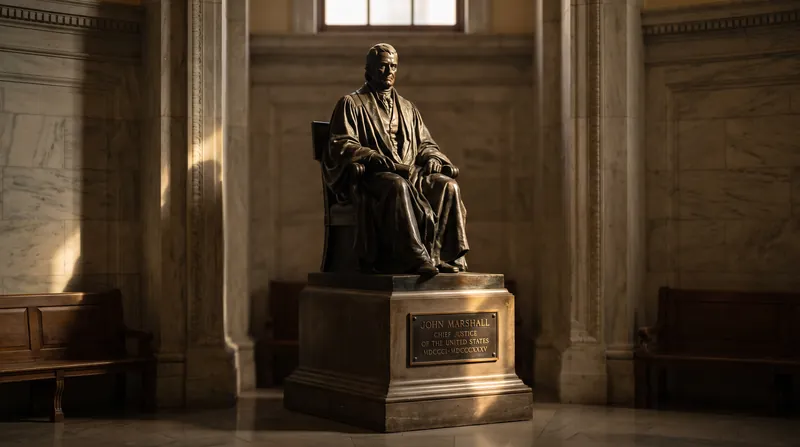
The Court's modern authority was largely cemented during the tenure of Chief Justice John Marshall, who served from 1801 to 1835. Under Marshall's leadership, the Court transitioned to issuing single majority opinions rather than individual seriatim opinions. This shift projected a unified institutional voice that dramatically strengthened the judiciary's legitimacy in the early republic.[2][6]
Marshall's tenure also defined the boundaries of federal power. In landmark rulings, the Marshall Court took a broad view of the federal government's authority under the interstate commerce clause and the Necessary and Proper Clause. These foundational decisions established the supremacy of federal law over conflicting state statutes, a principle that continues to govern American federalism today.[2]
In the landmark 1803 case Marbury v. Madison, the Court explicitly claimed the power of judicial review. Chief Justice Marshall wrote that it is emphatically the province and duty of the judicial department to say what the law is. He also ruled that Congress cannot expand the Court's original jurisdiction beyond the specific categories enumerated in the Constitution.[2][12]
Marshall argued that if Congress could alter this constitutional distribution of power, the framework established by the framers would be rendered meaningless. This decision firmly established that the Supreme Court, not the legislature, holds the final authority to interpret the boundaries of the Constitution, setting the stage for the modern judicial system.[2][12]
Original vs. Appellate Jurisdiction
Article III, Section 2 of the Constitution divides the Court's authority into original and appellate jurisdiction. Original jurisdiction allows the Supreme Court to act as a trial court of first instance. The Constitution explicitly limits this power to cases affecting ambassadors, public ministers, and those in which a state is a party.[11][13]
The Court exercises its original jurisdiction rarely, typically hearing only a handful of such cases each decade. In practice, this docket is almost entirely dedicated to resolving high-stakes disputes between state governments. These cases frequently involve complex conflicts over water rights, state boundaries, or environmental pollution that cannot be resolved in lower courts.[12][13]
The vast majority of the Court's work falls under its appellate jurisdiction, which allows it to review decisions from the 13 federal courts of appeals and the highest state courts. Congress holds the constitutional authority to regulate and make exceptions to this appellate power, shaping the flow of cases that reach the justices.[11][13]
To invoke the Court's appellate jurisdiction, a case must present a substantial question of federal law or constitutional interpretation. State court decisions can only be reviewed if they turn on a federal question. The Supreme Court has no authority to overrule a state supreme court on matters of pure state law, preserving a dual judicial sovereignty.[1][13]
The Merits Docket and Certiorari
The modern Supreme Court is a court of discretionary review, meaning it chooses which cases it will hear. Parties seeking review must file a petition for a writ of certiorari. The Court receives between 7,000 and 8,000 such petitions each term but typically grants full review to only 80 to 100 cases—roughly one percent of all requests.[9][14]
The selection process is governed by the "Rule of Four," a long-standing institutional custom. During private conferences, at least four of the nine justices must vote to grant certiorari for a case to be placed on the merits docket. If fewer than four agree, the petition is denied, and the lower court's ruling stands as the final word.[9][14]
The justices look for specific criteria when selecting cases, primarily focusing on resolving splits among the federal circuit courts of appeals. If two regional appellate courts interpret a federal statute differently, the Supreme Court will often intervene to ensure that federal law is applied uniformly across the nation, preventing geographic disparities in legal rights.[13][14]
The appellate pathway requires exhaustion of lower court remedies. Most federal cases begin in a U.S. District Court, proceed to a U.S. Court of Appeals, and only then become eligible for Supreme Court review. This hierarchical structure ensures that the high court only addresses legal questions that have been thoroughly vetted by inferior tribunals.[1][9]
Briefing and Oral Arguments
Once a case is granted certiorari, it enters the briefing stage. The petitioner and respondent submit lengthy written arguments detailing their legal positions. Additionally, outside organizations, government entities, and experts frequently file amicus curiae—or "friend of the court"—briefs to provide broader context and advocate for specific outcomes that might affect their interests.[9][14]
Once a case is granted certiorari, it enters the briefing stage.
The federal government's position is represented by the Solicitor General, who exercises immense influence over the docket. The Court frequently asks the Solicitor General to file briefs in pending cases, and justices grant a high percentage of the petitions filed by this office. This unique relationship has earned the Solicitor General the informal title of the "tenth justice."[9]
Following the briefing, cases proceed to oral argument, typically scheduled between October and April. Attorneys for each side are granted a strictly limited time—usually 30 minutes—to present their case while fielding intense, rapid-fire questions from the justices. These public sessions test the limits of the legal theories presented in the written briefs.[9][14]
After oral arguments, the justices meet in a private conference to cast their initial votes. If the Chief Justice is in the majority, they assign the writing of the Court's opinion; if not, the most senior justice in the majority makes the assignment. The resulting written opinions detail the legal reasoning that will bind the nation.[9][14]
The Shadow Docket
Alongside the highly visible merits docket, the Court operates a secondary channel for emergency applications and summary decisions, widely known as the "shadow docket." This term, coined in 2015 by legal scholar William Baude, describes the thousands of non-merits orders the Court issues each year without full briefing or oral argument.[3][14]
Historically, the emergency docket was reserved for true administrative necessities or life-and-death emergencies, such as last-minute applications to stay an impending execution. These orders are typically brief, unsigned, and issued without detailed explanations of the Court's legal reasoning, designed merely to preserve the status quo while litigation proceeds.[3][5]
In recent years, the shadow docket has become a source of intense procedural controversy. The Court has increasingly used emergency orders to block or allow major federal policies, state election laws, and environmental regulations to take effect. This shift allows the justices to intervene in high-stakes national disputes long before lower courts have reached a final judgment.[3][5]
The expedited nature of these decisions means they are often handed down just days after an application is filed. While merits cases take months of deliberation, emergency orders are issued rapidly to prevent "irreparable harm," bypassing the traditional safeguards of extensive public scrutiny and comprehensive judicial writing.[3][14]
Transparency and the Emergency Docket
Critics argue that deciding consequential policy disputes through expedited, unexplained orders damages the Court's legitimacy. Because shadow docket rulings often lack signed opinions, the public and lower court judges are left to infer the legal rationale. It is frequently unclear how individual justices voted unless they choose to publish a public dissent.[3][5]
"The ordinary requirement that judges explain their decisions in reasoned opinions can be a tremendous check on judicial power," notes a Congressional Research Service report analyzing the practice. The report emphasizes that procedural regularity and transparent reasoning are essential components of substantive judicial legitimacy in the American system.[2]
In the Court's August 2020 to July 2021 term, the exact vote count was known in only 14 cases out of the 73 emergency applications referred to the whole court. This lack of transparency complicates the work of lower court judges, who must attempt to apply these summary orders as binding precedent without a clear explanatory framework.[3]
Legal scholar William Baude noted that in these important cases, the Court granted stays and injunctions that were both debatable and mysterious. "The Court has not explained their legal basis and it is not even clear to what extent individual Justices agree with those decisions," he wrote, highlighting the procedural break from ordinary merits cases.[3]
Judicial Review and Separation of Powers
Despite its sweeping authority, the Court operates under self-imposed structural constraints designed to prevent it from usurping the democratic branches. Federal judges are bound by the Ashwander rules, a 1936 framework requiring courts to resolve disputes on statutory or procedural grounds whenever possible, avoiding constitutional questions unless absolutely necessary.[10][14]
The Court also relies on the political question doctrine to decline cases it deems inappropriate for judicial resolution. Under this principle, justices will refuse to rule on disputes that the Constitution textually commits to the executive or legislative branches, or cases that lack manageable judicial standards for resolution.[10][14]
Furthermore, Article III limits the federal judiciary to resolving actual "cases" and "controversies." The Court cannot issue advisory opinions on hypothetical legal questions. Plaintiffs must demonstrate Article III standing, proving they have suffered a concrete, particularized injury that is traceable to the defendant and redressable by a favorable ruling.[10][13]
These jurisdictional limitations ensure that the Court remains a reactive institution. It cannot proactively draft laws, initiate investigations, or strike down policies it simply disagrees with. It must wait for a valid legal dispute to work its way through the appellate system before it can issue a binding interpretation of federal law.[4][10]
Constitutional and Statutory Checks
The Court's power is also checked by the constitutional amendment process. If Congress and the states disagree with a Supreme Court interpretation of the Constitution, they can pass an amendment to override the ruling. Historically, this has occurred several times, most notably with the Eleventh and Fourteenth Amendments.[2][14]
Statutory decisions are even easier to override. If the Court interprets a federal law in a way that contradicts legislative intent, Congress can simply pass a new statute clarifying the law. This dynamic creates an ongoing dialogue between the branches, ensuring that the judiciary does not have the final, unchallengeable word on everyday policy.[14]
The United States employs a unified apex court model, which contrasts sharply with the judicial architecture of many civil law democracies. In the American system, the Supreme Court serves as both the final court of appeal for ordinary federal law and the ultimate constitutional arbiter, concentrating immense power in a single nine-member body.[1][14]
Because the U.S. Supreme Court is a court of general jurisdiction, its justices must navigate complex administrative statutes, intricate financial regulations, and profound constitutional rights within the same docket. A single ruling can simultaneously reshape the regulatory authority of federal agencies and redefine individual civil liberties.[4][13]
The Justices and Lifetime Tenure
The composition of the Court is determined by a shared constitutional process. Under Article II, the President holds the power to nominate Supreme Court justices, while the Senate must provide its "advice and consent" through a majority confirmation vote. This process inherently injects political considerations into the judicial branch.[5][7]
Once confirmed, justices serve during "good behavior," which effectively grants them lifetime tenure. They can only be removed through congressional impeachment and conviction—a mechanism that has never successfully removed a Supreme Court justice in American history, though Justice Samuel Chase was impeached and acquitted in 1805.[5][9]
Article III also protects judicial independence by prohibiting Congress from reducing the justices' salaries during their time in office. These structural guarantees were designed by the framers to insulate the judiciary from the immediate pressures of electoral politics, allowing justices to make unpopular decisions without fear of financial or professional retaliation.[5][10]
In recent decades, the lifetime appointment model has faced increasing scrutiny. Critics point out that modern justices serve significantly longer terms than their historical counterparts, leading to calls for structural reforms. Proposals for 18-year term limits have gained traction among legal scholars, though implementing such changes would likely require a constitutional amendment.[3][7]
Ethics and Institutional Legitimacy
The Court's internal ethics have also become a subject of intense public debate. Unlike lower federal judges, Supreme Court justices were historically not bound by a formal, enforceable code of conduct. They relied entirely on self-governance to determine when financial interests or personal relationships required them to recuse themselves from a case.[3][14]
Following sustained public pressure and congressional scrutiny, the Court adopted its first formal ethics code in late 2023. However, the new framework lacks an independent enforcement mechanism, leaving individual justices with the final authority to decide whether their own conduct violates the established ethical standards.[3][14]
Ultimately, the Supreme Court's power relies entirely on its institutional legitimacy. As Alexander Hamilton noted in Federalist No. 78, the judiciary has "no influence over either the sword or the purse." It depends on the executive branch to enforce its rulings and on the public to accept its authority as the final word on the Constitution.[4][10]
Comparison
| Feature | Merits Docket | Shadow Docket |
|---|---|---|
| Briefing | Extensive, public, with amicus briefs | Severely limited and expedited |
| Oral Argument | Yes (typically 60 minutes total) | No |
| Timeline | Months of deliberation | Days or hours |
| Opinions | Lengthy, signed, and fully reasoned | Often short, unsigned, and unexplained |
| Primary Use | Resolving circuit splits and major constitutional questions | Emergency relief, stays, and preserving the status quo |
Terms to know
- Writ of Certiorari
- A formal request for the Supreme Court to review the decision of a lower court.
- Amicus Curiae
- A "friend of the court" brief filed by an individual or organization that is not a party to the case but has a strong interest in the outcome.
- Original Jurisdiction
- The authority of a court to hear a case for the first time, acting as a trial court rather than an appellate reviewer.
- Appellate Jurisdiction
- The power of a higher court to review, amend, and overrule decisions made by lower trial or appellate courts.
- Article III Standing
- The constitutional requirement that a plaintiff must have suffered a concrete, traceable, and redressable injury to bring a lawsuit in federal court.
Questions readers ask
What is the Rule of Four?
The Rule of Four is an internal Supreme Court custom requiring that at least four of the nine justices vote to grant a petition for certiorari. If four justices agree, the case is placed on the merits docket for full briefing and oral argument.
How long do Supreme Court justices serve?
Justices are appointed for life, serving during "good behavior." They remain on the bench until they resign, retire, die, or are impeached and convicted by Congress—an event that has never successfully removed a justice.
What is the shadow docket?
The shadow docket refers to the thousands of emergency applications and summary orders the Court issues each year. Unlike merits cases, these decisions are made quickly, often without full briefing, oral argument, or signed opinions explaining the legal reasoning.
Can the Supreme Court overrule a state supreme court?
Yes, but only if the state court's decision involves a question of federal law or the U.S. Constitution. The U.S. Supreme Court cannot overrule a state supreme court's interpretation of its own state constitution or state statutes.
How is the Chief Justice chosen?
Like Associate Justices, the Chief Justice is nominated by the President and confirmed by a majority vote in the Senate. A sitting Associate Justice can be elevated to the position, or a new individual can be appointed directly from outside the Court.
Different angles
Structural Traditionalists
Defenders of the current system argue that lifetime tenure and discretionary review are vital for judicial independence.
This perspective emphasizes that the framers intentionally insulated the judiciary from democratic pressures by granting lifetime appointments and salary protections. Traditionalists argue that the Court's ability to choose its own docket through the certiorari process allows it to focus strictly on resolving critical splits in federal law rather than acting as a routine court of error correction. They maintain that the current structure, while imperfect, successfully prevents the judiciary from becoming entirely subservient to the shifting political winds of the executive and legislative branches.
Shadow Docket Critics
Legal scholars and transparency advocates warn that the overuse of emergency orders damages the Court's institutional legitimacy.
Critics of the shadow docket argue that deciding major national policy disputes through unsigned, unexplained orders bypasses the essential safeguards of the judicial process. Without extensive briefing, oral arguments, or reasoned opinions, lower court judges are left guessing how to apply the Court's logic to future cases. This camp contends that when the Court issues late-night injunctions that alter environmental regulations or election laws without showing its work, it behaves more like a political body than a judicial tribunal, eroding public trust in the rule of law.
Court Reform Advocates
Proponents of structural reform argue that the modern Court requires new checks and balances to function fairly.
Reform advocates point out that modern justices serve significantly longer terms than those in the 18th and 19th centuries, leading to a stagnant bench that is out of step with the electorate. This group frequently pushes for 18-year term limits, which would guarantee each president two appointments per term and regularize the confirmation process. Additionally, they argue that the Court's self-policing ethics code is insufficient, advocating for an independent enforcement mechanism to ensure justices recuse themselves from cases where they have financial or personal conflicts of interest.
What changed
- · Revision 1Published.
Related explainers
- Explainer: The Legal Mechanics of the 2026 Mail-In Voting Overhaul
- The Two Requirements That Must Be Met for a Case to Be Heard Under the Supreme Court's Original Jurisdiction
- Supreme Court Expands Presidential Power to Fire Top Federal Workers in Major Civil Service Ruling
- Supreme Court Faces Third Emergency Appeal on 2026 Mail-In Ballot Rules
- The Supreme Court's Presidential Immunity Ruling, Explained
- Missouri Appeals to US Supreme Court After State Justices Block Congressional Map
- Why the Supreme Court Refuses to Rule Under the Political Question Doctrine
- The Three Requirements That Must Be Met for a Law to Survive Intermediate Scrutiny Under the First Amendment
- Federal Court Blocks Executive Order on Mail Voting as Administration Appeals to Supreme Court
- Ashwander Rules Require Federal Courts to Avoid Ruling on Constitutional Questions
- The Structural Divide Between Constitutional Courts and Supreme Courts in Civil Law Systems
- Structural Traditionalists
- Value lifetime tenure and the current merits process as essential for judicial independence and insulation from political pressure.
- Shadow Docket Critics
- Argue that unexplained emergency orders bypass democratic transparency, damage legitimacy, and create confusion for lower courts.
- Court Reform Advocates
- Support structural changes like 18-year term limits and binding, enforceable ethics codes to modernize the institution and restore public trust.
Perspectives this story doesn't cover
- Lower court judges who must apply shadow docket rulings without clear precedent
- Litigants whose cases are denied certiorari without explanation
Sources
Source coverage
14 outlets
3 viewpoints surfaced









- [1]WikipediaShadow Docket Critics
Supreme Court of the United States
Read on Wikipedia → - [2]WikipediaShadow Docket Critics
History of the Supreme Court of the United States
Read on Wikipedia → - [3]WikipediaShadow Docket Critics
Shadow docket
Read on Wikipedia → - [4]Britannica
Supreme Court of the United States
Read on Britannica → - [5]Ballotpedia
Supreme Court of the United States
Read on Ballotpedia → - [6]Justia
Supreme Court History
Read on Justia → - [7]U.S. SenateCourt Reform Advocates
Supreme Court Nominations
Read on U.S. Senate → - [8]U.S. SenateCourt Reform Advocates
Supreme Court of the United States
Read on U.S. Senate → - [9]U.S. CourtsStructural Traditionalists
Supreme Court Procedures
Read on U.S. Courts → - [10]U.S. CourtsStructural Traditionalists
Supreme Court Background
Read on U.S. Courts → - [11]Congress.govCourt Reform Advocates
Supreme Court Original Jurisdiction
Read on Congress.gov → - [12]Federal Judicial CenterStructural Traditionalists
Jurisdiction Essays
Read on Federal Judicial Center → - [13]FindLaw
Supreme Court Jurisdiction
Read on FindLaw → - [14]Factlen Editorial TeamShadow Docket Critics
Synthesis by Factlen editorial team
Read on Factlen Editorial Team →

More in Law & Justice
See all →Judicial Power
The Structural Divide Between Abstract and Concrete Judicial Review
10 sources
Judicial Precedent
Applying the 1977 Marks Rule to Interpret Supreme Court Plurality Opinions
6 sources
Judicial Review
The Three Requirements That Justify Judicial Review Under Marbury v. Madison
8 sources
Severability Doctrine
The Two Requirements That Determine If an Unconstitutional Statute Can Be Severed
6 sources
Comments
Every angle. Every day.
Get Law & Justice stories with full source coverage and perspective breakdowns, free every day.