
GuideFood Science and Human NutritionRevision 1Updated
The Science of Nutrient Bioavailability: How Preparation Alters Human Digestion
The nutritional value of a meal is dictated by how it is prepared, not just its raw ingredients. Temperature, timing, and mechanical stress fundamentally alter the molecular structure of food, unlocking hidden compounds and bypassing the body's absorption limits.

Share this story
In short
- Cooling cooked potatoes to 4°C converts rapidly digestible carbohydrates into gut-nourishing resistant starch.
- Crushing garlic and waiting ten minutes before cooking allows the alliinase enzyme to fully form beneficial allicin.
- Adding raw mustard seed to cooked broccoli replaces heat-destroyed enzymes, quadrupling sulforaphane absorption.
Food is not merely a static list of ingredients printed on a label. It is a complex, interactive matrix of locked chemical potential. What you read on a nutrition panel represents the total nutrients present in the raw material, which rarely reflects what your digestive system actually extracts.[15]
The difference between the potential nutrition of a meal and its actual biological value is dictated entirely by preparation. How you cut, heat, cool, and time your food fundamentally changes its molecular structure. These physical actions dictate whether a nutrient is absorbed or passed through the body unused.[15]
From the enzymatic reactions triggered by a chef's knife to the hormonal feedback loops governing mineral uptake, human nutrition is a highly dynamic process. The body does not passively receive nutrients; it reacts to the specific chemical state in which those nutrients arrive.[15]
Modern food science has mapped these interactions, revealing that traditional cooking techniques often serve a precise biochemical purpose. Modifying the temperature history of a carbohydrate or the resting time of a crushed allium can drastically alter its metabolic fate.[15]
This guide explores the foundational mechanisms of food science and human digestion. By understanding how specific kitchen techniques and dosing strategies manipulate the food matrix, you can unlock the true biological value of what you eat.[15]
The Chemistry of Cooking and Cooling
Plant starches, such as those found in potatoes and rice, are primarily composed of two glucose chains known as amylose and amylopectin. In their raw state, these starches are locked inside tight crystalline granules that human digestive enzymes cannot easily access.[3]
When you boil or bake a potato, heat and water break these structures apart in a process called gelatinization. The starch granules swell and burst, uncoiling the glucose chains and making the carbohydrates highly accessible to your digestive system.[3]
Eating a freshly cooked, hot potato results in rapid digestion, leading to a sharp spike in blood glucose levels. However, dropping the temperature of those cooked starches fundamentally alters their metabolic fate and their physical structure.[4]
When cooked potatoes are cooled to 4°C for several hours, the uncoiled amylose chains begin to realign. They form tight, hydrogen-bonded structures in a process known as retrogradation, creating a newly formed crystalline matrix that is incredibly difficult to break apart.[3][4]
The rapidly digestible carbohydrate has transformed into resistant starch. Instead of breaking down into glucose in the small intestine, it travels intact to the colon, where it acts as a prebiotic fiber to nourish beneficial gut bacteria.[3][4]
Mechanical Prep and Enzyme Activation
The physical act of chopping vegetables does more than change their shape; it initiates critical chemical reactions. Garlic is the classic example of mechanical nutrient activation, relying entirely on cellular damage to produce its medicinal compounds.[9]
A whole, intact garlic clove contains absolutely no allicin, the sulfur-rich compound responsible for its primary health benefits. Instead, it holds an amino acid called alliin and an enzyme called alliinase, which are kept safely in separate cellular compartments.[9][10]
Crushing or mincing the garlic ruptures those cell walls, allowing the enzyme and the amino acid to mix. This triggers a chemical reaction that produces allicin, but the conversion process requires a specific window of time to complete.[9][10]
If you immediately throw freshly crushed garlic into a hot pan, the heat instantly denatures the alliinase enzyme, halting allicin production before it truly begins. Waiting ten minutes before cooking allows the compound to fully form and stabilize.[9][10]
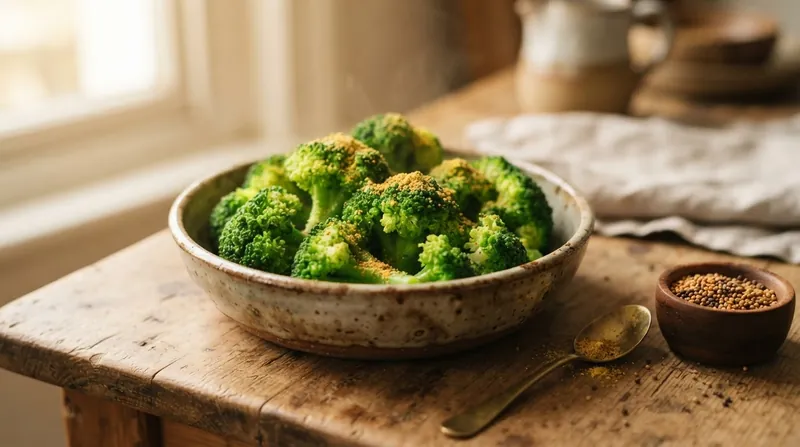
Broccoli faces a remarkably similar enzymatic hurdle. It contains a beneficial precursor called glucoraphanin, which must be converted into active sulforaphane by the plant's native myrosinase enzyme to deliver its well-documented antioxidant benefits.[1][2]
The Mustard Seed Multiplier
The problem with broccoli is that standard cooking methods, particularly boiling or steaming for extended periods, completely destroy its heat-sensitive myrosinase. Without the active enzyme, the glucoraphanin remains largely unconverted and biologically inert.[1][2]
While human gut bacteria can perform a small amount of this conversion, the process is highly inefficient and varies wildly between individuals. Clinical trials show that relying on gut bacteria alone yields exceptionally poor sulforaphane absorption.[2]
Food scientists discovered a simple kitchen workaround to bypass this limitation: adding a pinch of raw mustard seed powder to the cooked broccoli. Mustard seeds belong to the same brassica family and contain a robust supply of active myrosinase.[1][2]
Dusting the cooked vegetable with this raw powder replaces the lost enzyme and restarts the chemical reaction. In a 2018 randomized crossover trial, this technique increased the bioavailability of sulforaphane by more than four times compared to eating cooked broccoli alone.[1]
The addition of the raw enzyme essentially rescues the nutritional potential of the cooked vegetable. It proves that the biological value of a meal can be rescued simply by reintroducing the specific catalyst that heat destroyed.[1][2]
Heat as a Nutrient Unlocker
While heat is the enemy of enzymes like alliinase and myrosinase, it is absolutely essential for unlocking other vital nutrients. The proteins found in raw eggs demonstrate exactly why cooking is sometimes mandatory for human absorption.[11]
Raw egg whites contain a specific glycoprotein called avidin. Avidin evolved as a biological defense mechanism to bind tightly to biotin, also known as vitamin B7, forming a complex that is incredibly stable and resistant to digestion.[11]
This avidin-biotin bond is one of the strongest non-covalent interactions in nature. It is so secure that human digestive enzymes cannot break it apart, meaning the bound vitamin passes through the gastrointestinal tract completely unabsorbed.[11]
Consuming raw egg whites regularly can lead to a severe biotin deficiency, characterized by hair loss, skin rashes, and lethargy. Cooking the egg completely solves this nutritional trap by fundamentally altering the protein's architecture.[11]
The heat of a frying pan or boiling water denatures the avidin protein, unraveling its structure and permanently destroying its ability to bind biotin. The cooked egg immediately transforms from a nutrient trap into a highly bioavailable source of the vitamin.[11]
Dosing and the Body's Regulators
Beyond physical preparation, the human body actively regulates how much of a nutrient it absorbs based on the size and timing of the dose. A persistent fitness myth claims the gut can only absorb 30 grams of protein per meal.[5][6]
According to this rule, any protein consumed beyond that arbitrary ceiling is simply wasted or burned for energy. Modern isotope tracer studies have thoroughly debunked this concept, revealing a much more adaptable and efficient digestive system.[5][6]
In a landmark 2023 trial at Maastricht University, researchers fed young men a massive 100-gram dose of milk protein. The gut did not stop absorbing at 30 grams; instead, it slowed the digestive process to match the incoming load.[6]
The massive dose sustained elevated muscle protein synthesis for more than 12 hours, with the body continuously extracting and utilizing the amino acids long after a smaller dose would have been entirely depleted.[6]
The body does not hit a wall and discard the excess macronutrients. It simply extends the metabolic shift, proving that total daily protein intake matters far more than strictly dividing meals into 30-gram portions.[5][6]
The Hepcidin Blockade
Mineral absorption is governed by even stricter biological gatekeepers than macronutrients. Iron uptake, for example, is tightly controlled by a liver hormone called hepcidin, which prevents toxic metal accumulation in the bloodstream.[12]
When you take a large iron supplement, the sudden influx of the mineral triggers a sharp spike in hepcidin production. This hormone travels to the gut and actively blocks further iron absorption for up to 48 hours.[12]
"Oral iron remains the first-line therapy for iron deficiency anemia, but optimal dosing strategies have shifted in recent years," writes Dr. William Aird for The Blood Project. He notes that traditional daily dosing keeps hepcidin chronically elevated.[12]
By spacing doses to every other day, the body's regulatory system is allowed to reset. "By spacing doses, hepcidin levels decline, allowing for better fractional absorption of subsequent doses," Aird explains.[12]
Clinical trials have shown that this simple timing adjustment increases the fractional absorption of the iron by 34 percent. Patients absorb significantly more of the mineral with fewer gastrointestinal side effects, proving that more frequent dosing is not always better.[12]
The Lipid Pathway and Saturated Fat
The way the body processes dietary fats provides another clear example of complex internal regulation. Saturated fats do not raise blood cholesterol by simply pouring more cholesterol directly into the bloodstream.[7][8]
Instead, specific saturated fatty acids, namely palmitic and myristic acids, alter the way the liver clears existing cholesterol. These fats are poor substrates for the ACAT enzyme, which normally packages cholesterol for safe cellular storage.[7][8]
Because they cannot be efficiently stored, free cholesterol begins to accumulate inside the liver cells. The liver interprets this localized buildup as a signal that the entire body has too much cholesterol available.[7][8]
In response, it suppresses a transcription factor called SREBP-2, which halts the production of new LDL receptors on the cell surface. These receptors are the primary mechanism for pulling low-density lipoproteins out of the blood.[7][8]
With fewer receptors on the liver's surface, LDL particles remain trapped in circulation, driving up blood cholesterol levels. Swapping saturated fats for unsaturated fats reverses this signal, prompting the liver to build more receptors and clear the blood.[7][8]
Preservation and Spoilage Thresholds
Understanding food science also requires understanding how food degrades over time. The safety and shelf life of a product are governed by a metric known as water activity, rather than its total moisture content.[13]
Water activity measures the amount of free, unbound water available in a food matrix to support chemical reactions and microbial growth. It is the definitive threshold that dictates whether bacteria, yeasts, or molds can survive in a product.[13]
Most pathogenic bacteria, including Salmonella and E. coli, require a water activity above 0.91 to multiply. The FDA specifically exempts foods with a water activity of 0.85 or below from certain strict regulations because they cannot support bacterial hazards.[13]
Food preservation techniques rely entirely on manipulating this metric. Dehydration physically removes the water, while adding humectants like salt or sugar binds the free water chemically, lowering the activity level without necessarily drying the food out.[13]
However, the use of salt as a humectant is tightly regulated for human health. To earn a strict "low sodium" label on grocery shelves, the FDA mandates that a food must contain 140 milligrams or less of sodium per standard serving.[14]
Comparison
| Preparation Method | Target Nutrient / Compound | Primary Mechanism | Bioavailability Impact |
|---|---|---|---|
| Cooling cooked potatoes to 4°C | Carbohydrates (Starch) | Amylose retrogradation | Converts rapid glucose into digestion-resistant prebiotic fiber |
| Crushing garlic and resting 10 mins | Allicin | Alliinase enzyme activation | Maximizes sulfur compound formation before heat destroys the enzyme |
| Adding raw mustard seed to cooked broccoli | Sulforaphane | Exogenous myrosinase introduction | Quadruples absorption by replacing heat-destroyed native enzymes |
| Cooking raw egg whites | Biotin (Vitamin B7) | Avidin protein denaturation | Unlocks vitamin B7 by destroying the binding protein |
| Alternate-day iron supplementation | Iron | Hepcidin hormone suppression | Increases fractional absorption by 34% by bypassing the hormonal blockade |
How we did this
- Method
- Compared the quantitative impact of mechanical, thermal, and temporal food preparation methods on nutrient bioavailability and molecular structure across distinct food matrices.
- What we found
- Across completely different nutrient classes—from phytonutrients and minerals to macronutrients—the timing and mechanical preparation of food exert a larger influence on actual human absorption than the raw quantity of the nutrient present in the food.
- What we worked from
- Sulforaphane absorption increase via mustard seed myrosinase: 4x greater bioavailability — National Institutes of Health
- Fractional iron absorption increase via alternate-day dosing: 34% higher absorption — The Blood Project
- Protein synthesis duration from 100g dose: 12+ hours — FitChef
- Limits of this analysis
- This analysis compares distinct biological mechanisms (enzymatic conversion, hormonal regulation, and structural denaturation) which operate on different timelines and cannot be universally applied to all nutrients.
Terms to know
- Allicin
- A bioactive sulfur compound formed in garlic when the enzyme alliinase reacts with alliin after the clove is crushed.
- Avidin
- A glycoprotein found in raw egg whites that binds tightly to biotin, preventing the body from absorbing the vitamin.
- Hepcidin
- A hormone produced by the liver that regulates iron homeostasis by blocking the absorption of iron in the intestines.
- Myrosinase
- An enzyme found in brassica vegetables and mustard seeds that converts glucoraphanin into the beneficial compound sulforaphane.
- Resistant Starch
- A type of carbohydrate that escapes digestion in the small intestine and ferments in the colon, acting as a prebiotic fiber.
- Water Activity
- A measurement of the free, unbound water in a food product that is available to support microbial growth and chemical reactions.
- Retrogradation
- The process by which gelatinized starch molecules realign into tight, digestion-resistant crystalline structures as they cool.
Questions readers ask
Does reheating cooled potatoes destroy the resistant starch?
No. Once the starch has retrograded at 4°C, the newly formed crystalline structure is highly stable. Reheating the potatoes reduces the resistant starch slightly, but it remains significantly higher than in freshly cooked potatoes.
Can I use garlic powder instead of fresh crushed garlic?
Garlic powder contains almost no active allicin because the commercial dehydration process uses heat that destroys the alliinase enzyme. To get the full benefits, you must crush fresh garlic and let it rest.
Is it safe to eat raw eggs if they are pasteurized?
Pasteurization kills bacteria like Salmonella, but it does not fully denature the avidin protein. Consuming pasteurized raw egg whites regularly can still bind biotin and lead to a vitamin B7 deficiency.
Does the 30-gram protein limit apply to fast-digesting whey?
While whey digests faster than whole food or casein, recent studies show that large doses of protein simply take longer to digest. The body does not waste the excess; it extends the absorption window.
Why does alternate-day iron dosing work better?
Taking iron triggers the release of hepcidin, a hormone that blocks further iron absorption for up to 48 hours. Skipping a day allows hepcidin levels to drop, making the next dose much more effective.
Different angles
Nutritional Biochemists' View
Focus on the molecular mechanisms of food, arguing that preparation methods dictate nutrient value more than raw ingredient profiles.
Biochemists emphasize that a food's raw nutritional profile is merely a baseline of potential. They study the enzymatic reactions, protein denaturation, and hormonal feedback loops that dictate actual human absorption. From this perspective, the kitchen is a laboratory where temperature and mechanical stress are used to actively manipulate the food matrix, unlocking compounds like sulforaphane and allicin that do not exist in the intact plant.
Clinical Dietitians' View
Emphasize practical application, translating complex absorption kinetics into actionable meal timing and cooking advice for patients.
Dietitians focus on how these biochemical realities translate into daily habits. Rather than overwhelming patients with the mechanics of the SREBP-2 pathway or hepcidin regulation, they provide actionable rules: wait ten minutes after crushing garlic, take iron supplements every other day, and cool starchy carbohydrates before eating them. Their goal is to maximize patient compliance and nutritional outcomes without requiring a degree in molecular biology.
Food Safety Regulators' View
Prioritize strict thresholds for microbial growth and standardized labeling to protect public health at a population level.
Regulatory bodies like the FDA approach food science through the lens of risk mitigation and population-scale health. They rely on hard metrics like water activity to establish universal safety thresholds that prevent bacterial outbreaks in packaged foods. Similarly, they enforce strict definitions for terms like 'low sodium' to ensure that consumers can make informed, safe choices without needing to independently verify the chemical composition of every meal.
What changed
- · Revision 1Published.
Related explainers
- The SREBP-2 Pathway: How Saturated Fat Downregulates LDL Receptors to Raise Blood Cholesterol
- Adding Raw Mustard Seed to Cooked Broccoli Quadruples Its Sulforaphane Absorption
- The 4°C Retrogradation Shift: How Chilling and Reheating Potatoes Transforms Rapid Carbs into Prebiotic Fiber
- The 30-Gram Protein Myth: What a 12-Hour Tracer Study Revealed About Human Digestion
- The 10-Minute Garlic Rule: How Crushing and Resting Unlocks Allicin Before Heat Destroys It
- The Emerging Science of Psychobiotics: How Gut Health Influences Mental Well-Being
- Cooling Cooked Starches Builds Resistant Starch That Blunts Blood Sugar Spikes
- How Cooking Eggs Unlocks Vitamin B7 by Destroying the Avidin Protein
- How Alternate-Day Iron Dosing Increases Absorption by 50 Percent
- Water Activity: The Critical Thresholds That Control Microbial Growth and Food Spoilage
- The 140 Milligrams Per Serving Maximum: How the FDA Defines a 'Low Sodium' Food
- Nutritional Biochemists
- Focus on the molecular mechanisms of food, arguing that preparation methods dictate nutrient value more than raw ingredient profiles.
- Clinical Dietitians
- Emphasize practical application, translating complex absorption kinetics into actionable meal timing and cooking advice for patients.
- Food Safety Regulators
- Prioritize strict thresholds for microbial growth and standardized labeling to protect public health at a population level.
Perspectives this story doesn't cover
- Agricultural producers breeding crops for higher baseline nutrient density.
- Culinary professionals balancing optimal nutrient retention with flavor and texture.
Sources
Source coverage
15 outlets
3 viewpoints surfaced














- [1]National Institutes of HealthNutritional Biochemists
Supplementation of the Diet by Exogenous Myrosinase via Mustard Seeds
Read on National Institutes of Health → - [2]Eat Well PlannerClinical Dietitians
Maximizing Sulforaphane in Broccoli
Read on Eat Well Planner → - [3]Otto ChefClinical Dietitians
The Chemistry of Starch: Amylose and Amylopectin
Read on Otto Chef → - [4]HealthlineFood Safety Regulators
Cooling Some Foods After Cooking Increases Resistant Starch
Read on Healthline → - [5]KcalmClinical Dietitians
How Much Protein Can Your Body Absorb? No 30g Limit
Read on Kcalm → - [6]FitChefClinical Dietitians
The 30g Protein Limit Myth
Read on FitChef → - [7]Empirical HealthClinical Dietitians
Saturated Fat, Cholesterol, & Heart Health
Read on Empirical Health → - [8]Real NutritionClinical Dietitians
How Does Saturated Fat Raise LDL Cholesterol?
Read on Real Nutrition → - [9]Nutrition From FoodClinical Dietitians
How to Get Allicin from Garlic (Step-by-Step)
Read on Nutrition From Food → - [10]Inner BuddiesClinical Dietitians
The Optimal Garlic Prep Method
Read on Inner Buddies → - [11]Vegan OmegaClinical Dietitians
Avidin: The Biotin Blocker in Raw Egg Whites
Read on Vegan Omega → - [12]The Blood ProjectClinical Dietitians
Iron Dosing in Iron Deficiency Anemia: An Evolving Approach
Read on The Blood Project → - [13]Agriculture InstituteNutritional Biochemists
Why Water Activity Matters for Food Spoilage
Read on Agriculture Institute → - [14]IngrediCheckFood Safety Regulators
What Does Low Sodium Mean on a Food Label?
Read on IngrediCheck → - [15]Factlen Editorial TeamNutritional Biochemists
Synthesis by Factlen editorial team
Read on Factlen Editorial Team →
More in Food & Drink
See all →Iron Supplementation
How Alternate-Day Iron Dosing Increases Absorption by 50 Percent
9 sources
Food Security
Mid-Year Global Report Projects 44.5% Decline in Food Aid Funding by 2026
4 sources

Cholesterol Science
The SREBP-2 Pathway: How Saturated Fat Downregulates LDL Receptors to Raise Blood Cholesterol
7 sources
Heart Health
Eating 4 to 6 Servings of Whole Grains Daily Lowers Major Cardiovascular Risk Factors, Meta-Analysis Finds
5 sources

Comments
Every angle. Every day.
Get Food & Drink stories with full source coverage and perspective breakdowns, free every day.