full timeline
NASA nuclear space propulsion development
NASA and the Department of Energy have signed a new pact to accelerate space nuclear technologies, advancing the SR-1 Freedom spacecraft toward its 2028 Mars launch.
Follow NASA nuclear space propulsion development in the Factlen app and get an alert when there is news. Get the app
Share this story
Latest report
NASA and DOE Advance Fission-Powered Space Reactor With Key Module Milestones
NASA and the Department of Energy have signed a new pact to accelerate space nuclear technologies, advancing the SR-1 Freedom spacecraft toward its 2028 Mars launch. The mission recently secured a critical contract for its nuclear power module, marking a major step in transitioning fission propulsion from laboratory research to deep-space operations.
- NASA and the DOE finalized a ten-year pact to accelerate space nuclear technologies, advancing the SR-1 Freedom mission toward a 2028 launch.
- The agencies secured a contract for a closed Brayton cycle power conversion system, a critical component of the spacecraft's 20-kilowatt nuclear module.
- SR-1 Freedom will use nuclear electric propulsion to power plasma thrusters, enabling highly efficient transit to Mars without relying on solar energy.
- The technology directly supports the development of Lunar Reactor-1, a 40-kilowatt surface power system mandated to sustain a Moon base by 2030.
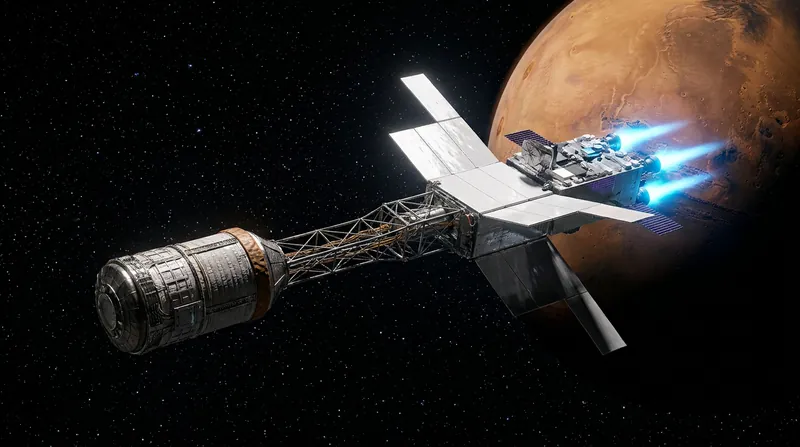
NASA and the Department of Energy have finalized a strategic agreement to accelerate space nuclear technologies, propelling the Space Reactor-1 Freedom mission past critical development milestones. The agencies have secured the closed Brayton cycle power conversion system for the spacecraft's nuclear power module. This keeps the fission-powered vehicle on track for a late 2028 launch to Mars.[1][4]
The milestone marks a definitive shift from theoretical laboratory research to operational deep-space hardware. Unlike traditional chemical rockets or solar-powered systems, SR-1 Freedom relies on nuclear electric propulsion to navigate the vast distances of the solar system. The spacecraft will be humanity's first fission-powered vehicle to travel outside Earth's orbit.[1][2]
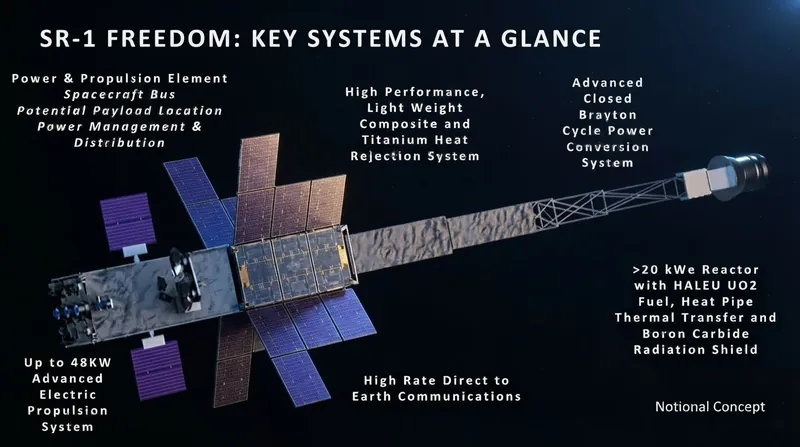
At the heart of the spacecraft is a 20-kilowatt uranium-fueled fission reactor, currently being designed by the Department of Energy's Idaho National Laboratory. The newly contracted power conversion system, provided by Sierra Lobo Inc., translates the reactor's thermal energy directly into electricity. The integration work will take place at NASA's Glenn Research Center in Cleveland.[1][5]
"These contract actions not only reduce technical risk and help us maintain momentum toward our 2028 launch, but they also strengthen collaboration across our partners," said Steve Sinacore, the SR-1 Freedom program director. "These actions keep SR-1 Freedom on track and ensure we're building the strongest possible foundation for NASA's first fission-powered voyage."[1]
Bypassing the Need for Sunlight
The electricity generated by the module powers a suite of plasma thrusters, specifically three 12-kilowatt and four 6-kilowatt Hall-effect engines. By ionizing and accelerating xenon propellant, the nuclear electric propulsion system achieves far greater fuel efficiency than chemical rockets. This enables sustained, continuous thrust over interplanetary distances where solar arrays become useless.[5]
NASA Administrator Jared Isaacman emphasized the necessity of the technology for deep-space exploration during a recent summit in Washington. "Nuclear power will allow us to go farther, operate longer, and field more capable spacecraft and instruments than ever before," Isaacman said. "We are entering the 'Nuclear NASA-era,' which represents a major transformation for space exploration."[4]
The broader framework driving this progress is a Memorandum of Understanding titled "Accelerating American Leadership in Space Nuclear Power and Propulsion." Signed on October 8, 2026, by Isaacman and U.S. Secretary of Energy Chris Wright, the pact unites the agencies across research, fuel production, and launch integration. The agreement takes effect on November 1.[2][4]
The new ten-year agreement replaces two earlier frameworks from 2016 and 2025, consolidating the government's approach to space nuclear development. It directly implements a December 2025 executive order on space superiority, which mandated an accelerated timeline for deploying nuclear systems. The pact ensures that both agencies coordinate closely on rigorous testing and safety protocols.[3][4]
"The Energy Department is proud to partner with NASA as we help American space missions reach uncharted territory," Wright said during the signing ceremony at the Donald J. Trump Institute of Peace. "America's nuclear renaissance is reaching a new frontier."[4]
Powering the Martian SkyFall Payload
When SR-1 Freedom launches in December 2028, it will serve as a critical pathfinder for deep-space fission power. The spacecraft is slated to carry the SkyFall payload, a science package that includes three advanced Mars helicopters. By demonstrating reliable nuclear power in transit, the mission aims to prove that fission systems can safely operate and deliver heavy payloads.[1][3]
Engineers are repurposing existing hardware to meet the aggressive 2028 deadline, rather than designing the entire spacecraft from scratch. The mission utilizes the Power and Propulsion Element originally developed for the Lunar Gateway space station, combining it with the new nuclear power module. This pragmatic approach limits the scope of new development strictly to the reactor and power conversion systems.[5]
The power conversion system itself represents a significant engineering challenge, as it must operate in a vacuum without the cooling water used by terrestrial nuclear plants. The closed Brayton cycle system converts heat directly into electricity using a circulating gas, bypassing the need for heavy liquid coolants. Mass efficiency remains the primary constraint for the orbital hardware.[1][5]
Sustaining a Permanent Lunar Base
The technology developed for SR-1 Freedom directly supports NASA's longer-term ambitions for the lunar surface. The agencies are concurrently working on Lunar Reactor-1, a fission surface power system mandated for deployment by 2030. This reactor is designed to provide continuous, baseline electricity to sustain a permanent Moon base through the two-week-long lunar night.[2][3]
The lunar surface reactor will generate up to 40 kilowatts of electricity, which is enough to continuously power 30 average households for a decade. Operating autonomously, the system will energize habitats, communications arrays, scientific instruments, and rovers. The Department of Energy has already engaged commercial partners to refine the system's design and ensure it meets strict mass limits.[4][6]
To reach the lunar surface, the entire 40-kilowatt reactor system must weigh less than 6,000 kilograms so it can be transported by a commercial lunar lander. Once deployed, the system is designed to operate safely with a radiation footprint of just 5 rem per year at a distance of one kilometer, protecting co-located plant equipment and crew habitation areas.[6]
"The work we're doing today is laying the foundation for the fission-powered spacecraft of tomorrow and opening an entirely new frontier for exploration and discovery," Isaacman said. He compared the upcoming launch of SR-1 Freedom to the maiden voyage of the USS Nautilus, the world's first nuclear-powered submarine, which revolutionized maritime operations.[3][4]
Expanding Radioisotope Battery Use
Beyond active fission reactors, the NASA and Department of Energy pact expands their long-standing collaboration on radioisotope power systems. These nuclear batteries convert the natural heat from radioactive decay into steady electricity. They have reliably powered deep-space probes for decades, including the Voyager spacecraft and the Curiosity rover.[3][4]
Under the new agreement, the Department of Energy will supply radioisotope power and heater units for several upcoming flagship missions. These include NASA's Dragonfly rotorcraft, which is scheduled to launch to Saturn's moon Titan in 2028, and the European Space Agency's Rosalind Franklin Mars rover. The batteries will protect sensitive equipment in extremely cold environments.[3]
The integration of the nuclear power module at the Glenn Research Center marks the beginning of a rigorous testing phase for SR-1 Freedom. Engineers must validate the heat transfer technologies and ensure the Brayton cycle converters can seamlessly interface with the Idaho National Laboratory's reactor design under simulated space conditions.[1][5]
The successful deployment of SR-1 Freedom will ultimately dictate the pace of future nuclear-electric missions across the solar system. If the 2028 pathfinder mission performs as expected, fission power could become the standard architecture for humanity's expansion, providing the abundant energy required to sustain outposts on Mars and explore the outer planets.[2][3]
Sources
- [1]NASA — NASA’s SR-1 Freedom Advances with Progress on Nuclear Power Module Read on NASA →
- [2]World Nuclear News — NASA, DOE join forces for 'new era' of space technologies Read on World Nuclear News →
- [3]Payload Space — NASA Signs Space Nuclear Pact, Says Moon Base Is Ahead of Schedule Read on Payload Space →
- [4]NASA — NASA, Energy Department Advance New Era of Nuclear-Powered Exploration Read on NASA →
- [5]Wikipedia — Space Reactor-1 Freedom Read on Wikipedia →
- [6]Wikipedia — Fission Surface Power Read on Wikipedia →
Key numbers
From: How NASA Pivoted to Nuclear Electric Propulsion for Deep Space
Charts, maps and images
Timeline
October 2026
NASA and DOE Advance Fission-Powered Space Reactor With Key Module Milestones
June 2026
How NASA Pivoted to Nuclear Electric Propulsion for Deep Space