full timeline
Japan MMX Phobos mission
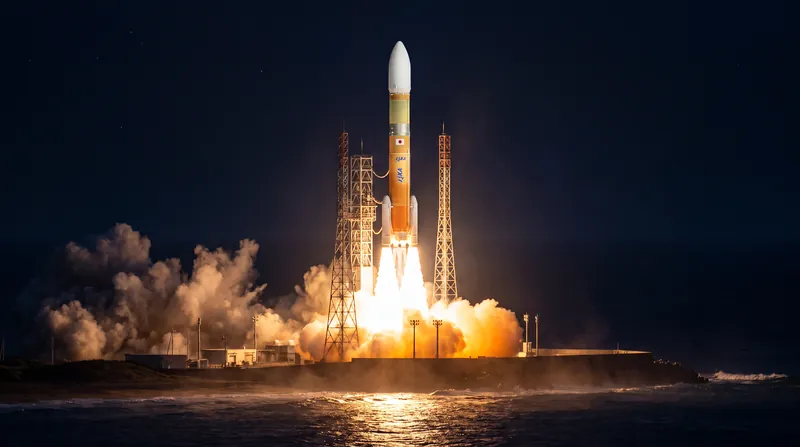
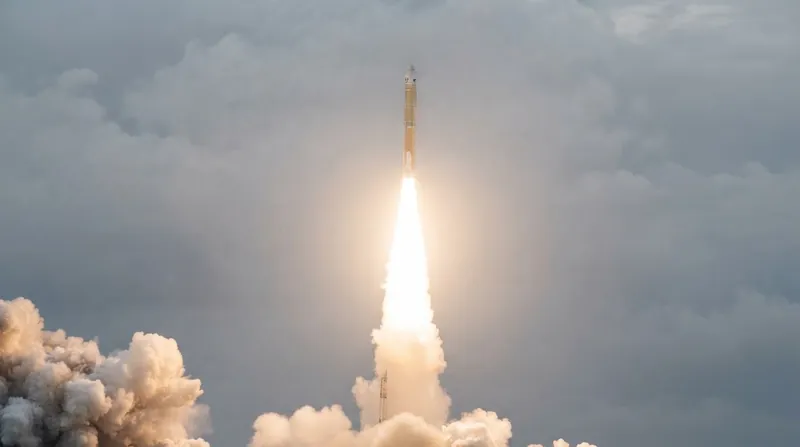
The Japan Aerospace Exploration Agency (JAXA) successfully launched the Martian Moons eXploration (MMX) spacecraft, beginning a five-year mission to collect the first-ever surface samples from Mars's…
Follow Japan MMX Phobos mission in the Factlen app and get an alert when there is news. Get the app
Share this story
Latest report
Japan Launches Flagship H3 Rocket on Historic MMX Mission to Martian Moon Phobos
The Japan Aerospace Exploration Agency (JAXA) successfully launched the Martian Moons eXploration (MMX) spacecraft, beginning a five-year mission to collect the first-ever surface samples from Mars's moon Phobos. The probe will deploy a rover, gather at least 10 grams of regolith, and return to Earth in 2031 to help determine the origins of the Martian moons.
- JAXA successfully launched the MMX spacecraft aboard an H3 rocket to execute the first sample return from a Martian moon.
- The probe will deploy a French-German rover in 2029 to survey Phobos before collecting at least 10 grams of surface material.
- Scientists hope the samples will reveal whether Phobos and Deimos are captured asteroids or debris from an ancient Martian impact.
- The mission's return capsule is scheduled to deliver the collected regolith to the Australian outback in 2031.
The Japan Aerospace Exploration Agency (JAXA) successfully launched its Martian Moons eXploration (MMX) spacecraft aboard an H3 rocket from the Tanegashima Space Center. The mission marks the beginning of a five-year journey to Mars's largest moon, Phobos, aiming to execute the first-ever sample return from the Martian sphere.[1][6]
The 4,480-kilogram spacecraft lifted off from the Yoshinobu Launch Complex, riding Japan's new flagship launch vehicle into a transfer trajectory. The successful deployment initiates a historic scientific endeavor and solidifies the reliability of the H3 rocket, which was developed to secure Japan's independent access to deep space.[1][6]
Navigating the Martian System
The spacecraft will travel for approximately 10 months, covering an actual flight distance of 500 to 600 million kilometers, before arriving in the Martian system by August 2027. Once there, it will enter a quasi-satellite orbit around Phobos, spending three years conducting detailed observations of both Phobos and Deimos.[1][5]
In early 2029, the MMX probe will deploy a 25-kilogram rover named Idefix, jointly developed by the French and German space agencies. The rover will spend 100 days navigating the moon's ultra-low gravity to identify a safe and level landing site for the main spacecraft.[1][5]
Because the gravity on Phobos is roughly one two-thousandth of Earth's, the rover will weigh the equivalent of just 15 grams on the surface. It is equipped with miniaturized cameras and radiometers to study the surface microstructure and thermal properties of the regolith before the primary landing.[1]
Following the rover's reconnaissance, the primary spacecraft will touch down on Phobos to collect surface material. JAXA engineers equipped the probe with two distinct collection mechanisms to ensure redundancy and maximize the scientific yield from the brief surface operations.[1][3]
The first is a pneumatic system developed with NASA that uses pressurized nitrogen gas to blow surface dust into a receptacle. The second is a Japanese coring tool designed to extract material from a depth of at least two centimeters, protecting the sample from intense surface radiation.[1][3]
"Despite their potential importance, Martian moons have never been fully investigated," said Yasuhiro Kawakatsu, the project manager for the MMX mission. He noted that the two moons are widely considered the most important unclimbed mountains in the solar system.[1]
Resolving a Planetary Mystery
The mission's primary scientific objective is to resolve a longstanding debate regarding the origins of Phobos and Deimos. Astronomers remain divided on whether the two potato-shaped moons are captured asteroids pulled in by Mars's gravity, or if they coalesced from debris ejected after a massive impact.[1][5]
By returning at least 10 grams of regolith to Earth in 2031, scientists hope to analyze the isotopic composition of the material. If the moons formed from a planetary collision, the samples should contain traces of ancient Martian crust, offering insights into early conditions that supported life.[1][2]
Material from Mars itself is expected to make up about 0.1 percent of the regolith collected from Phobos, according to JAXA officials. Because Phobos orbits just 6,000 kilometers above the Martian surface, it has steadily accumulated ejecta from asteroid impacts on Mars over billions of years.[1]
The mission also serves as a critical technology demonstration for future deep-space exploration. The ability to land on a low-gravity body, collect samples, and execute a round-trip journey to the Martian system is seen as a necessary precursor for crewed missions to Mars.[1]
"Samples from Phobos would provide useful data for scientists to consider using a Martian moon as a base for a future manned mission to the planet," Kawakatsu noted. He highlighted the strategic value of the mission for international space agencies aiming to send astronauts to Mars.[1]
International Partnerships and Past Failures
While led by Japan, the MMX mission relies heavily on international partnerships to mitigate the immense risks of interplanetary sample return. The European Space Agency provided deep-space communication equipment, including a transponder and power amplifier, and will support the mission through its Estrack ground station network.[1][5]
NASA's contribution includes the pneumatic sampling device and a gamma-ray and neutron spectrometer designed to analyze the elemental composition of Phobos from orbit. The French space agency supplied a near-infrared spectrometer and flight dynamics expertise to assist with the complex orbital maneuvers.[1][3]
The collaborative nature of the mission reflects the growing complexity and cost of interplanetary exploration. The MMX project has an estimated budget exceeding 55 billion yen, underscoring the financial commitment required to push the boundaries of robotic spaceflight.[1]
Historically, Phobos has proven to be an exceptionally difficult target for space agencies. Multiple Russian attempts to land on the moon have ended in failure, including the Phobos-Grunt mission launched in 2011, which became stranded in Earth orbit shortly after liftoff.[1]
The Journey Home
After completing its sampling operations and conducting flyby observations of Deimos, the MMX spacecraft will depart the Martian system in 2030. The return module is scheduled to release its sample capsule into Earth's atmosphere in 2031, with a targeted landing in the Australian outback.[1][5]
The successful launch of the H3 rocket also provides a significant boost to Japan's domestic space program. Mitsubishi Heavy Industries intends for the new flagship launch vehicle to secure Japan's independent access to space and compete aggressively in the global commercial launch market.[1]
As the spacecraft begins its transit to Mars, mission controllers in Japan will spend the coming months verifying the health of the probe's 13 scientific instruments. If successful, the mission will rewrite the history of the Martian system and establish a new paradigm for robotic exploration.[1]
Sources
- [1]The Guardian — Japan to launch world-first mission to collect samples from Martian moon Read on The Guardian →
- [2]India Today — Japan to launch spacecraft to Martian moon Phobos on Tuesday, bring back rocks in 2031 Read on India Today →
- [3]NASA — NASA to Help Unlock Mysteries of Mars' Moons in Upcoming Mission Read on NASA →
- [4]Saudi Gazette — Japan to launch historic mission to collect samples from Martian moon Read on Saudi Gazette →
- [5]EarthSky — MMX mission will travel to Phobos and bring a sample home Read on EarthSky →
- [6]Japan Today — Japan to launch historic round-trip mission to Mars moon Read on Japan Today →
Charts, maps and images
Timeline
October 2026
Japan Launches Flagship H3 Rocket on Historic MMX Mission to Martian Moon Phobos
AIJapan Readies MMX Mission to Phobos to Retrieve First Martian Moon Samples