full timeline
Ireland–Israel UEFA Nations League fixtures
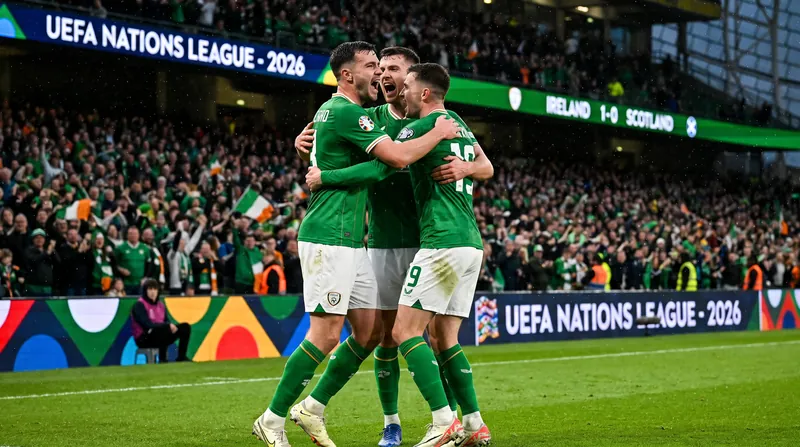
Ireland secured a commanding 3-0 victory over Israel in Debrecen, scoring three times in a ruthless 12-minute first-half spell after a week of intense off-pitch controversy.
Follow Ireland–Israel UEFA Nations League fixtures in the Factlen app and get an alert when there is news. Get the app
Share this story
Latest report
Republic of Ireland Overwhelms Israel 3-0 in Politically Charged Nations League Clash
Ireland secured a commanding 3-0 victory over Israel in Debrecen, scoring three times in a ruthless 12-minute first-half spell after a week of intense off-pitch controversy.
- The Republic of Ireland defeated Israel 3-0 in their UEFA Nations League clash in Debrecen, Hungary.
- Ireland scored all three goals in a ruthless 12-minute spell in the first half.
- Irish players protested the war in Gaza by wearing black armbands and refusing pre-match handshakes.
- Israel held 64 percent possession but failed to register a single big chance.
- The match proceeded only after a majority vote by the Irish squad following calls for a boycott.
When a national team is torn apart by internal votes, public boycott demands, and high-profile squad withdrawals days before a fixture, the usual result on the pitch is a disjointed, distracted collapse. The Republic of Ireland's 2026 UEFA Nations League clash against Israel on Sunday carried all those hallmarks of impending disaster.
Yet, the outcome differed in one spectacular respect: Heimir Hallgrímsson’s squad channeled a week of unprecedented political angst into the most ruthless 25 minutes of transition football they have played in a decade, completely dismantling their opponents before the half-hour mark.[1][5]
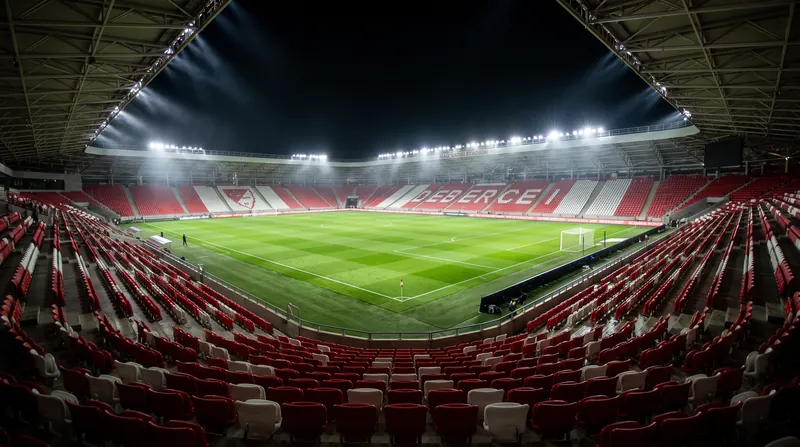
Playing at the neutral Nagyerdei Stadion in Debrecen, Hungary—an alternative venue mandated by UEFA due to ongoing security concerns in Israel—Ireland overwhelmed the designated hosts 3-0 to secure their first victory of the League B Group 3 campaign. The damage was done entirely in the first half, with Troy Parrott, Adam Idah, and Jack Moylan finding the net in a blistering 12-minute spell that left the Israeli defense in tatters. The result marks Israel's worst-ever start to an official international campaign.[2][3]
The buildup to the match was dominated entirely by off-pitch tension. Following intense calls from Irish advocacy groups and over 160 athletes to boycott the fixture over the war in Gaza, backup goalkeeper Gavin Bazunu withdrew from the squad on moral grounds. The game only proceeded after a majority vote by the Irish players, who opted to fulfill the fixture while staging visible protests. That internal angst translated into a unified, steely resolve once the squad arrived at the 20,000-seat arena.[4][6]
Those protests materialized immediately before kickoff, setting a surreal tone in the near-empty stadium. The Irish starting XI wore black armbands—which the Football Association of Ireland stated was a mark of respect for all lives lost in the conflict—and bowed their heads during the Israeli national anthem. In a stark departure from standard UEFA pre-match protocols, there was no exchange of pennants, and players, including captains Dara O'Shea and Manor Solomon, refused to shake hands at the center circle.[3][4][6]
Once the referee's whistle blew, the political theater gave way to a tactical masterclass in counter-attacking football. Ireland set up in a disciplined, compact defensive shape, willingly inviting Israel to hold the ball in non-threatening central areas. In the 13th minute, the trap was sprung. Wingback James Abankwah drove aggressively down the right flank and cut a precise pass back to Parrott, who finished low through the body of Israeli goalkeeper Daniel Peretz to open the scoring.[1][2]
Israel barely had time to reset their defensive lines before they were punished again. Just three minutes later, Moylan slipped a clever, line-breaking through ball to Idah. Running on the shoulder of the last defender, the forward calmly slotted his shot inside the left post to double the advantage. By the 25th minute, Moylan turned from provider to executioner, driving 25 yards into the penalty box and firing a right-footed strike into the net to make it 3-0 and effectively end the contest.[1][2]
Moylan’s celebration carried its own heavy symbolism on a night defined by it. After scoring his fourth goal in as many international caps, the midfielder sprinted to the corner flag, removed his black armband, and kissed it in front of the traveling Irish staff and the small contingent of fans. It was a moment of pure catharsis for a squad that had spent the previous seven days under an intense national microscope, heavily criticized by some at home for agreeing to play at all.[1][5]
The underlying match statistics tell a fascinating story of two entirely different, colliding game plans. Israel dominated the ball, holding 64 percent possession and completing 576 accurate passes compared to Ireland's 281. Yet, that possession was entirely sterile and predictable. The home side failed to register a single big chance in the first half, repeatedly running into a congested, hard-tackling Irish midfield anchored by Conor Coventry and Jayson Molumby, who clogged the middle spaces and forced the ball wide.[2]
Ireland’s attacking efficiency, by contrast, was staggering. The visitors generated 1.57 Expected Goals (xG) from just a handful of final-third entries, compared to Israel's meager 0.31 xG. Every one of Ireland's three shots on target in the first half ended up in the back of the net. As Sofascore's tactical review noted, the performance was "a textbook example of doing more with less of the ball," highlighting how Ireland's direct play and rapid transitions completely bypassed Israel's possession structure.[2]
The second half was a straightforward exercise in game management and physical endurance. Israel manager Ran Ben Shimon turned to his bench, introducing Dor Peretz and Ethane Azoulay to inject pace, and the hosts did manage to force one excellent save from Irish goalkeeper Caoimhín Kelleher. However, the match largely devolved into a series of physical midfield scuffles and disjointed fouls, resulting in yellow cards for Israel's Raz Shlomo and Ireland's Idah following a heated 59th-minute altercation.[2]
For Israel, the comprehensive 3-0 defeat leaves them anchored at the bottom of Group 3, searching for tactical answers and defensive solidity ahead of their next international window. For the Republic of Ireland, the victory serves as a massive validation for Hallgrímsson's ability to shield his squad from deafening external noise.
Key numbers
Sources
- [1]The Guardian — Republic of Ireland put controversy aside to earn impressive win over Israel Read on The Guardian →
- [2]Sofascore — Israel 0-3 Ireland: Nations League, Sofascore Rating Read on Sofascore →
- [3]Sky Sports — Israel 0-3 Republic of Ireland: Heimir Hallgrimsson's side win controversial Nations League meeting in Hungary Read on Sky Sports →
- [4]Al Jazeera — Ireland defeats Israel in controversial UEFA Nations League match Read on Al Jazeera →
- [5]The Irish Times — Ireland keep their heads on surreal night as early burst of goals clinches win over Israel Read on The Irish Times →
- [6]The Times of Israel — Israel's Nations League game against Ireland ends in a 3-0 defeat Read on The Times of Israel →
Charts, maps and images
Timeline
September 2026
Republic of Ireland Overwhelms Israel 3-0 in Politically Charged Nations League Clash
Israel vs Ireland: Nations League Preview, Tactical Matchups, and Stakes