full timeline
Humanoid robot commercialization race
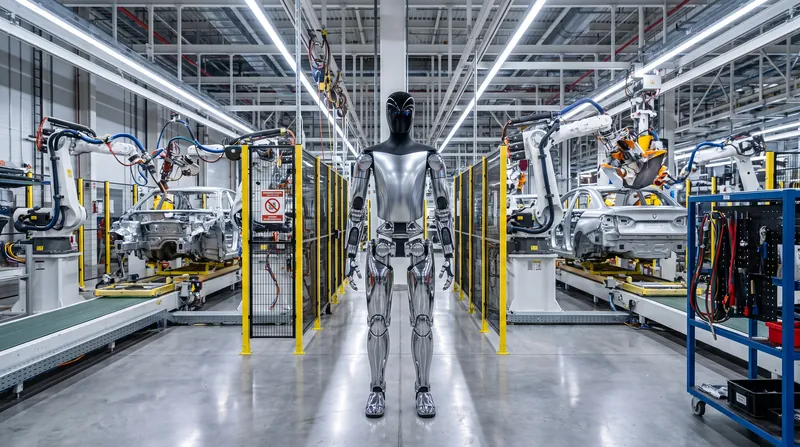
Tesla has begun manufacturing its Optimus humanoid robot at its California facility, targeting 20,000 units a week by late 2027, even as heavy AI investments drove a sharp decline in third-quarter…
Follow Humanoid robot commercialization race in the Factlen app and get an alert when there is news. Get the app
Share this story
Latest report
Tesla Starts Optimus Robot Production in Fremont as Quarterly Profit Drops 43%
Tesla has begun manufacturing its Optimus humanoid robot at its California facility, targeting 20,000 units a week by late 2027, even as heavy AI investments drove a sharp decline in third-quarter earnings.
- Tesla has initiated mass production of its Optimus humanoid robot at its Fremont, California manufacturing facility.
- The production milestone coincides with a 43 percent drop in the company's third-quarter profit, driven by heavy investments in AI infrastructure.
- Early production units will be deployed internally in Tesla's own factories rather than sold to external customers.
- Chief Executive Officer Elon Musk estimates it will take at least a year to scale production to the target of 20,000 units per week.
On October 22, 2026, assembly lines at Tesla's Fremont, California factory began turning out the first mass-produced units of the Optimus humanoid robot. The manufacturing milestone arrives alongside the company's third-quarter financial update, which revealed a 43 percent drop in quarterly profit.[3][4]
The earnings contraction directly reflects the capital-intensive nature of Tesla's pivot toward artificial intelligence and physical automation. According to the company's Q3 2026 Update, capital expenditures on AI computing infrastructure and Optimus development climbed significantly over the previous three months.[5][8]
While manufacturing has officially commenced, the initial output remains tightly constrained as the company refines its assembly processes. "It will take at least a year to reach 20,000 units a week," Chief Executive Officer Elon Musk stated regarding the Fremont facility's production ramp.[2][3]
The robots currently rolling off the California line are not bound for external customers or commercial sale. Tesla is deploying these early production units internally to perform repetitive tasks within its own manufacturing facilities, effectively treating its automotive plants as a beta-testing environment.[1][6]
External commercial availability remains a longer-term objective tied to the success of these internal trials. The company is currently targeting late 2027 to begin shipping Optimus units to outside buyers, though that timeline depends heavily on the hardware surviving continuous industrial use.[1][6]
Shifting from automotive to automation
The Fremont production start marks a structural shift in how Tesla allocates its physical manufacturing footprint. By dedicating factory floor space to humanoid robotics rather than electric vehicles, the company is betting that physical AI will eventually eclipse its core automotive revenue.[3][7]
That strategic bet requires sustaining massive research and development budgets while the primary revenue engine slows down. The 43 percent profit decline reported this week highlights the tension between funding next-generation robotics and maintaining margins in an increasingly competitive global electric vehicle market.[4][5]
Financial analysts have noted that the heavy capital expenditure on Optimus and the underlying AI training clusters is currently yielding zero external revenue. The robots must first prove they can reliably replace human labor in Tesla's own factories to justify the ongoing multibillion-dollar investment.[5][8]
The hardware itself has evolved significantly from the initial prototypes demonstrated in 2022 and 2023. The mass-produced units feature custom-designed actuators and sensors, moving away from off-the-shelf components to tightly integrate the physical chassis with Tesla's proprietary neural network architecture.[6][7]
This vertical integration mirrors the company's approach to automotive manufacturing, but humanoid robotics presents entirely different physical tolerances. Bipedal locomotion and fine motor manipulation require a level of real-time inference that pushes current edge-computing hardware to its absolute thermal and processing limits.[1][8]
The race for humanoid commercialization
Tesla is not operating in a vacuum as it ramps up the Fremont assembly lines. The broader robotics sector has seen a surge in humanoid deployments throughout 2026, with competitors like Figure AI already placing hundreds of units into logistics and automotive facilities.[3][7]
What distinguishes the Optimus program is the sheer scale of manufacturing Tesla intends to achieve over the next 12 months. A target of 20,000 units per week would represent an unprecedented volume for complex bipedal robots, dwarfing the artisanal production rates typical of the current industry.[2][3]
Achieving that volume requires solving massive supply chain bottlenecks for highly specialized components. High-torque, low-weight rotary actuators and tactile sensor arrays are not currently manufactured anywhere in the world at the scale Tesla's late-2027 commercial targets demand.[2][8]
The software challenge is equally daunting for the engineering teams managing the rollout. While the physical robots are now being assembled in California, their utility depends entirely on the generalized AI models governing their behavior, which must learn to handle edge cases in chaotic factory environments.[5][6]
Musk's timeline suggests the company expects these software models to mature in tandem with the physical manufacturing ramp. However, the gap between a robot executing a pre-mapped routine and one capable of autonomous problem-solving remains a fundamental hurdle for the entire automation sector.[1][2]
Navigating the financial transition
The intersection of the Fremont production launch and the steep profit decline creates a complex narrative for Tesla's institutional investors. The company is effectively asking markets to look past current automotive margin compression and value the firm primarily as an artificial intelligence conglomerate.[4][5]
That premium valuation relies on Optimus eventually generating substantial, high-margin revenue streams. If the robots can be manufactured at a cost lower than human labor equivalents, the addressable market spans global logistics, heavy manufacturing, and eventually consumer applications.[1][6]
For now, the focus remains strictly on the factory floor and the immediate production hurdles. The coming months will reveal whether the early mass-produced units can withstand the rigors of continuous industrial operation without requiring constant human intervention, recalibration, and maintenance.[3][7]
Sources
- [1]Business Insider — Tesla targets shipping Optimus to customers by the end of 2027 Read on Business Insider →
- [2]Electric Vehicles — Musk Says Optimus Will Take at Least a Year to Reach 20,000 Units a Week Read on Electric Vehicles →
- [3]Drive Tesla Canada — Tesla starts Optimus production in Fremont, says 20,000 robots a week is about a year away Read on Drive Tesla Canada →
- [4]The Cryptonomist — Tesla's Optimus production starts as quarterly profit falls 43% Read on The Cryptonomist →
- [5]Techlantis — Tesla's Q3 profit fell 43% as AI and Optimus spending climbed Read on Techlantis →
- [6]BigGo — Tesla Ships First Mass-Produced Optimus Robots; Musk Says External Supply by Late 2027 Read on BigGo →
- [7]Afriwallstreet — From EVs to Humanoids: Tesla Starts Optimus Robot Production in Fremont Read on Afriwallstreet →
- [8]Tesla — Q3 2026 Update Read on Tesla →
Charts, maps and images
Timeline
October 2026
Tesla Starts Optimus Robot Production in Fremont as Quarterly Profit Drops 43%
AI
August 2026
Figure AI Deploys 1,000 Humanoid Robots as Tesla Begins Optimus Production Ramp-Up