full timeline
BYD–Tesla global EV rivalry
Tesla delivered 486,532 vehicles in the third quarter, beating Wall Street expectations but falling slightly from its record a year ago.
Follow BYD–Tesla global EV rivalry in the Factlen app and get an alert when there is news. Get the app
Share this story
Latest report
BYD Widens Global Electric Vehicle Lead Over Tesla to 276,000 Deliveries in Third Quarter
Tesla delivered 486,532 vehicles in the third quarter, beating Wall Street expectations but falling slightly from its record a year ago. The result leaves the American automaker further behind China's BYD, which sold over 762,000 battery-electric vehicles during the same period.
- Tesla delivered 486,532 vehicles in the third quarter, a 2.1 percent year-over-year decline that still beat Wall Street estimates.
- BYD sold 762,478 battery-electric vehicles during the same period, widening its lead over Tesla to roughly 276,000 units.
- Tesla cleared excess inventory for the second consecutive quarter, delivering about 22,000 more vehicles than it produced.
- The American automaker also deployed 13.7 gigawatt-hours of energy storage, falling short of analyst projections.
Like the second quarter of this year, the third quarter saw Tesla clear more inventory than it built. But unlike that earlier period, the gap between the American automaker and its chief Chinese rival has now widened into a chasm that reshapes the global electric vehicle hierarchy.[1][2]
Tesla delivered 486,532 vehicles globally between July and September, according to its production report released Friday. The figure comfortably surpassed Wall Street consensus estimates of roughly 462,000, driven almost entirely by 478,237 combined deliveries of the mass-market Model 3 sedan and Model Y SUV.[2][4][5]
The total represents a 2.1 percent drop from the 497,099 vehicles Tesla delivered in the third quarter of 2025. That year-ago period was heavily inflated by U.S. buyers rushing to claim a $7,500 federal tax credit before it expired, making a year-over-year decline widely expected.[2][6]
"I expected Tesla's deliveries to be roughly flat to slightly down versus Q3 last year, and that's what we got," wrote automotive outlet Electrek in its quarterly analysis. The publication noted that clearing the low bar set by analysts was enough to send Tesla shares up roughly 5 percent in early trading.[2]
Despite that market optimism, the American automaker lost significant ground to BYD. The Shenzhen-based manufacturer sold 762,478 passenger battery-electric vehicles in the third quarter, representing a 30.9 percent year-over-year increase that cements its position as the world's highest-volume electric car brand.[1][7]
That performance puts BYD ahead of Tesla by 275,946 battery-electric vehicles for the quarter, establishing a 57 percent lead. The contrast is stark compared to the second quarter, when BYD's margin over its American rival was just under 77,000 vehicles.[1]
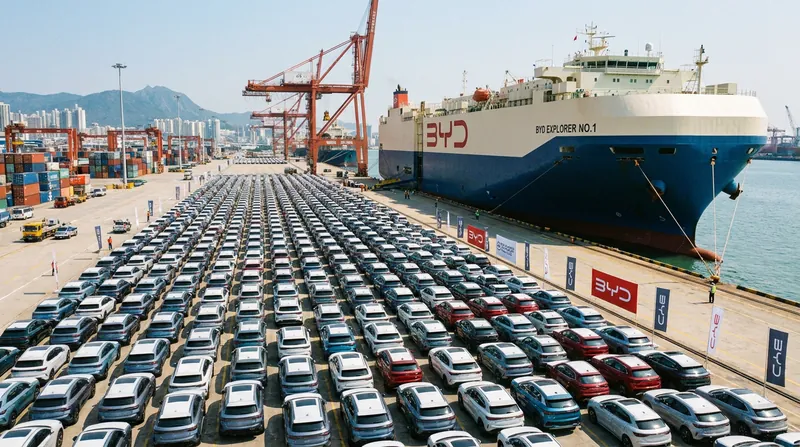
When including plug-in hybrids, BYD's total new-energy vehicle sales for the quarter reached a staggering 1,323,065 units. The company exported 180,700 vehicles in September alone, accelerating its push into overseas markets despite mounting tariff threats from the European Union and the United States.[7]
Tesla produced 464,391 vehicles in the third quarter, meaning deliveries outpaced production by 22,141 units. It marks the second consecutive quarter the company has drawn down excess inventory built up earlier in the year, effectively clearing the 50,000 unsold vehicles it accumulated during the first quarter.[2][4]
The "Other Models" category, which now encompasses the Cybertruck, the Semi, and the aging Model S and Model X, accounted for just 8,295 deliveries. That figure represents a 48 percent drop from the 15,933 premium and niche vehicles Tesla delivered in the same quarter last year.[2]
Beyond its automotive division, Tesla deployed 13.7 gigawatt-hours of energy storage products. While that marks an increase from the 12.5 gigawatt-hours deployed a year earlier, the figure fell short of the 15.9 gigawatt-hours analysts had projected, slightly dampening the quarter's overall momentum.[5][6]
The energy storage division has become an increasingly critical pillar for Tesla as automotive growth slows. The third-quarter deployment represents a slight increase from the 13.5 gigawatt-hours installed in the second quarter, though it remains below the company's all-time quarterly record.[5][6]
BYD's rapid expansion is largely fueled by its aggressive pricing strategy and vertical integration, which allows it to manufacture its own batteries and components. The company's average selling price hovered around $27,000 in recent quarters, significantly undercutting Tesla's average of roughly $45,000.[1][7]
For prospective electric vehicle buyers, the diverging trajectories signal a market increasingly split between premium technology platforms and affordable, high-volume alternatives. While Tesla focuses its capital on autonomous driving infrastructure, BYD continues to flood the global market with accessible battery-electric options.[1][3]
Sources
- [1]CnEVPost — Tesla beats Q3 delivery expectations but falls further behind BYD in BEV sales Read on CnEVPost →
- [2]Electrek — Tesla (TSLA) Q3 2026 deliveries slip 2% to 486,532, but beat estimates Read on Electrek →
- [3]Reuters — Tesla posts stronger-than-expected quarterly deliveries Read on Reuters →
- [4]CNBC — Tesla reports 486,532 vehicle deliveries for third quarter, topping expectation Read on CNBC →
- [5]Quartz — Tesla posted 486,532 deliveries in third quarter, beating Wall Street estimates Read on Quartz →
- [6]EVwire — Tesla delivers 486,532 vehicles in Q3 2026, its best quarter ever without the US EV credit Read on EVwire →
- [7]CarNewsChina — Chinese NEV sales rankings in September 2026 Read on CarNewsChina →
Charts, maps and images
Timeline
October 2026
BYD Widens Global Electric Vehicle Lead Over Tesla to 276,000 Deliveries in Third Quarter
July 2026
BYD Reclaims Global EV Sales Lead From Tesla With 557,000 Q2 Deliveries