full timeline
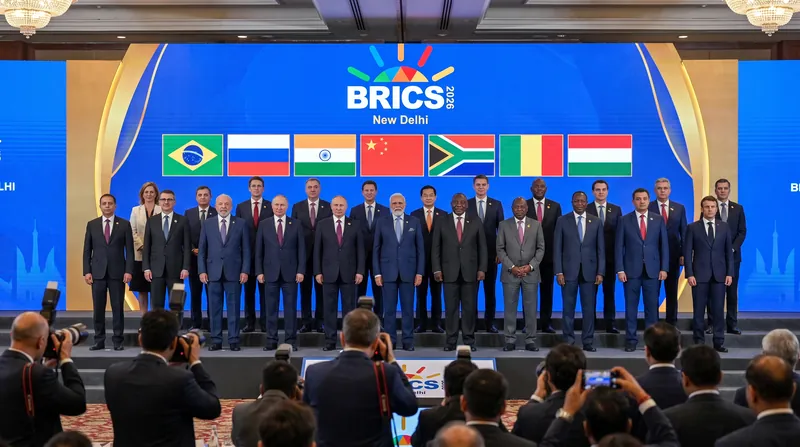
BRICS New Delhi Summit
The 18th BRICS Summit concluded with a joint declaration emphasizing the protection of cultural heritage in conflict zones and the repatriation of stolen antiquities to their countries of origin.
Follow BRICS New Delhi Summit in the Factlen app and get an alert when there is news. Get the app
Share this story
Latest report
BRICS Adopts New Delhi Declaration Calling for Global Restitution of Antiquities
The 18th BRICS Summit concluded with a joint declaration emphasizing the protection of cultural heritage in conflict zones and the repatriation of stolen antiquities to their countries of origin.
- The 11-member BRICS bloc unanimously adopted the 140-paragraph New Delhi Declaration on September 12, 2026.
- The consensus document calls for the protection of cultural heritage sites in conflict zones to prevent illicit trafficking.
- Leaders emphasized the urgent need to repatriate stolen antiquities and objects of spiritual significance to their countries of origin.
- The summit also endorsed an Artist Registry and deeper institutional cooperation among member states' museums and archives.
The 18th BRICS Summit in New Delhi has officially thrown the bloc's collective weight behind the global movement to return stolen antiquities to their countries of origin. In a sweeping 140-paragraph consensus document adopted over the weekend, the expanded 11-member coalition called for the restitution of cultural heritage and the protection of historical sites in active conflict zones.
The move signals a definitive shift in how emerging economies plan to leverage their combined cultural capital on the world stage, transforming what were once bilateral disputes between individual nations and Western museums into a unified multilateral demand.[1][4]
Amid the heavy security and intense diplomatic maneuvering at the Bharat Mandapam convention center, the New Delhi Declaration managed to thread a needle through some of the world's most fraught geopolitical fault lines.
The document was formally adopted on September 12, 2026, following a closed-door session of the 11 core member nations and 10 newly designated partner countries, a roster that now includes Malaysia, Thailand, and Uganda. While much of the summit's oxygen was consumed by debates over global governance reform and the ongoing war in West Asia, the cultural provisions emerged as a rare, frictionless point of unanimous agreement.[1][4]
The declaration explicitly stresses the need to ensure the repatriation of antiquities, framing the issue as a matter of fundamental historical justice. "We call for the protection of cultural heritage, including in regions affected by conflict, to prevent the destruction and illicit trafficking of cultural property, which is vital for preserving the history and identity of affected communities," the joint statement read.
For countries like India and Egypt—both of which have spent decades lobbying foreign institutions to return looted artifacts—the language provides a powerful new diplomatic framework to amplify their long-standing demands.[1][3]
The cultural mandates build directly on the Bhopal Declaration, which was adopted earlier in the year at the 11th BRICS Culture Ministers' Meeting. That earlier agreement laid the necessary groundwork for deeper institutional cooperation among museums, archives, and libraries across the member states. By integrating those ministerial-level commitments into the primary summit declaration, the bloc's leaders have elevated heritage preservation from a secondary cultural initiative to a core pillar of the BRICS strategic partnership, placing it alongside digital public infrastructure and financial cooperation.[1][3]
Beyond the restitution of specific antiquities, the New Delhi Declaration outlines a broader, highly structured strategy for cultural diplomacy. The leaders endorsed the creation of an "Artist Registry" on a pilot basis, designed to facilitate seamless exchanges in the creative industries and streamline cross-border collaborations. The document also mandates new capacity-building programs for cultural practitioners, aiming to share best practices in art conservation, museum management, and the digital archiving of historical records across the 11 member nations.[1][2]
Tourism was similarly reframed within the document, treated not just as a standard economic engine but as a vital tool for heritage preservation and national image-building. The bloc committed to advancing sustainable and smart tourism development, acknowledging that the influx of foreign exchange earnings must be balanced against the physical toll that mass tourism takes on fragile historical sites. The leaders encouraged joint multinational nominations for UNESCO recognition, signaling a desire to present a united front in global cultural forums.[1][2]
These cultural commitments sit within a massive logistical framework that caps India's 2026 chairship of the organization. Over the past 12 months, the host nation orchestrated more than 400 meetings across 30 different Indian cities, culminating in a summit theme focused heavily on resilience, innovation, cooperation, and sustainability. By weaving cultural heritage into this broader narrative of inclusive global growth, the expanded BRICS grouping is effectively arguing that true economic multipolarity requires a foundation of cultural multipolarity to match.[2][4]
As the BRICS chairship officially passes to China for the 2027 cycle, the immediate challenge will be translating the New Delhi Declaration's cultural mandates into binding, actionable international mechanisms. The consensus document provides the necessary diplomatic cover, but the actual work of tracking down illicit antiquities, negotiating their return, and integrating the cultural institutions of 11 very different nations is just beginning.
Sources
- [1]India Today — BRICS backs heritage protection, return of antiquities in New Delhi Declaration Read on India Today →
- [2]The Tribune — BRICS New Delhi Declaration calls for stronger people-to-people ties, women-led development, youth cooperation Read on The Tribune →
- [3]Press Trust of India — BRICS calls for protection of cultural heritage Read on Press Trust of India →
- [4]Wikipedia — 18th BRICS summit Read on Wikipedia →
Charts, maps and images
Timeline
September 2026
BRICS Adopts New Delhi Declaration Calling for Global Restitution of Antiquities
BRICS Summit Opens in New Delhi as Iran-UAE Tensions Threaten Joint Declaration