
full timeline
BMW EV battery expansion
The automaker has begun assembling its sixth-generation battery packs at a new facility in Woodruff, securing a local supply chain for its shift to electric vehicles.
Follow BMW EV battery expansion in the Factlen app and get an alert when there is news. Get the app
Share this story
Latest report
BMW Opens $700 Million South Carolina Battery Plant for Upcoming iX5
The automaker has begun assembling its sixth-generation battery packs at a new facility in Woodruff, securing a local supply chain for its shift to electric vehicles.
- BMW has opened a $700 million battery assembly plant in Woodruff, South Carolina, employing 300 workers and 250 robots.
- The facility builds sixth-generation battery packs for the upcoming all-electric BMW iX5, which will be assembled 15 miles away in Spartanburg.
- The new cell-to-pack design increases energy density by 20 percent, giving the US-spec iX5 an estimated 435 miles of range.
- Cell supplier AESC paused construction on a nearby factory in 2025, forcing BMW to rely on alternative cell sources until LG Energy Solution comes online.
BMW has officially fired up its new $700 million battery assembly plant in Woodruff, South Carolina, marking a critical step in its North American electric vehicle strategy. The facility will supply the nearby Spartanburg plant with sixth-generation battery packs for the upcoming all-electric BMW iX5.[1]
The Woodruff site, which broke ground on a former 315-acre peach farm just over three years ago, represents a massive shift toward localized production. By building batteries just 15 miles from where the vehicles are assembled, the automaker aims to insulate its supply chain from global shipping bottlenecks and reduce transit emissions.[1]
"We've been looking forward to this moment for a long time," Robert Engelhorn, president and CEO of BMW Manufacturing Co., told attendees at the opening ceremony. "And today, we finally get to celebrate it together."
A New Generation of Power
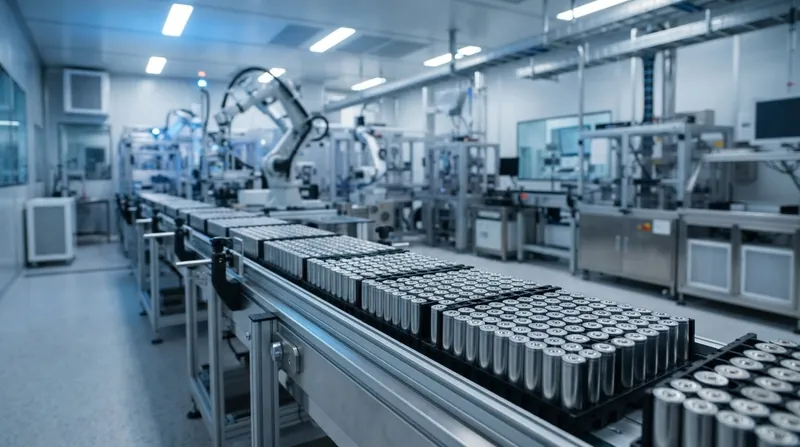
The Woodruff plant is tasked with assembling BMW's "Gen6" high-voltage batteries, which utilize a cell-to-pack design. This architecture integrates cylindrical cells directly into the battery housing, bypassing the need for intermediate modules and saving significant space and weight.[1][3]
According to the company, this direct integration boosts energy density by more than 20 percent compared to previous designs. The resulting US-spec pack for the iX5 holds 144 kilowatt-hours of usable energy, targeting an estimated 435 miles of range on a full charge.[3]
The new cylindrical cells measure 46 millimeters wide and 120 millimeters tall, holding almost 30 percent more usable energy than the older 95-millimeter cells used in the current iX3. The packs also utilize an 800-volt electrical architecture, allowing the iX5 to charge at rates up to 460 kilowatts.[3]
The manufacturing process itself leans heavily on automation and digital tracking. The plant employs roughly 300 workers who operate alongside 250 robots, with artificial intelligence systems monitoring production steps in real time to prevent defects.[1]
To prepare the workforce for the new assembly techniques, BMW implemented extensive virtual reality training programs. Every production worker completes a VR curriculum developed on site, allowing them to master the complex cell-to-pack integration before stepping onto the physical line.[1][3]
The Supply Chain Reality
While the packs are assembled in South Carolina, the individual cells inside them highlight the complexities of building a domestic EV supply chain. BMW currently relies on external suppliers for the cylindrical cells, which are shipped to Woodruff for final integration.[2]
The automaker initially partnered with AESC, which planned to build a dedicated 30-gigawatt-hour cell factory two hours away in Florence, South Carolina. However, AESC paused construction on that facility in June 2025, citing market uncertainty and the impact of import tariffs on its production equipment.[2]
As a result, BMW is bridging the gap with cells from other AESC facilities. To secure its long-term domestic supply, the automaker has also tapped LG Energy Solution to provide US-made Gen6 cells starting in the late 2020s from its existing American plants.[2]
Anchoring the Local Economy
For local leaders, the facility represents a vital economic anchor as the automotive industry transitions away from internal combustion engines. Woodruff Mayor Kenneth Gist highlighted the broader impact during the opening event, noting that the investment secures the region's manufacturing future.
"Thank you for choosing Woodruff," Gist said at the ceremony, adding that the decision was a vote of confidence in the community and its workforce. The plant's operations are designed to run entirely without fossil fuels, utilizing hydrogen-powered industrial trucks on the factory floor.[1]
The batteries themselves are designed with a lower environmental impact in mind. The Gen6 cells incorporate a high proportion of secondary materials in their cobalt, lithium, and nickel content, while renewable energy powers the production of the anode and cathode materials.[1]
BMW claims these changes reduce carbon dioxide equivalent emissions by roughly 28 percent per watt-hour compared to the previous generation. This aligns with the broader corporate mandate to lower the lifecycle footprint of its electric fleet.[1][3]
The South Carolina expansion is part of a broader $1.7 billion investment package announced in October 2022. While $700 million funded the Woodruff battery plant, the remaining $1 billion was allocated to retool the massive Spartanburg complex for electric vehicle production.
The Global Network
Woodruff is the fourth node in BMW's global rollout of Gen6 battery plants, following similar facilities in Debrecen, Hungary; Irlbach-Straßkirchen, Germany; and Shenyang, China. A fifth plant in San Luis Potosí, Mexico, is scheduled to complete the network in 2027.[1]
"With the opening of our Woodruff plant, we are expanding our global Gen6 network: high-voltage battery assembly is now in place in Europe, Asia and North America," said Raymond Wittmann, BMW board member responsible for production.[1][2]
"This creates a key prerequisite for producing fully electric Neue Klasse vehicles on three continents," Wittmann added, emphasizing the scale of the transition.[1][2]
BMW has committed to assembling at least six fully electric models in the United States by 2030. The Spartanburg plant, which has anchored the company's US output since 1999, currently produces 450,000 vehicles annually across various fuel types.[1][2]
For now, the focus remains on ramping up the Woodruff lines. As the first pre-series packs give way to full production, the facility will soon begin feeding the Spartanburg lines for the iX5's market debut early next year, where the electric SUV will start at $81,250.[1]
Sources
- [1]BMW Group — Plant Woodruff begins assembly of Gen6 high-voltage batteries for electric vehicles from Plant Spartanburg Read on BMW Group →
- [2]EV Infrastructure News — German automaker BMW Group has begun production of high-voltage batteries Read on EV Infrastructure News →
- [3]Tarmac Life — BMW opens new US battery assembly plant to support electric vehicle production Read on Tarmac Life →
What to watch
- The launch of the Neue Klasse electric vehicle platform.
- The assembly of the all-electric BMW iX5 in Spartanburg.
- LG Energy Solution coming online to supply battery cells to the Woodruff plant.
Charts, maps and images
Timeline
November 2026
BMW Opens $700 Million South Carolina Battery Plant for Upcoming iX5
BMW Secures EV Battery Supply Agreements With Samsung SDI and LG Energy Solution
How the story developed
BMW's shift to electric vehicles centers on its upcoming Neue Klasse platform, which utilizes new 46-millimeter cylindrical battery cells. These sixth-generation cells are designed to deliver a 30 percent improvement in both driving range and charging speed.
To support the rollout of the Neue Klasse platform, the automaker initiated a local for local procurement strategy. This approach aims to establish regional supply chains for battery manufacturing, specifically targeting a reduction in reliance on Chinese battery imports in the North American market.
On November 10, BMW advanced this strategy by securing supply agreements with two South Korean manufacturers, Samsung SDI and LG Energy Solution. The contracts dictate that the suppliers will provide the sixth-generation cylindrical cells from regional plants located in Europe and the United States.
Under the terms of the agreements, Samsung SDI is tasked with supplying BMW's European operations from a facility in Hungary. Meanwhile, LG Energy Solution will supply the United States market, completing the automaker's regional diversification strategy for its next-generation electric vehicles.