
Ukraine Confirms US Has Fully Resumed Ballistic Missile Early Warning Sharing
President Volodymyr Zelenskyy announced the restoration of critical intelligence sharing following a brief suspension of advance notice for Russian strikes. The agreement follows high-level diplomatic talks in Oslo between Ukrainian officials and American representatives.

Share this story
The United States has restored its real-time ballistic missile early warning feed to the Ukrainian military, ending a week-long suspension that left cities vulnerable to sudden Russian strikes. President Volodymyr Zelenskyy confirmed the resumption following emergency diplomatic meetings in Oslo.[1][2][3]
The intelligence pipeline provides Ukrainian air defense commanders with immediate notification of Russian missile launches detected by American space-based infrared sensors. This data is critical for tracking high-speed ballistic trajectories that regional radar systems cannot spot until the final moments of flight.[3]
"The United States has resumed sharing intelligence with Ukraine about Russian strikes," Zelenskyy announced on October 20. He noted that the restoration followed direct negotiations with American representatives during a broader European diplomatic summit.[1][2]
The suspension lasted approximately one week, during which Ukrainian forces operated without advance notice of incoming Russian attacks. The gap forced local commanders to rely entirely on ground-based radar, significantly reducing the reaction time for both civilian evacuations and interceptor launches.[3]
Diplomatic intervention in Oslo
The breakthrough occurred during a multilateral summit in the Norwegian capital, where Zelenskyy held consecutive meetings with European and American officials. The Ukrainian delegation prioritized the intelligence-sharing gap as an immediate security crisis.[4][6]
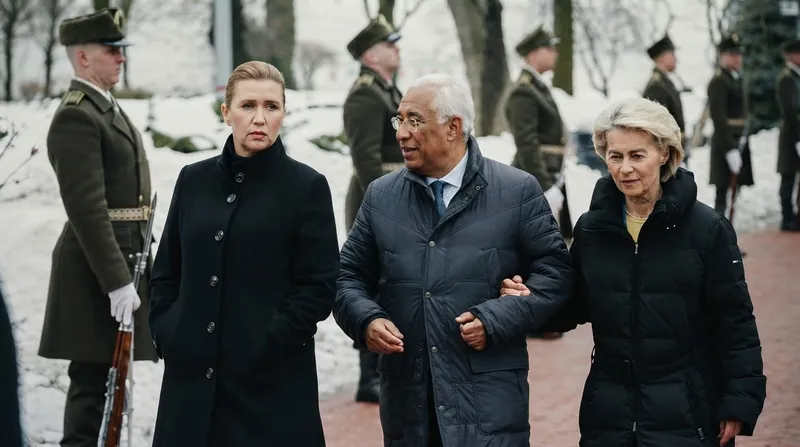
Zelenskyy met with the Prime Minister of Norway and the President of Finland before sitting down with the American delegation. The US side included special envoy Steve Witkoff, who attended the Oslo talks to discuss the trajectory of the Russia-Ukraine war.[6][7]
European diplomats in Oslo characterized the meetings as an exercise in diplomatic damage control. The sudden halt in early warning data had alarmed NATO allies who rely on the US-Ukrainian intelligence architecture to monitor Russian military escalation.[4]
"We had very productive, very specific talks with the American side," the Office of the President of Ukraine stated in a release detailing the Oslo itinerary. The statement emphasized that the meetings focused on immediate battlefield requirements and long-term security guarantees.[6]
The mechanics of early warning
Ballistic missiles, such as the Russian Iskander-M, travel at hypersonic speeds and follow a parabolic trajectory that breaches the upper atmosphere. They can strike targets in central Ukraine less than ten minutes after launching from Russian territory.[3]
American early warning satellites detect the intense thermal bloom of a missile launch the moment the rocket engine ignites. This data is processed and relayed to allied command centers in seconds, providing the crucial lead time needed to calculate the weapon's intended target.[2][3]
Without this feed, Ukrainian Patriot and SAMP/T air defense batteries must wait for the incoming missile to cross the horizon and enter the range of their organic radar systems. That delay shrinks the intercept window from minutes to mere seconds.[3][5]
The restoration of the feed immediately reinstates the national air raid alert protocol. When the US system detects a launch, Ukrainian authorities can trigger sirens in the projected impact zone before the missile even reaches its apex.[5]
Strategic implications of the pause
Neither Washington nor Kyiv has publicly detailed the exact operational or political reasons behind the week-long suspension. The interruption coincided with a period of intense political transition in the United States and shifting diplomatic postures regarding the conflict.[2][4]
The brief cutoff demonstrated the absolute dependency of Ukraine's air defense network on American space assets. While European nations have supplied interceptor missiles and launcher platforms, the overarching sensory architecture remains fundamentally reliant on US infrastructure.[4][7]
Zelenskyy hailed the resumption as a vital stabilization of the bilateral defense relationship. The swift resolution in Oslo suggests that both sides recognized the immediate humanitarian and tactical risks of leaving Ukrainian airspace blind to ballistic threats.[1][5]
The presence of Steve Witkoff at the Oslo talks indicates that the intelligence sharing was resolved at the highest levels of the incoming US diplomatic apparatus. His involvement points to a direct channel between the Ukrainian presidency and American policymakers shaping the next phase of the war.[7]
Next steps for air defense
With the early warning feed restored, Ukrainian commanders are now pushing to secure additional Patriot batteries to capitalize on the intelligence. The advance notice is only effective if interceptors are positioned along the missile's terminal flight path.[2][6]
The Oslo summit also secured commitments from Nordic allies to bolster Ukraine's ground-based radar networks. While these systems cannot replace US satellites, they provide a necessary redundancy for detecting low-flying cruise missiles and attack drones.[6]
Key points
- The US has restored its real-time ballistic missile early warning feed to Ukraine after a one-week suspension.
- President Zelenskyy confirmed the resumption following emergency diplomatic meetings in Oslo with American and European officials.
- The intelligence pipeline relies on US satellites to detect Russian launches instantly, providing crucial minutes for air defense interception.
- The brief blackout forced Ukrainian forces to rely solely on ground radar, severely reducing reaction times for civilian evacuations.
What we don’t know
- The specific political or operational reasons that prompted the United States to suspend the intelligence feed for a week.
- Whether the restoration of the early warning data includes any new conditions or limitations on how Ukraine utilizes the intelligence.
- The exact nature of the discussions between Zelenskyy and US envoy Steve Witkoff regarding the broader trajectory of the war.
How we got here
Mid-October 2026
The United States suspends its real-time ballistic missile early warning feed to the Ukrainian military.
Oct 20, 2026
President Zelenskyy holds emergency diplomatic meetings in Oslo with US envoy Steve Witkoff and Nordic leaders.
Oct 20, 2026
Zelenskyy publicly confirms that the US has fully restored the intelligence sharing pipeline.
- Ukrainian Leadership
- Emphasizes the absolute necessity of the US early warning feed for protecting civilian populations from ballistic strikes.
- US Diplomatic Channels
- Focuses on stabilizing the bilateral defense relationship and managing allied concerns during political transitions.
- European Allies
- Views the intelligence sharing as a critical pillar of European security that must be maintained to prevent Russian escalation.
Perspectives this story doesn't cover
- Russian military command regarding the operational impact of the restored early warning feed.
- US Space Command officials managing the satellite detection infrastructure.
Sources
Source coverage
7 outlets
3 viewpoints surfaced







- [1]The GuardianEuropean Allies
US has resumed sharing intelligence with Ukraine about Russian strikes, says Zelenskyy
Read on The Guardian → - [2]The Washington PostUS Diplomatic Channels
U.S. restores intelligence sharing with Ukraine, Zelensky says
Read on The Washington Post → - [3]Euromaidan PressUkrainian Leadership
US restores ballistic missile warnings to Ukraine after a week without advance notice before Russian attacks, Zelenskyy says
Read on Euromaidan Press → - [4]EuronewsEuropean Allies
Diplomatic damage control in Oslo as Zelenskyy says US intelligence sharing restored
Read on Euronews → - [5]AFPEuropean Allies
Zelensky hails resumption of US advance warning of strikes on Ukraine
Read on AFP → - [6]Office of the President of UkraineUkrainian Leadership
In Oslo, the President of Ukraine Held Meetings with the Prime Minister of Norway, the President of Finland, and the American Side
Read on Office of the President of Ukraine → - [7]Al JazeeraUS Diplomatic Channels
Zelenskyy to hold talks on Russia-Ukraine war with Witkoff, Europeans
Read on Al Jazeera →
More in News & Politics
See all →Haiti Intervention
El Salvador Deploys Special Forces to Haiti to Rescue Abducted Aviation Technicians
6 sources
South China Sea Dispute
US Warship Challenged by Chinese Naval Forces Near Contested Sabina Shoal
6 sources

Nuclear Strategy
The Mathematical Floor of Nuclear Deterrence: How Silo Hardening and Dispersal Guarantee Survival
6 sources
Abyei Conflict
Strike by Drones Kills at Least 70 People in Contested Southern Sudan Territory
6 sources

Comments
Every angle. Every day.
Get News & Politics stories with full source coverage and perspective breakdowns, free every day.