
UEFA and CONCACAF Plan 96-Team Joint Nations League in Direct Challenge to FIFA
European and North American football confederations are negotiating a massive cross-continental tournament for 2028. The proposed 96-team league would replace standard friendlies with high-stakes global fixtures, bypassing FIFA to generate independent broadcast revenue.
By Xia Wu

International football is on the verge of a structural earthquake. UEFA and CONCACAF are in advanced negotiations to merge their respective Nations League competitions into a massive 96-team cross-continental tournament, a move that would fundamentally rewrite the sport's global calendar.[1]
Targeted for a 2028 launch, the biennial competition is designed to replace the monotonous cycle of regional friendlies with high-stakes, tiered matches. The initiative would bring all 55 European associations and 41 North, Central American, and Caribbean nations under a single competitive umbrella.[1][2]
The mechanics mirror the successful multi-league format already utilized by both confederations. In League A, traditional European heavyweights like Spain, France, England, and Germany would face off against CONCACAF's top tier, guaranteeing regular heavyweight clashes involving the United States, Mexico, and Canada outside of a World Cup setting.[1]
Crucially, the blueprint avoids adding new dates to an already saturated schedule. The group stage would slot directly into the existing September, October, and November international windows. Knockout phases would follow in March, culminating in a lucrative 'Final Four' showdown in June.[1]
Beyond the pitch, the proposed merger is a calculated political strike against FIFA and President Gianni Infantino. The alliance between UEFA and CONCACAF solidified following intense backlash over Infantino's controversial—and ultimately aborted—proposal to sell off World Cup commercial rights to private investors.[1][2]
By bypassing Zurich to create their own global broadcasting product, the two confederations are securing an independent revenue stream. This allows them to distribute wealth directly to their member associations without FIFA acting as the financial intermediary.[1][2]
The economic and developmental stakes are highest for the sport's minnows. For the dozens of smaller Caribbean and European nations, a joint league guarantees regular, meaningful fixtures against varied opposition, replacing the financial black hole of arranging ad-hoc international friendlies.
Logistical hurdles remain, particularly regarding transatlantic travel during tight 10-day international windows. Planners are reportedly exploring geographically optimized scheduling to mitigate player fatigue, a critical sticking point for elite European clubs already vocal about calendar congestion.[1]
While the Asian Football Confederation (AFC) has reportedly monitored the situation with interest, the immediate battle lines are drawn. If UEFA and CONCACAF successfully launch the 96-team behemoth, it will permanently dilute FIFA's monopoly on intercontinental competition and shift the balance of power in global football governance.[1][2]
Perspectives explored
The Joint UEFA-CONCACAF Model
A 96-team cross-continental league replacing regional friendlies with high-stakes, tiered global fixtures.
For: Delivers high-revenue, competitive cross-continental matches outside the World Cup, while guaranteeing 41 CONCACAF and 55 UEFA nations regular playing time and shared broadcast income. Against: Increases transatlantic travel burdens during tight 10-day international windows and deepens the financial gap between the UEFA/CONCACAF bloc and the rest of the world. Evidence: UEFA's existing Nations League boosted European broadcast revenues by replacing meaningless friendlies; CONCACAF's version similarly stabilized Caribbean football calendars with guaranteed competitive matches per cycle. Fits well when: Confederations need to maximize commercial value, elevate mid-tier teams, and bypass FIFA's revenue-sharing models. Does not fit when: Player welfare and carbon footprint reduction are the absolute priorities, given the extensive long-haul travel required.
The Traditional FIFA-Centric Model
Maintaining separate regional competitions while relying on the World Cup for cross-continental play.
For: Preserves the prestige and exclusivity of the FIFA World Cup as the sole arena for intercontinental clashes, while keeping travel localized within confederations during standard international breaks. Against: Leaves mid-tier and lower-tier nations trapped in low-revenue regional friendlies with limited opportunities to test themselves against global opposition, stunting tactical development. Evidence: Under the current system, European teams play each other almost exclusively between World Cups, severely limiting CONCACAF teams' exposure to top-tier tactical development outside of a 3-match group stage every four years. Fits well when: The global calendar is already congested, player burnout is a critical concern, and regional rivalries drive local engagement. Does not fit when: Regional confederations face financial stagnation and require new, globally appealing broadcasting products to fund grassroots development.
Key points
- UEFA and CONCACAF are negotiating a joint 96-team Nations League targeted for a 2028 launch.
- The biennial tournament would replace standard friendlies with tiered, cross-continental competitive matches.
- Top-tier European teams would regularly face North American heavyweights like the US, Mexico, and Canada.
- The initiative serves as a direct political and commercial challenge to FIFA's global authority.
Open questions
- Whether FIFA has the legal or political leverage to block the tournament's creation.
- How transatlantic travel logistics will be managed within existing 10-day international windows.
- The exact broadcast revenue projections and how the funds will be distributed among the 96 nations.
- Confederation Reformers
- Argue that a joint league maximizes revenue and provides a necessary check on FIFA's centralized power.
- Developing Nations & Fans
- Highlight the massive developmental benefits and novel matchups for Caribbean and lower-tier European teams.
Perspectives this story doesn't cover
- Elite European Club Managers
- Asian and African Confederation Officials
- Player Unions (FIFPRO)
Sources
Source coverage
2 outlets
2 viewpoints surfaced


- [1]The GuardianConfederation Reformers
Uefa and Concacaf discuss joint Nations League in latest challenge to Fifa
Read on The Guardian → - [2]The Irish TimesConfederation Reformers
Uefa and Concacaf discuss joint Nations League in latest challenge to Fifa
Read on The Irish Times →
More in Sports
See all →UEFA Nations League
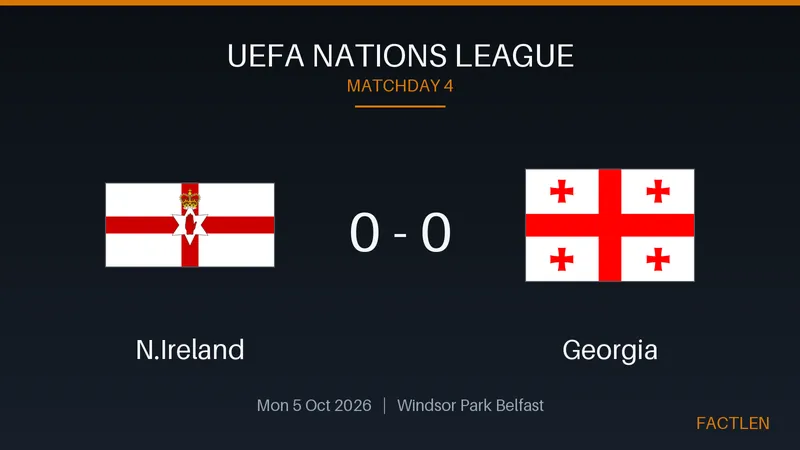
Northern Ireland Held to 0-0 Draw by Georgia as Mamardashvili Saves Late Penalty
2 sources
Standings
MLS Playoff Bubble Boils Over: Three-Way Tie in the East as Decision Day Looms
3 sources

UEFA Nations League
Northern Ireland Chases Nations League Promotion Against Struggling Georgia
6 sources
UEFA Nations League
Ukraine and Hungary Face Defining Nations League Clash in Trnava
6 sources
Comments
Every angle. Every day.
Get Sports stories with full source coverage and perspective breakdowns, free every day.