
Norway's 2026 Fjord Zero-Emission Rules Force Refits While Delaying Mega-Ships
Starting January 1, 2026, Norway will enforce the world's strictest maritime environmental laws, banning all direct carbon and methane emissions for passenger vessels under 10,000 gross tons in its UNESCO World Heritage fjords. The mandate is forcing the cruise industry to either invest heavily in hybrid technologies or quietly reroute legacy ships to standard coastal ports.

Share this story
On January 1, 2026, the Norwegian Maritime Authority will draw a sharp, invisible line across the mouths of the country's most famous waterways. Under an amendment to the Environmental Safety Regulations, Norway's five UNESCO World Heritage fjords—including the iconic Geirangerfjord and Nærøyfjord—will become the world's first zero-emission maritime zones.
The mandate is absolute. Any passenger vessel entering these protected waters must prove it can operate without emitting a single gram of direct carbon dioxide or methane. The legislation, rooted in Norway's Pollution Control Act, is designed to protect fragile marine ecosystems from the heavy fuel oil and mass consumption that have long characterized the global cruise industry.[3]
However, the implementation of this landmark law features a critical, heavily negotiated compromise based on vessel size. The 2026 deadline applies strictly to passenger ships and ferries under 10,000 gross tons. For the massive, ocean-going cruise ships that dominate the industry—virtually all of which exceed this threshold—the Norwegian Parliament has extended the zero-emission deadline to January 1, 2032.[1]
This phased approach acknowledges a stark technological reality: the alternative fuel infrastructure required to power a 150,000-ton floating city simply does not exist yet at scale. By splitting the mandate, Norway is forcing immediate compliance from smaller expedition vessels and local ferries, while giving the heavyweights a six-year grace period to develop viable hydrogen, ammonia, or advanced battery solutions.[1]
For vessels subject to the 2026 rules, the regulatory mechanics are deliberately technology-neutral. The law does not mandate a specific propulsion system; it merely dictates the environmental outcome. Shipowners can utilize battery-electric systems, green hydrogen fuel cells, or certified green ammonia to meet the standard.
Biogas is also permitted as a transitional alternative, but under exceptionally strict conditions. To qualify, the biogas must achieve a 50 to 65 percent reduction in greenhouse gases, cannot be produced from food or feed crops, and must be bunkered within the final month prior to entering the fjords. Furthermore, it must be kept entirely separate from fossil fuels, eliminating the mass balance accounting loopholes often used in corporate sustainability reporting.
Enforcement of these rules represents a shift in maritime policing. The Norwegian Maritime Authority will not rely on physical exhaust sniffing or real-time emissions testing at the fjord entrances. Instead, compliance is verified through rigorous onboard energy-log data and classification society certifications.[3]
The penalties for non-compliance are severe. Vessels that attempt to enter the protected zones using traditional combustion engines will face operational bans, administrative fines, and potential vessel detention. More practically, they will be physically turned away, forcing captains to divert to standard concrete coastal ports outside the heritage zones.[3]
Even the large cruise ships enjoying the extension to 2032 face immediate operational tightening. When visiting the fjords in 2026, these mega-ships must adhere to a strict 0.10 percent fuel sulfur limit and connect to shore power whenever compatible facilities are available. Additionally, the use of exhaust gas cleaning systems, known as scrubbers, is heavily restricted; ships must operate them in closed-loop mode with zero water discharge into the fjords.
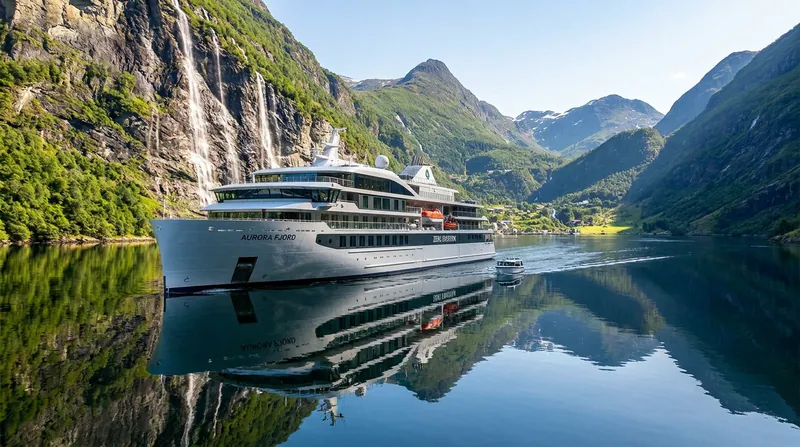
The industry's response to the mandate has fractured into two distinct strategies: rapid refitting and quiet rerouting. Forward-thinking operators are embracing the challenge, launching hybrid vessels equipped with massive battery packs that allow them to sail silently through the fjords.[2]
These compliant voyages offer a radically different passenger experience. When a hybrid ship switches to stored battery power, the low mechanical rumble of the engines fades entirely. Guests experience near-silent cruising, pristine air quality, and the ability to pause beneath towering waterfalls without the intrusion of industrial exhaust.[2]
Conversely, many legacy cruise lines are opting for the cheaper route: reassigning their older, heavily polluting ships to regions with looser environmental regulations, such as the Caribbean. For itineraries that still include Norway, some operators are quietly swapping out the protected heritage fjords for less-regulated coastal ports.[1][2]
This dynamic has created what industry analysts call the 2026 Fjord Trap for consumers. Passengers booking Norwegian cruises based on glossy brochures featuring Geirangerfjord may find themselves on non-compliant ships that are legally barred from entering those specific waters. Travelers are increasingly advised to verify a ship's environmental clearance before booking, as partial compliance—such as running on liquefied natural gas (LNG), which still produces greenhouse gases—will not grant access to the inner fjords.
Beyond the immediate logistical reshuffling, Norway's mandate is accelerating the rise of microcruising. Smaller operators are deploying vessels carrying just 10 to 50 passengers, utilizing advanced hybrid-electric propulsion to offer low-impact, immersive journeys. These microcruises not only meet the zero-emission standards but also align with Norway's broader zero trace philosophy, which strictly regulates approach distances to wildlife and imposes speed limits to reduce underwater noise pollution.[2]
Ultimately, the 2026 fjord ban serves as a live testbed for the future of global shipping. By proving that strict environmental engineering can dictate maritime itineraries, Norway is establishing a precedent that other coastal nations are watching closely. The mandate demonstrates that the preservation of fragile ecosystems and the operation of a profitable tourism industry do not have to be mutually exclusive, provided the industry is forced to innovate.
Key points
- Starting January 1, 2026, passenger vessels under 10,000 gross tons must produce zero direct emissions to enter Norway's World Heritage fjords.
- Large ocean-going cruise ships have been granted an extension until 2032 to develop scalable alternative fuel technologies.
- The mandate strictly prohibits the emission of carbon dioxide and methane, forcing ships to rely on batteries, hydrogen, or certified biogas.
- Non-compliant ships will be physically turned away, leading to last-minute itinerary changes for passengers booked on legacy vessels.
What we don’t know
- How severely the rerouting of large legacy ships will impact the local economies of fjord towns like Geiranger and Flåm in the short term.
- Whether the global supply chain for green hydrogen and ammonia will scale fast enough to meet the 2032 deadline for large cruise ships.
How we got here
Spring 2018
The Norwegian Parliament adopts a resolution to make the World Heritage fjords zero-emission zones by 2026.
2021
The government proposes the establishment of mandatory shore power infrastructure in key fjord ports like Flåm.
August 2024
Following industry pushback, Norway extends the zero-emission deadline for ships over 10,000 gross tons to 2032.
May 2025
The Norwegian Maritime Authority finalizes the regulatory framework and exemption conditions for the 2026 implementation.
January 1, 2026
The zero-emission mandate officially takes effect for all passenger vessels under 10,000 gross tons.
- Norwegian Regulators
- Prioritizing ecosystem preservation and forcing technological innovation through strict mandates.
- Legacy Cruise Operators
- Highlighting the lack of scalable zero-emission technology for large ships and the economic impact of rerouting.
- Environmental Innovators
- Embracing the regulations as a competitive advantage and a catalyst for sustainable microcruising.
Perspectives this story doesn't cover
- Local businesses in fjord towns reliant on mass cruise tourism
- Shipyard engineers tasked with retrofitting legacy vessels
Sources
Source coverage
3 outlets
3 viewpoints surfaced


- [1]ForbesLegacy Cruise Operators
Norway Allows Cruise Ships In World Heritage Fjords Until 2032
Read on Forbes → - [2]ForbesLegacy Cruise Operators
Innovation Sustainability: How Norwegian Microcruises Are Rethinking Green Travel
Read on Forbes → - [3]Global Law ExpertsNorwegian Regulators
What Are the Zero Emission Requirements for Passenger Ships in World Heritage Fjords
Read on Global Law Experts →
More in Travel
See all →Outbreak Response
Containment and Evacuation of 147 People From the MV Hondius Andes Virus Outbreak
2 sources
Maritime Access
Port Clearance Rules That Allowed Turkey and Egypt to Bar an LGBTQ+ Cruise Ship
2 sources
Regenerative Tourism
Hawaii's 14% Cruise Tax: Raising $100 Million to Fund Climate Resilience
2 sources
Maritime Tech
The Engineering of Zero-Emissions Cruising: Inside the World's First Hydrogen-Powered Ship, the Viking Libra
1 sources
Comments
Every angle. Every day.
Get Travel stories with full source coverage and perspective breakdowns, free every day.