
The 2.0 mmol/L Inflection Point: How a Single Blood Marker Defines the Boundary of Aerobic Base Training
For half a century, exercise physiologists have used a specific concentration of blood lactate to mark the exact moment the body stops burning fat and starts relying on carbohydrates. Understanding this 2.0 mmol/L threshold allows runners and cyclists to build endurance without accumulating fatigue.

Share this story
In short
- Lactate Threshold 1 (LT1) occurs when blood lactate reaches approximately 2.0 mmol/L.
- Staying below LT1 maximizes fat oxidation and builds mitochondrial density without causing excessive fatigue.
- Most recreational athletes mistakenly perform their 'easy' runs above LT1, blunting aerobic adaptations.
In a laboratory at the German Sport University Cologne in the late 1970s, researchers began drawing blood from athletes running on treadmills, looking for a specific chemical shift. They were hunting for the exact moment the body's energy demands outpaced its oxygen supply. What the Cologne Sports Medicine Group found, as documented in their foundational physiological papers, was a distinct metabolic boundary: at a blood lactate concentration of exactly 2.0 millimoles per liter (mmol/L), the human body fundamentally changes how it fuels movement.[4]
That 2.0 mmol/L mark became known as Lactate Threshold 1, or LT1. It represents the ceiling of the aerobic base. Below this line, muscle cells rely primarily on fat oxidation, a slow but virtually limitless energy source. "The first lactate threshold marks the upper limit of the intensity domain where energy is provided almost exclusively by aerobic metabolism," researchers note in the journal Sports Medicine. As long as an athlete stays below this concentration, they can theoretically continue moving until their structural mechanics fail or they run out of hydration.[1]
The problem for everyday runners and cyclists is that this boundary is entirely invisible from the outside. Without a needle and a lactate meter, athletes rely on perceived exertion or generic heart rate formulas. Consequently, a 2025 analysis published in Running Writings observed that most recreational runners spend their "easy" days hovering just above LT1, operating in a metabolic no-man's-land that is too intense to maximize fat oxidation but too easy to trigger high-end cardiovascular adaptations.
To understand why crossing 2.0 mmol/L matters, you have to look at the cellular exhaust pipe. When you run or cycle, your muscles break down glucose for fuel, producing a byproduct called pyruvate. If enough oxygen is present, the mitochondria absorb this pyruvate and convert it into clean energy. But as your pace increases, the mitochondria cannot keep up with the volume of fuel being processed.
The excess pyruvate is converted into lactate, which spills into the bloodstream. At LT1, the body is still clearing this lactate just as fast as it produces it, maintaining a steady state. The INSCYD performance laboratory defines this as the point where "glycolytic energy production begins to increase disproportionately," meaning carbohydrates are taking over the workload from fat stores.
If you push past LT1, lactate levels begin a slow, steady climb. This middle zone continues until you hit Lactate Threshold 2 (LT2), often around 4.0 mmol/L. At LT2, the clearance mechanism is completely overwhelmed. "The second threshold represents the maximal lactate steady state," explains the IDRO performance center, marking the absolute redline before rapid fatigue sets in and the muscles are forced to slow down.
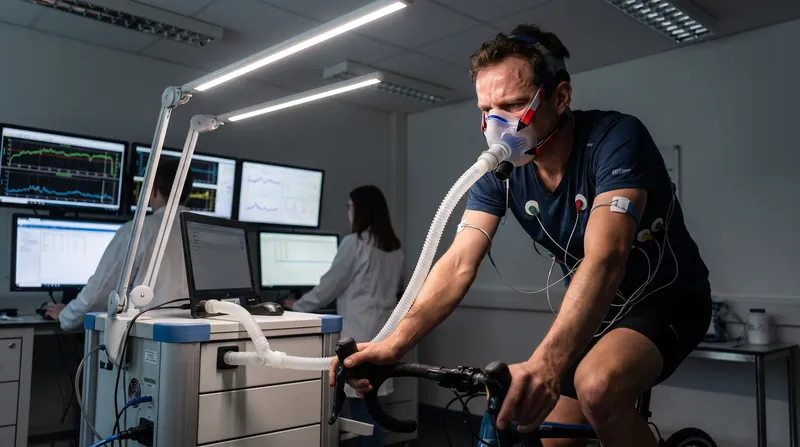
Finding that first 2.0 mmol/L boundary historically required a treadmill, a technician, and a series of finger pricks. A standard incremental test, as detailed in PLoS One, involves running at a controlled speed for three minutes, pausing for a blood sample, and increasing the pace by 1.0 kilometer per hour until exhaustion. It is a highly precise but highly disruptive way to measure fitness.[2]
But modern sports science is finding ways to bypass the needle. A recent study in the journal Sensors demonstrated that muscle oxygen saturation (SmO2)—measured via non-invasive optical sensors strapped to the thigh—shows a distinct drop-off that perfectly mirrors the 2.0 mmol/L blood lactate inflection point. By shining near-infrared light into the muscle belly, these sensors track the exact moment oxygen extraction maxes out, translating a clinical metric into a wearable daily target.[3]
For the athlete looking to apply this without laboratory equipment or optical sensors, breathing rate offers a highly accurate proxy. The ventilatory threshold—the point where you can no longer speak in full, unbroken sentences—aligns closely with LT1. When blood lactate crosses 2.0 mmol/L, the body must exhale excess carbon dioxide produced by carbohydrate metabolism, forcing a shift from deep, rhythmic breathing to a more rapid, shallow pattern.
Training strictly below this threshold yields specific structural changes in the muscle. The body responds to high-volume, sub-LT1 exercise by building denser capillary networks and increasing mitochondrial volume. This is the physiological definition of "base building," allowing an athlete to sustain a higher power output before tapping into limited carbohydrate reserves.
Conversely, spending too much time between LT1 and LT2—often called the "grey zone"—generates significant autonomic nervous system fatigue without delivering the maximal aerobic benefits of true high-intensity interval training. The Cologne researchers established early on that separating training into distinct, polarized zones yields superior long-term endurance adaptations compared to moderate, continuous strain.[4]
The exact pace that correlates with 2.0 mmol/L is highly individual and highly trainable. An untrained runner might hit LT1 at a 12-minute mile, while an elite marathoner might not cross that boundary until they are running sub-6-minute miles. The goal of endurance training is not to tolerate more lactate, but to push the 2.0 mmol/L threshold to a faster pace, allowing you to run harder while remaining metabolically relaxed.[1]
Jargon, explained
- Lactate Threshold 1 (LT1)
- The exercise intensity where blood lactate first begins to rise above resting baseline, typically around 2.0 mmol/L, marking the upper limit of pure aerobic metabolism.
- Lactate Threshold 2 (LT2)
- The point where lactate production exceeds the body's ability to clear it, leading to rapid accumulation and fatigue, often occurring around 4.0 mmol/L.
- Pyruvate
- A byproduct of glucose breakdown that is either used by mitochondria for aerobic energy or converted into lactate when oxygen supply is insufficient.
- Mitochondria
- The cellular structures responsible for using oxygen to convert fuel into usable energy.
- Muscle Oxygen Saturation (SmO2)
- The balance between oxygen delivery and oxygen consumption in the capillary beds of a working muscle, measurable via optical sensors.
Common questions
Does lactic acid cause muscle soreness?
No. Lactate is cleared from the blood within an hour after exercise. Delayed onset muscle soreness is caused by micro-tears in the muscle fibers, not lactic acid accumulation.
How can I find my LT1 without a blood test?
The "talk test" is the most reliable field metric. If you can comfortably speak in full, unbroken paragraphs while exercising, you are likely below your first lactate threshold.
Should I ever train above my lactate threshold?
Yes. While base training below LT1 builds structural endurance, short intervals above LT2 are necessary to increase your absolute cardiovascular capacity and VO2 max.
Competing readings
Laboratory Physiologists
Argue that precise blood lactate measurement remains the only gold standard for defining metabolic zones.
For clinical researchers, the exactness of the 2.0 mmol/L and 4.0 mmol/L anchors is non-negotiable. They argue that perceived exertion and heart rate are too easily skewed by heat, caffeine, sleep deprivation, and cardiac drift. By directly measuring the chemical byproduct of cellular respiration, laboratory testing removes the guesswork, ensuring that an athlete's prescribed training zones are anchored to their actual metabolic reality rather than an algorithmic estimate.
Field Coaches
Focus on practical proxies like the talk test and perceived exertion to guide daily training.
Applied coaches note that an athlete's true lactate threshold fluctuates daily based on fatigue and glycogen depletion. Because of this, they argue that constantly chasing a specific blood number is impractical and disruptive to the flow of training. Instead, they rely on the ventilatory threshold—the point where breathing deepens to expel carbon dioxide—as a real-time, auto-regulating proxy that adjusts naturally to the athlete's daily readiness.
Sports Technologists
Focus on the shift toward non-invasive wearables replacing traditional blood draws.
Technology developers view the finger-prick blood test as an outdated bottleneck. By utilizing near-infrared spectroscopy to measure muscle oxygen saturation (SmO2) directly at the working muscle, they are attempting to provide continuous, real-time threshold data. This perspective argues that the future of endurance training lies in wearable sensors that can detect the LT1 inflection point dynamically during a workout, without ever breaking the skin.
- Clinical Exercise Physiologists
- Argue that precise blood lactate measurement remains the only gold standard for defining metabolic zones and prescribing training intensity.
- Applied Endurance Coaches
- Emphasize practical application, using field tests and breathing rates to estimate thresholds without interrupting daily training routines.
- Sports Technology Developers
- Focus on replacing invasive blood draws with continuous, non-invasive optical sensors that track muscle oxygenation in real time.
Perspectives this story doesn't cover
- Recreational athletes who do not use structured training zones
- Sports nutritionists focusing on carbohydrate fueling at threshold
Sources
Source coverage
5 outlets
3 viewpoints surfaced



- [1]Sports MedClinical Exercise Physiologists
Lactate threshold concepts: how valid are they?
Read on Sports Med → - [2]PLoS OneClinical Exercise Physiologists
Detection of the Lactate Threshold in Runners: What is the Ideal Speed to Start an Incremental Test?
Read on PLoS One → - [3]SensorsSports Technology Developers
Estimation of Lactate Thresholds, Aerobic Capacity and Recovery Rate from Muscle Oxygen Saturation in Highly Trained Speed Skaters and Healthy Untrained Individuals
Read on Sensors → - [4]Front PhysiolSports Technology Developers
Lactate Thresholds and the Simulation of Human Energy Metabolism: Contributions by the Cologne Sports Medicine Group in the 1970s and 1980s
Read on Front Physiol → - [5]Factlen Editorial Team
Synthesis by Factlen editorial team
Read on Factlen Editorial Team →

More in Fitness
See all →Exercise Physiology
Mechanical Friction Along the Parietal Peritoneum Causes Runner's Side Stitches
7 sources

Bicarbonate Buffering
The Physiology of the Talk Test: How Non-Metabolic Carbon Dioxide Restricts Speech During Exercise
3 sources

Cardiac Rehab
Exercise-Based Cardiac Rehab Cuts Heart Attacks by 28% and Hospital Admissions by 35%, Cochrane Review Finds
6 sources

Ventilatory Thresholds
The Exponential Increase in VE/VCO2: How the Respiratory Compensation Point Defines the Highest Sustainable Endurance Pace
7 sources
Comments
Every angle. Every day.
Get Fitness stories with full source coverage and perspective breakdowns, free every day.