
The Physiology of Heart Rate Zones: How VO2 Max, Lactate Threshold, and FatMax Define Training Intensity
Traditional age-based heart rate zones often trap athletes in inefficient training routines. Understanding individual metabolic markers like VO2 max, lactate threshold, and FatMax allows for precise, science-backed cardiovascular conditioning.

Share this story
In short
- Traditional age-based heart rate formulas fail to account for individual metabolic differences, often leading to inefficient training.
- VO2 max represents the ultimate ceiling of cardiovascular fitness and is a strong predictor of longevity.
- Lactate thresholds (LT1 and LT2) dictate how long an athlete can sustain different exercise intensities before fatigue sets in.
Most fitness trackers, smartwatches, and gym machines rely on a remarkably simple formula to dictate how hard you should work out: 220 minus your age. This equation, originally developed in the 1970s as a rough population average, generates a theoretical maximum heart rate and divides it into neat, color-coded zones. It is the default setting for almost every piece of commercial cardio equipment in the world, offering a comforting sense of mathematical precision to anyone stepping onto a treadmill or strapping on a heart rate monitor.
But human physiology is rarely that uniform, and for millions of athletes and recreational exercisers, these default zones are fundamentally misaligned with their actual metabolic engines. Because the standard formula relies entirely on age, it completely ignores genetics, baseline fitness level, and individual metabolic efficiency. Two 40-year-olds might share a theoretical maximum heart rate of 180 beats per minute, but their bodies could be utilizing completely different energy systems at the exact same intensity, rendering the generic zones useless.[7][8]
The result of following these generic zones is a pervasive training error known among endurance coaches as the 'grey zone.' Exercisers push themselves too hard to efficiently burn fat or build a durable aerobic base, but they do not push hard enough to trigger the high-end cardiovascular adaptations of true interval training. They accumulate systemic fatigue without maximizing their fitness, essentially spinning their wheels in a physiological space that feels difficult but yields suboptimal returns for their effort.
To train effectively and escape the grey zone, exercise physiologists look beyond age-based heart rate and focus on three distinct metabolic markers: VO2 max, lactate threshold, and FatMax. These metrics define what is actually happening inside the muscle cells at varying intensities, providing a personalized map of an individual's cardiovascular engine. By understanding these thresholds, athletes can tailor their workouts to target specific energy systems, ensuring that every session delivers the intended physiological benefit without unnecessary strain.[8]
The ultimate ceiling of cardiovascular fitness is VO2 max. It measures the maximum volume of oxygen the body can absorb, transport, and utilize during exhaustive exercise. Expressed in milliliters of oxygen per kilogram of body weight per minute, it is the gold standard for quantifying aerobic power. When an athlete reaches their VO2 max, their oxygen consumption plateaus even if exercise intensity continues to increase, indicating that the cardiovascular system has reached its absolute limit for aerobic energy production.
A high VO2 max indicates a robust cardiovascular system—a strong heart capable of pumping large volumes of blood, efficient lungs, and dense capillary networks capable of delivering oxygen to working muscles. Beyond athletic performance, it is widely considered one of the strongest predictors of longevity and all-cause mortality. A high aerobic capacity reflects the overall resilience of the body's internal systems, offering profound protection against chronic diseases and age-related cardiovascular decline.[5]
However, VO2 max only dictates the absolute size of the cardiovascular engine; it does not determine how long that engine can run at high speeds. That crucial endurance factor is governed by the lactate threshold. As exercise intensity increases, the body requires energy faster than oxygen alone can provide, prompting a shift toward glucose metabolism. This transition marks the point where the body begins to rely heavily on anaerobic pathways to sustain the required power output.
This metabolic shift produces lactate as a byproduct. Historically misunderstood as a toxic waste product that directly causes muscle soreness, lactate is actually a vital fuel source that the body recycles for energy. At lower exercise intensities, the body clears lactate from the bloodstream as quickly as it is produced, maintaining a steady metabolic state. The muscles operate efficiently, and the athlete feels capable of sustaining the effort indefinitely.[6]
The first inflection point, often called the aerobic threshold or LT1, occurs when blood lactate begins to rise slightly above resting levels—typically around 2 millimoles per liter. This marks the upper limit of easy, sustainable endurance work. Below LT1, an athlete can exercise for hours with minimal fatigue, relying primarily on slow-twitch muscle fibers and aerobic metabolism. It is the foundational zone where the body builds its endurance base and enhances capillary density.
The second inflection point, the anaerobic threshold or LT2, occurs when lactate production overwhelms the body's clearance capacity, usually around 4 millimoles per liter. Beyond this point, blood lactate spikes exponentially, and the effort can only be sustained for a short duration before the muscles are forced to slow down. When athletes talk about their 'threshold pace,' they are referring to the razor's edge just below LT2, where they are running as fast as possible without flooding their system.[6]
While lactate thresholds dictate performance ceilings and fatigue resistance, another crucial metric governs metabolic efficiency: FatMax. This is the specific exercise intensity at which the body oxidizes fat at its highest absolute rate, making it the true 'fat-burning zone.' Unlike the generic fat-burning zones programmed into gym treadmills, FatMax is a highly individualized metric that depends heavily on an athlete's baseline fitness, mitochondrial density, and daily nutritional habits.
Research demonstrates that maximal fat oxidation typically occurs at surprisingly low intensities. A comprehensive cross-sectional study published in the Journal of Applied Physiology found that FatMax occurs, on average, at just 48.3 percent of VO2 max, which equates to roughly 61.5 percent of maximum heart rate. For many people, this intensity feels incredibly easy—often just a brisk walk or a light jog—leading them to mistakenly push harder and inadvertently shift their body away from burning fat.[2]
For overweight or inactive individuals, training precisely at FatMax has profound therapeutic effects. Clinical trials show that supervised FatMax training significantly decreases body mass, body mass index, and overall fat percentage while improving cardiovascular function. Because the intensity is so low, it allows individuals to burn a high percentage of calories from fat without the heavy physiological stress, joint impact, or extended recovery times associated with high-intensity interval training.
When these three metrics—VO2 max, lactate threshold, and FatMax—are mapped together, a clear picture of individualized training emerges. The most effective endurance programs utilize a 'polarized' approach, ensuring that every workout has a specific, targeted metabolic purpose. Rather than spending every session at a moderately hard pace, athletes deliberately separate their training into distinct extremes, maximizing the physiological adaptations of both the aerobic floor and the anaerobic ceiling.[1][3][4][8]
In polarized training, roughly 80 percent of exercise is performed at low intensities—near FatMax and strictly below LT1—to build mitochondrial density, enhance fat-burning capacity, and improve aerobic efficiency. The remaining 20 percent is performed at very high intensities, above LT2 and approaching VO2 max, to raise the cardiovascular ceiling. This high-intensity work forces the heart to adapt and pump more blood per beat, directly increasing the body's maximum oxygen uptake.
The middle ground—the space between LT1 and LT2—is the dreaded grey zone. It is too intense for optimal fat oxidation and too moderate to push the VO2 max ceiling higher. Yet, because of flawed age-based formulas, this is exactly where most smartwatches place 'moderate' or 'tempo' workouts, trapping well-meaning exercisers in a cycle of inefficient training. They finish their workouts feeling exhausted, but they have missed the primary benefits of both FatMax and VO2 max training.[8]
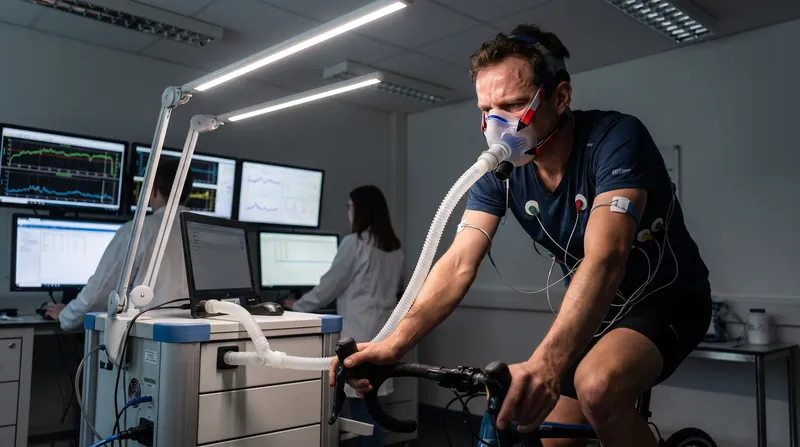
While precise metabolic thresholds require laboratory testing with gas exchange masks and blood lactate sampling, individuals can estimate them in the real world. The 'talk test'—the ability to comfortably hold a full, uninterrupted conversation—reliably indicates an intensity below LT1 and near FatMax, ensuring the workout remains truly aerobic. If you have to pause for breath mid-sentence, you have likely crossed your aerobic threshold and entered the grey zone.
By shifting focus from generic heart rate formulas to actual metabolic responses, exercisers can stop guessing and start training the specific physiological systems that drive health, endurance, and longevity. Understanding the body's true thresholds transforms cardio from a blind effort into a precise science. Whether the goal is to burn fat, finish a marathon, or simply live a longer, healthier life, the key is knowing exactly what your engine is doing at every speed.[6][8]
How we did this
- Method
- Synthesizing and normalizing distinct metabolic threshold models (VO2 max percentages, lactate inflection points, and maximal fat oxidation rates) into a unified intensity framework.
- What we found
- The standard 5-zone heart rate model based purely on age-predicted maximums fails to align with individual metabolic realities, meaning many athletes train in a 'grey zone' that neither maximizes fat oxidation (FatMax) nor effectively builds anaerobic capacity (Lactate Threshold).
- What we worked from
- Average FatMax intensity: 48.3% of VO2 max — Journal of Applied Physiology
- Lactate inflection point (LIP) intensity: 75% of maximum oxygen intake — Wikipedia
- Limits of this analysis
- This analysis relies on aggregated population ranges; individual athletes must undergo clinical metabolic testing (e.g., graded exercise tests with blood lactate sampling) to determine their exact physiological turn points.
Jargon, explained
- VO2 Max
- The maximum volume of oxygen the body can absorb, transport, and utilize during exhaustive exercise, serving as the ceiling for cardiovascular fitness.
- Lactate Threshold (LT2)
- The exercise intensity at which lactate production overwhelms the body's clearance capacity, causing fatigue to accumulate rapidly.
- Aerobic Threshold (LT1)
- The first inflection point where blood lactate begins to rise slightly above resting levels, marking the upper limit of easy, sustainable endurance work.
- FatMax
- The specific exercise intensity at which the body oxidizes fat at its highest absolute rate, typically occurring at lower intensities.
- Polarized Training
- A training model where roughly 80 percent of exercise is performed at low intensities and 20 percent at high intensities, avoiding the moderate 'grey zone'.
Common questions
What is the 'grey zone' in training?
The grey zone is an exercise intensity that falls between your aerobic threshold (LT1) and anaerobic threshold (LT2). It is generally considered too intense to optimally burn fat or build base endurance, but not intense enough to raise your cardiovascular ceiling (VO2 max).
Do I need a lab test to find my heart rate zones?
While a lab test with gas exchange and blood lactate sampling is the most accurate method, you can estimate your zones. The 'talk test'—being able to hold a full conversation—is a reliable indicator that you are below your first lactate threshold and near your FatMax.
Why is my smartwatch heart rate zone different from my actual effort?
Most smartwatches use a generic formula (like 220 minus your age) to estimate your maximum heart rate and divide it into zones. This formula does not account for your individual metabolic efficiency, genetics, or fitness level.
Does training at FatMax guarantee weight loss?
FatMax optimizes the percentage of calories burned from fat during exercise, which improves metabolic health. However, overall weight loss still requires a caloric deficit, meaning diet plays an equally critical role.
Competing readings
Clinical Exercise Physiologists
Focus on precise laboratory measurements of gas exchange and blood lactate to map individual metabolic pathways.
For clinical researchers, age-based formulas are fundamentally inadequate because they ignore the vast interindividual variation in human metabolism. Physiologists rely on graded exercise tests—measuring the exact volume of oxygen consumed (VO2) and carbon dioxide produced (VCO2) via indirect calorimetry, alongside capillary blood lactate sampling. This clinical precision reveals that two athletes with the exact same maximum heart rate can have drastically different FatMax and lactate threshold points, dictating entirely different training prescriptions.
Endurance Coaches
Emphasize practical application, using polarized training models to avoid the grey zone and maximize performance.
In the coaching community, the focus shifts from lab precision to practical execution. Coaches advocate for the 'polarized' training model, where the vast majority of volume is kept strictly below the first lactate threshold (LT1) to build aerobic efficiency without accumulating systemic fatigue. They warn against the 'grey zone'—the moderate-to-hard intensity where athletes feel they are working hard, but are neither maximizing fat oxidation nor triggering the high-end adaptations of true VO2 max intervals.
Public Health Advocates
Highlight low-intensity FatMax training as a safe, effective therapeutic tool for metabolic health and obesity treatment.
Public health experts view metabolic thresholds through the lens of disease prevention and obesity treatment. Because FatMax occurs at a relatively low intensity (often a brisk walk or light jog), it presents a highly accessible intervention for sedentary or overweight populations. Studies demonstrate that sustained training at this specific intensity improves insulin sensitivity, lowers blood pressure, and reduces visceral fat more effectively than generic 'moderate' exercise, all while minimizing joint stress and injury risk.
- Clinical Exercise Physiologists
- Focus on precise laboratory measurements of gas exchange and blood lactate to map individual metabolic pathways.
- Endurance Coaches
- Emphasize practical application, using polarized training models to avoid the grey zone and maximize performance.
- Public Health Advocates
- Highlight low-intensity FatMax training as a safe, effective therapeutic tool for metabolic health and obesity treatment.
Perspectives this story doesn't cover
- Wearable Technology Developers
- Recreational Exercisers
Sources
Source coverage
8 outlets
3 viewpoints surfaced



- [1]PubMed / NIHClinical Exercise Physiologists
Effects of FATmax training on body composition and cardiovascular function
Read on PubMed / NIH → - [2]Journal of Applied PhysiologyClinical Exercise Physiologists
Determinants of fat oxidation during exercise in healthy men and women: a cross-sectional study
Read on Journal of Applied Physiology → - [3]Journal of Sports Science and MedicinePublic Health Advocates
The Therapeutic Effects of 12 Weeks of Supervised Exercise Training at Maximal Fat Oxidation Intensity
Read on Journal of Sports Science and Medicine → - [4]Journal of Sports Science and MedicinePublic Health Advocates
Maximal Fat Oxidation During Exercise in Inactive and Overweight Men and Women
Read on Journal of Sports Science and Medicine → - [5]WikipediaEndurance Coaches
VO2 max
Read on Wikipedia → - [6]WikipediaEndurance Coaches
Lactate threshold
Read on Wikipedia → - [7]WikipediaEndurance Coaches
Heart rate
Read on Wikipedia → - [8]Factlen Editorial TeamEndurance Coaches
Synthesis by Factlen editorial team
Read on Factlen Editorial Team →
More in Fitness
See all →Metabolic Health
How Zone 2 Training Triggers Mitochondrial Biogenesis and Enhances Fat Oxidation
10 sources

VO2 Max Training
The 4-Minute Exhaustion Window: How Maximal Aerobic Speed Defines the Optimal Duration and Intensity for VO2max Intervals
5 sources

Cardiovascular Drift
How Fluid Loss and Core Temperature Drive Cardiovascular Drift During Steady-State Running
6 sources

Cardio Science
Why HIIT and MICT Trigger Entirely Different Physiological Adaptations
6 sources

Comments
Every angle. Every day.
Get Fitness stories with full source coverage and perspective breakdowns, free every day.