
The 10-Degree Shift: How the Munsell Color System Predicts a Paint's Appearance Under Different Light Sources
The discrepancy between a store paint chip and a finished wall is driven by illuminant metamerism and the geometry of human vision. Understanding the CIE standard observer models explains why colors shift under residential lighting.
By Adrien Caron

- Color Scientists
- Focus on standardizing human visual perception through mathematical models and controlled illuminants.
- Paint Manufacturers
- Rely on the Munsell system and CIE standards to ensure batch consistency and accurate pigment formulation.
- Architectural Designers
- Prioritize the practical application of color in dynamic, uncontrolled residential lighting environments.
Perspectives this story doesn't cover
- Lighting Manufacturers
- Residential Homeowners
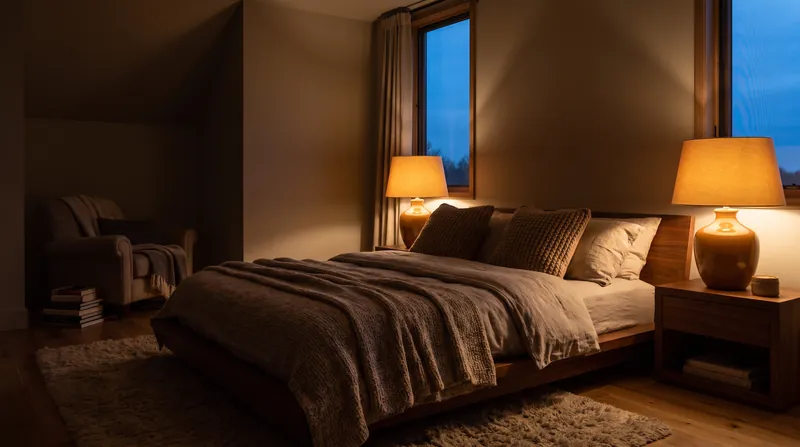
The binding constraint for a paint color to look exactly like its sample chip is that the viewing angle and the light source must remain identical to the laboratory conditions under which the color was measured. In residential design, this condition almost never holds. A homeowner typically selects a hue from a two-inch square—engaging only the central 2 degrees of their vision—under the harsh fluorescent lighting of a hardware store. They then apply that same pigment to a 200-square-foot living room wall, filling their peripheral vision, under the warm glow of residential incandescent or LED bulbs. The result is a predictable, systematic failure of expectation.[3]
This discrepancy is not a defect in the paint, but a fundamental mechanism of human optics and physics known as illuminant metamerism. To understand why a soft gray suddenly reads as lavender in a bedroom, the architectural coatings industry relies on the Munsell color system. Developed in the early 20th century by Albert H. Munsell, the framework maps color across three independent dimensions. "This practice provides a means of specifying the colors of objects in terms of the Munsell color order system, a system based on the color-perception attributes hue, lightness, and chroma," according to the ASTM International standard D1535-14. Unlike subjective color wheels, the Munsell system is anchored in rigorous measurements of human visual responses, allowing manufacturers to assign a precise numerical coordinate to any physical surface.[1][4][6]
However, a Munsell coordinate is only accurate under a specific light source, known as an illuminant. The International Commission on Illumination (CIE) established standardized illuminants to quantify this relationship. The paint industry typically calibrates its Munsell values using CIE Illuminant D65, which simulates noon daylight at a color temperature of 6500 Kelvin, or Illuminant C, representing average daylight. When a surface formulated to match a specific Munsell notation under D65 is moved into a room lit by Illuminant A—representing a standard incandescent bulb at 2856 Kelvin—the spectral power distribution hitting the wall changes entirely.[4][5][7]
The physics of this shift dictate that the wall is no longer reflecting the same wavelengths of light back to the observer. Because residential lighting is heavily skewed toward the red and yellow end of the spectrum, paints with complex undertones will experience a chroma shift. A blue-green hue that appears perfectly balanced under daylight will lose its blue reflectance under incandescent light, causing the green or yellow undertones to dominate the perceived color. This phenomenon, illuminant metamerism, explains why two surfaces can appear identical in the store but clash violently in the home.[2][5]
The physics of this shift dictate that the wall is no longer reflecting the same wavelengths of light back to the observer.
The second half of the equation involves the geometry of the human eye, quantified by the CIE Standard Observer models. In 1931, color scientists established the 2-degree standard observer, which maps how the eye perceives color when looking at a small object at arm's length—roughly the size of a thumbnail, or a standard paint chip. At this narrow angle, the light falls exclusively on the fovea, the densely packed cluster of color-sensitive cones at the center of the retina.[3]
But a painted wall is not a thumbnail. When a color covers a broad architectural surface, it engages the 1964 CIE 10-degree standard observer model. A 10-degree field of view pushes the incoming light beyond the fovea and into the peripheral retina, where the distribution of rods and cones is fundamentally different. This wider angle alters the brain's color processing, typically making the hue appear more saturated and slightly lighter than it did on the 2-degree chip.[3][7]
When the 10-degree shift in human vision collides with the illuminant shift of residential lighting, the Munsell value of the paint effectively breaks down. The color has not physically changed, but the biological and environmental constraints have shifted so drastically that the brain perceives an entirely different hue. For homeowners and interior designers, this means that selecting a paint based purely on its Munsell notation or chip appearance under store lighting is a gamble.[2][7]
To mitigate this, architectural colorists recommend viewing large-scale drawdowns—painted samples of at least one square foot—inside the actual room where the paint will be applied. By observing the sample across different times of day and under the specific artificial lighting of the space, the buyer forces the 10-degree observer model and the local illuminant to interact before committing to the 5-gallon bucket. Until the industry develops a consumer-facing standard that accounts for both metamerism and peripheral vision, the physical environment will always have the final say on the color of a wall.[5][7]
Key points
- The Munsell color system maps hue, value, and chroma to provide precise numerical coordinates for physical surfaces.
- Illuminant metamerism causes paints to shift in appearance when moved from daylight to residential incandescent lighting.
- The CIE 2-degree standard observer models foveal vision, which applies when looking at a small paint chip.
- The CIE 10-degree standard observer models peripheral vision, which alters color perception when viewing a full wall.
- Testing large paint samples in the actual room under local lighting is the only way to predict final appearance.
Key terms
- Illuminant Metamerism
- A phenomenon where two colors appear to match under one light source but look completely different under another.
- Standard Observer
- A mathematical model representing how the average human eye perceives color at a specific viewing angle.
- Chroma
- The intensity, purity, or saturation of a color in the Munsell system.
- Spectral Power Distribution
- The specific mixture of wavelengths emitted by a light source, which dictates how it illuminates objects.
Frequently asked
Why does my paint look different on the wall than on the chip?
The color shift is caused by illuminant metamerism and the 10-degree observer effect. The warm lighting in your home reflects different wavelengths than the store's fluorescent lights, and the larger surface area engages your peripheral vision, altering how your brain processes the hue.
What is the Munsell color system?
It is a precise, three-dimensional framework developed in the early 1900s that defines colors based on their hue, value (lightness), and chroma (saturation).
How can I accurately test a paint color?
Paint a large sample (at least one square foot) and view it in the actual room where it will be applied. Observe the sample at different times of day and under the room's specific artificial lighting.
Sources
Source coverage
7 outlets
3 viewpoints surfaced




- [1]Britannica
Munsell colour system
Read on Britannica → - [2]Journal of the Optical Society of America AColor Scientists
Simultaneous color constancy: papers with diverse Munsell values
Read on Journal of the Optical Society of America A → - [3]HunterLabColor Scientists
Understanding Standard Observers in Color Measurement
Read on HunterLab → - [4]ASTM InternationalPaint Manufacturers
D1535-14 Standard Practice for Specifying Color by the Munsell System
Read on ASTM International → - [5]Journal of the Optical Society of America AColor Scientists
Color appearance: effects of illuminant changes under different surface collections
Read on Journal of the Optical Society of America A → - [6]Wikipedia
Munsell color system
Read on Wikipedia → - [7]Factlen Editorial TeamArchitectural Designers
Synthesis by Factlen editorial team
Read on Factlen Editorial Team →
Comments

More in Home
See all →5S Framework
The Sort, Set in Order, Shine, Standardize, Sustain Sequence: How the 5S Methodology Actually Organizes a Home
4 sources

Circadian Lighting
The 460-480 Nanometer Peak: How Blue Light Wavelengths Actually Suppress Melatonin and Govern Circadian Rhythm
9 sources
HVAC Efficiency
The 1,705-Hour Cooling Season: How the SEER2 Rating Predicts Your Air Conditioner's Annual Kilowatt-Hour Consumption
5 sources

Kitchen Tech
The Science of Induction: Why Magnetic Cooking is Taking Over the 2026 Kitchen
4 sources

Every angle. Every day.
Get Home stories with full source coverage and perspective breakdowns delivered to your inbox.