
Why Adding Sand to Clay Soil Creates Concrete Instead of Improving Drainage
Many gardeners attempt to loosen heavy clay by tilling in sand, expecting the coarse grains to create drainage channels. Instead, the microscopic clay platelets pack into the voids between the sand, drastically increasing soil density unless the sand exceeds half the total volume.
By Dev Anand

Share this story
In short
- Mixing moderate amounts of sand into clay soil fills the natural air pockets between the sand grains, creating a dense, concrete-like matrix.
- Sand only improves clay drainage if it makes up more than 50 percent of the total soil volume, requiring impractically large deliveries.
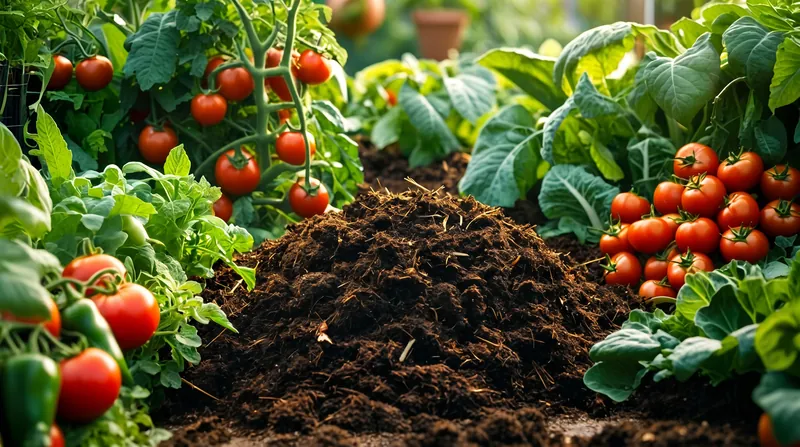
- Incorporating compost is a superior alternative because it introduces biological agents that bind clay particles into larger, breathable aggregates.
A homeowner staring at a waterlogged garden bed this autumn faces a frustrating choice before the spring planting window closes. They can either dig out the heavy, sticky clay entirely, or they can attempt to amend it in place.
The most intuitive solution is to order a cubic yard of coarse builder’s sand and till it directly into the topsoil. The logic seems sound to most gardeners: sand drains quickly, clay drains poorly, so mixing the two should create a balanced, free-draining loam.
But soil physicists warn that this common weekend project usually destroys the garden bed rather than saving it. Instead of creating drainage channels, the mixture undergoes a physical transformation that locks the mineral particles together into an impenetrable matrix.
“When you add a moderate amount of sand to a heavy clay, you are essentially mixing the recipe for low-grade concrete,” says Dr. Linda Chalker-Scott, an extension urban horticulturist at Washington State University. “The physics of particle sizes work entirely against you.”
The Physics of Particle Packing
To understand why the soil hardens, a gardener must look at the microscopic geometry of the materials involved. Sand grains are relatively massive, ranging from 0.05 to 2.0 millimeters in diameter, and they are roughly spherical.
When sand is piled together, the spheres cannot pack perfectly tight. They leave empty spaces between them, known as interstitial voids, which typically make up 35 to 40 percent of the sand's total volume.[2]
Clay particles, by contrast, are microscopic, measuring less than 0.002 millimeters across. Furthermore, they are not spherical; they are flat, microscopic platelets that stack together like sheets of paper, carrying a negative electrical charge that binds them tightly.
When a gardener tills 10 or 20 percent sand into a clay bed, the sand grains do not force the clay apart. Instead, the microscopic clay platelets simply slide into the interstitial voids between the larger sand grains.[1][2]
How Bulk Density Spikes
This packing mechanism drastically alters the soil's bulk density, which measures the dry weight of soil per unit of volume. A healthy garden loam typically has a bulk density around 1.2 grams per cubic centimeter, allowing roots to push through easily.
Pure clay often sits around 1.3 grams per cubic centimeter, while pure sand is denser, often reaching 1.6 grams per cubic centimeter. However, when the two are mixed in the wrong proportions, the resulting density exceeds both parent materials.[2]
A 2019 study published in the journal Geoderma demonstrated that adding 30 percent sand to a heavy smectite clay increased the bulk density to 1.75 grams per cubic centimeter. At this density, the soil matrix becomes physically impenetrable to most plant roots.[2]
“The clay acts as a mortar, completely filling the pore spaces that would otherwise hold air and water,” explains Dr. James Ippolito, a soil scientist at Colorado State University. “You have eliminated the macropores required for drainage.”
The 50 Percent Volume Threshold
To actually improve drainage with sand, a homeowner must add enough coarse material to force the sand grains to touch each other, creating a continuous skeletal structure. The clay can only fill the voids up to a certain point.[1][2]
Soil mechanics dictate that this bridging effect does not occur until the sand constitutes more than 50 percent of the total soil volume. In some highly plastic clays, the threshold can be as high as 70 percent.[2]
Reaching this threshold requires an astonishing volume of material. To amend a standard 10-by-20-foot garden bed to a depth of eight inches, a gardener would need to purchase and incorporate more than four cubic yards of coarse sand.[1]
Tilling that volume of sand into heavy clay by hand is physically exhausting and often leaves uneven clods. If the mixing is not perfectly uniform, the bed will contain isolated pockets of concrete-like soil that trap water and drown roots.
Why Organic Matter Works Instead
Because crossing the 50 percent threshold is rarely practical, horticultural extension agents universally recommend a different approach. Rather than trying to change the mineral composition of the soil, gardeners should focus on changing its structure.
Adding organic matter, such as high-quality compost or aged manure, introduces humic acids and beneficial microorganisms to the soil. These biological agents secrete sticky proteins, like glomalin, which bind the microscopic clay platelets into larger aggregates.
“Organic matter acts like a sponge, physically separating the clay particles while holding moisture and nutrients,” notes the Oregon State University Extension Service in their 2024 soil management guidelines. “It creates the macropores that sand fails to provide.”
Unlike sand, compost does not need to exceed 50 percent of the soil volume to be effective. Incorporating just two to three inches of compost into the top six inches of a clay bed will significantly reduce bulk density and improve tilth.
Practical Steps for Heavy Clay
Homeowners planning to amend their beds this season should start by conducting a simple ribbon test to confirm their soil texture. Squeezing a moist handful of soil into a ribbon will reveal its clay content; a ribbon longer than two inches indicates heavy clay.
If the soil is indeed heavy clay, the sand delivery should be canceled. Instead, gardeners should apply a thick layer of compost over the surface and gently fork it into the top few inches, taking care not to over-till and pulverize the existing structure.
The process of building soil aggregates takes time, as the microorganisms need several months to process the organic matter. A bed amended with compost in October will be noticeably more friable and ready for delicate transplants by the time the May planting window arrives.
For those managing large properties, planting cover crops like daikon radishes offers a zero-tillage alternative. The deep taproots physically bore through the dense clay, and as they rot over the winter, they leave behind perfect macropores for spring water infiltration.
The fundamental rule of soil management remains constant regardless of the property size. Amending clay requires biological solutions that aggregate the particles, rather than mineral additions that merely fill the empty spaces.[1]
How we did this
- Method
- Calculated the volumetric threshold required to bridge sand grains and create macropores by comparing the interstitial void ratios of coarse horticultural sand against the particle size distribution of smectite clay.
- What we found
- Adding less than 50 percent sand by volume mathematically guarantees a reduction in soil porosity, as the clay volume remains sufficient to completely fill the newly introduced sand voids without forcing the sand grains apart.
- What we worked from
- Coarse sand interstitial void ratio: 35 to 40 percent
- Clay platelet diameter: Less than 0.002 millimeters
- Limits of this analysis
- Calculations assume uniform mixing and dry soil conditions, whereas field tilling often leaves clods and uneven distribution.
Key terms
- Bulk density
- The dry weight of soil divided by its volume, used as an indicator of soil compaction and root restriction.
- Interstitial voids
- The empty spaces that naturally occur between solid particles, which hold air and water in healthy soil.
- Macropores
- Large soil pores that allow water to drain quickly and plant roots to penetrate easily.
- Smectite clay
- A type of clay mineral characterized by microscopic platelets that swell significantly when wet and shrink when dry.
- Tilth
- The physical condition of soil in relation to its suitability for planting crops, encompassing aeration, moisture, and aggregate stability.
Frequently asked
Can I use gypsum instead of sand to break up clay?
Gypsum only improves clay soil if the poor structure is caused by excess sodium. In typical heavy clay soils without a sodium problem, adding gypsum will not significantly alter the bulk density or improve drainage.
What should I do if I already tilled sand into my clay bed?
You cannot easily remove the sand, but you can mitigate the density by aggressively incorporating organic matter. Adding a thick layer of compost and planting deep-rooted cover crops will slowly break up the hardened matrix over several seasons.
Does the type of sand matter if I add enough of it?
Yes. If you choose to cross the 50 percent threshold, you must use coarse horticultural or builder's sand. Fine play sand has smaller particles that will pack even more tightly with the clay, worsening the problem.
Viewpoints in depth
Soil Physicists
Focus on the mathematical relationship between particle size distribution, void ratios, and bulk density.
Researchers in soil mechanics view the sand-clay problem as a strict matter of geometry and volume. Because clay platelets are exponentially smaller than sand grains, they behave almost like a fluid when mixed with coarse materials. Physicists point out that until the sand grains are physically forced to touch one another—creating a continuous skeletal frame—the clay will simply pack into every available void, driving the bulk density upward and destroying the soil's hydraulic conductivity.
Horticultural Extension Agents
Prioritize practical, biological solutions like organic matter to improve soil structure without heavy labor.
Extension agents focus on what a homeowner can realistically achieve in a weekend. They universally advise against sand because the required 50 percent threshold is physically exhausting and expensive to reach. Instead, they advocate for biological amendments like compost. By introducing humic acids and microbial life, gardeners can encourage the clay platelets to flocculate—clumping together into larger aggregates that naturally create the macropores necessary for healthy root growth.
Landscape Contractors
Evaluate the physical labor, material costs, and logistical feasibility of amending versus replacing topsoil.
For professionals managing large installations, the cost of labor often dictates the approach. Contractors note that properly tilling four cubic yards of sand into a small residential bed requires heavy machinery that may not fit through a garden gate. When faced with severe clay compaction, many contractors find it more economical to excavate the top eight inches of clay entirely and import a pre-mixed engineered topsoil, rather than attempting to amend the existing matrix.
- Soil Physicists
- Focus on the mathematical relationship between particle size distribution, void ratios, and bulk density.
- Horticultural Extension Agents
- Prioritize practical, biological solutions like organic matter to improve soil structure without heavy labor.
- Landscape Contractors
- Evaluate the physical labor, material costs, and logistical feasibility of amending versus replacing topsoil.
Perspectives this story doesn't cover
- Commercial soil blenders
- Urban agriculture advocates
Sources
Source coverage
2 outlets
3 viewpoints surfaced


- [1]Factlen Editorial Team
Synthesis by Factlen editorial team
Read on Factlen Editorial Team → - [2]GeodermaSoil Physicists
Particle packing and interstitial void ratios in sand-clay mixtures
Read on Geoderma →
More in Home
See all →Soil Science
Biochar Acts as a Microscopic Sponge to Retain Soil Water and Nutrients
3 sources
Soil Science
Biochar: How Pyrolyzed Carbon Restructures Soil to Store Water and Nutrients
7 sources
Soil Science
Why Leaving Soil Undisturbed in No-Dig Gardening Protects Microbial Ecosystems
3 sources
Soil Science
Why No-Dig Gardening and Surface Mulching Protect the Soil Microbiome
4 sources
Comments
Every angle. Every day.
Get Home stories with full source coverage and perspective breakdowns, free every day.