
Rare New Monkey Species Discovered in Congo Rainforest, Already Proposed as Endangered
Scientists have formally identified Colobus congoensis, a striking orange-faced monkey hidden in the Democratic Republic of Congo. The discovery marks only the fifth new monkey species found in Africa in 75 years, though researchers warn it is already highly endangered.

Share this story
The discovery of a new mammal in the 21st century is a rare event. In the dense rainforests of the Democratic Republic of Congo (DRC), an international team of scientists has formally identified a previously unknown species of primate.[1][3]
Named Colobus congoensis and known locally as "Likweli," the primate represents only the fifth new monkey species documented in Africa over the past 75 years. The formal description, published in the journal PLOS One, culminates nearly two decades of sporadic sightings, genetic sequencing, and morphological analysis.[2][4][8]
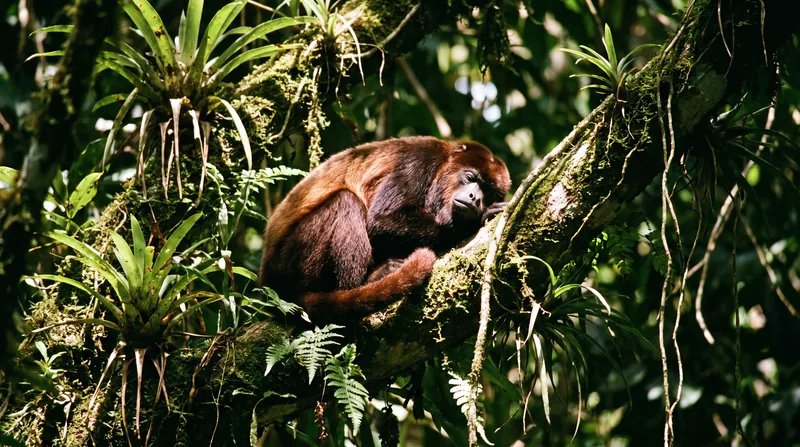
The primary evidence for the new species classification rests on its unique physical characteristics. Colobus congoensis is a small, arboreal monkey weighing approximately 15 pounds, roughly the size of a small dog.[1]
It is draped in glossy black fur with cape-like shoulders and a long, sweeping tail. However, its most striking feature is a vivid orange-cream patch surrounding its mouth and nose, set against a mask-like black face. Researchers utilized extensive museum collections, including specimens from the Yale Peabody Museum, to compare the skulls and pelts of the Likweli with known African colobus monkeys, confirming its anatomical uniqueness.[2][3][6][7]
Beyond physical appearance, DNA analysis provides the most definitive proof of the species' distinct lineage. Genetic sequencing reveals that Colobus congoensis is most closely related to the Black colobus (Colobus satanas).[4][7]
However, mitochondrial DNA indicates that the two lineages diverged roughly 4 to 5 million years ago. This represents the deepest evolutionary split between sister species anywhere within the Colobus genus, fundamentally reshaping anthropologists' understanding of African monkey evolution.[2][3][4][8]
Field observations have added behavioral and acoustic evidence to the genetic data. The Likweli produces deep, resonant roaring calls that carry over long distances in the forest canopy.[7]
While these vocalizations share structural similarities with other Colobus monkeys, acoustic analysis confirms they possess a distinct pitch and pattern, described by researchers as resembling a cross between a frog and a pig snorting.[1]
Behaviorally, the monkeys exhibit a quiet, watchful nature. Unlike many primates that flee upon encountering humans, Likweli groups—typically consisting of about six individuals—often climb higher into the canopy and quietly observe researchers for extended periods.[2]
The evidence also indicates that Colobus congoensis is highly endemic, restricted to an unusually small geographic footprint.[5][6]
Field surveys conducted between 2018 and 2022 recorded 114 sightings, all confined to an estimated range of just 1,700 square kilometers. This territory is nestled in the remote interfluve between the Lomami and Congo (Lualaba) rivers in east-central DRC.[3][4][7]
The species appears to be naturally isolated by these massive river systems and is dependent on scattered upland forest patches. Even among local communities, the monkey is elusive; surveys of 52 villages bordering the range found that residents in only eight villages were familiar with the animal.[1][3][5][7]
Local Mituku communities refer to the monkey as "kasaba nkoni," which translates to "the branch shaker," while Bangala people call it "Likweli." The integration of this local ecological knowledge was crucial in mapping the species' distribution.[3][4][7][8]
Despite only just entering the scientific record, the evidence strongly suggests that Colobus congoensis is already facing an existential threat.[2][6]
Based on its extremely limited range and small population size, the research team has proposed that the species be immediately classified as Endangered on the IUCN Red List.[1][8]
The primary pressures driving this vulnerability are ongoing habitat loss and increasing hunting pressure in the region. The monkey's restricted habitat means that even minor environmental disruptions could have catastrophic consequences for the population.[1][3][5][6]
The discovery underscores the critical importance of Lomami National Park, a protected area established in 2016 following the discovery of another new primate, the Lesula monkey. The park serves as a vital refuge for the Likweli and other threatened species in the Congo Basin.[1][2][5][8]
While the taxonomic status of Colobus congoensis is now firmly established, significant gaps in the evidence remain.[1][4]
Researchers do not yet have a precise estimate of the total population size, nor do they fully understand the monkey's specific dietary requirements or its broader ecological role within the canopy ecosystem.[1]
Key points
- Scientists have formally identified Colobus congoensis, a new monkey species in the Democratic Republic of Congo.
- The primate is distinguished by its glossy black fur, striking orange-cream lips, and unique roaring vocalizations.
- Genetic analysis reveals it diverged from its closest relative roughly 4 to 5 million years ago.
- The species is restricted to a 1,700-square-kilometer area between the Lomami and Congo rivers.
Unanswered questions
- The exact population size of Colobus congoensis remaining in the wild.
- The specific dietary requirements and foraging habits of the species.
- How the monkey interacts ecologically with other canopy-dwelling primates in the Lomami Basin.
How we got here
2008
Conservationists capture a blurry, partial photograph of an unidentified primate in the Lomami Basin.
2012
The Lesula monkey is discovered in the same region, leading to the creation of Lomami National Park.
Nov 2018
A park ranger photographs a clear image of the monkey, reigniting scientific investigation.
2018–2022
Researchers record 114 field observations and collect genetic and anatomical data.
Jul 2026
The species is formally described as Colobus congoensis in the journal PLOS One.
- Conservation Biologists
- Focusing on the immediate threats to the species and the urgency of habitat protection.
- Evolutionary Anthropologists
- Analyzing the deep genetic divergence to understand primate lineage and historical forest refugia.
- Local Knowledge Holders
- Highlighting the intersection of indigenous ecological knowledge and formal taxonomy.
Perspectives this story doesn't cover
- Congolese Government Officials
- Local Logging or Hunting Interests
Sources
Source coverage
8 outlets
3 viewpoints surfaced








- [1]Smithsonian MagazineLocal Knowledge Holders
New Monkey Species Discovered in the Congo
Read on Smithsonian Magazine → - [2]Yale UniversityEvolutionary Anthropologists
Meet 'Likweli': A new monkey species discovered in the Congo Basin
- [3]Florida Atlantic UniversityEvolutionary Anthropologists
New Monkey Species Discovered in the Congo Rainforest
- [4]ScienceAlertLocal Knowledge Holders
Entirely New Monkey Species Discovered in The Congo Rainforest, And It Doesn't Look Impressed
- [5]Frankfurt Zoological SocietyConservation Biologists
A New Monkey Species Hidden in the Congo Rainforest
Read on Frankfurt Zoological Society → - [6]Discover MagazineConservation Biologists
A New Orange-Faced Monkey Was Discovered Deep in the Congo — and It May Already Be Endangered
- [7]Sci.NewsEvolutionary Anthropologists
Scientists Discover New Monkey Species in Democratic Republic of Congo
- [8]PLOS OneEvolutionary Anthropologists
A new species of Colobus monkey from the Democratic Republic of the Congo

More in Science
See all →Biodiversity Tech
First Global Early Warning System Forecasts Biodiversity Exposure to Extreme Heat Up to Nine Months Out
4 sources
Ocean Chemistry
Arctic Sea Ice Loss Triggers Chemical Tipping Point, Stripping Ocean of Key Nutrient
6 sources

Soil Carbon
Decades-Long Experiment Reveals Warming Unlocks 'Stable' Soil Carbon, Threatening New Climate Feedback Loop
5 sources

Mass Extinctions
Scientists Pinpoint Warming Oceans and Oxygen Loss as Cause of Earth's Greatest Mass Extinction
2 sources

Comments
Every angle. Every day.
Get Science stories with full source coverage and perspective breakdowns, free every day.