
Philippines Summons Chinese Envoy Over Remarks Threatening Military Force
The Philippine foreign ministry summoned Chinese Ambassador Jing Quan on Monday after he suggested Beijing could "easily win" a military confrontation between the two nations. The diplomatic rebuke follows escalating tensions in the South China Sea and calls from Philippine lawmakers to expel the envoy.
By Anaya Sharma

Share this story
The Philippine government summoned China's ambassador on Monday to formally protest public remarks that Manila characterized as a direct threat of military force. Foreign Secretary Ma. Theresa Lazaro told Ambassador Jing Quan that his recent comments were "provocative and unacceptable," warning that they aggravated an already sensitive relationship. The diplomatic rebuke follows months of escalating maritime clashes between the two neighbors in the contested South China Sea.[1][2][3]
The controversy stems from statements Jing made on October 15 during the Second Diliman Dialogue at Diliman College in Quezon City. Responding to Philippine Defense Secretary Gilberto Teodoro Jr., who had described Beijing as a regional "troublemaker," the envoy suggested the Philippines should feel fortunate to have China as a neighbor. "If we want to use force, we may easily win," Jing told reporters, adding that Beijing would not choose force because "we love peace."[1][3][4]
Philippine officials swiftly condemned the rhetoric across multiple branches of government. President Ferdinand Marcos Jr. stated that the envoy's words sounded "very much like a threat" and lacked diplomatic tact, prompting the formal summons to clarify Beijing's intent. At least two sitting Philippine senators demanded Jing's immediate expulsion, while Philippine Coast Guard spokesperson Rear Adm. Jay Tarriela publicly rejected the ambassador's assurances of peaceful intentions.[1][4]
Severed Military Channels
The diplomatic rupture is compounded by a breakdown in direct crisis management mechanisms. During his remarks, Jing warned that the Philippines faced a greater risk of confrontation if it refused to restore direct military-to-military communications. Teodoro suspended those specific defense channels approximately three years ago and recently justified keeping them closed, citing China's alleged abuse of the lines and distortion of narratives.[4]
The Department of Foreign Affairs emphasized that disputes must be handled through established bilateral mechanisms rather than public intimidation. Lazaro reminded the envoy that diplomacy requires tact and restraint to allow dialogue to continue despite entrenched differences. The ministry's official statement noted that it reserves the right to take further diplomatic action as it deems necessary.[2][3][4]
Beijing has defended its ambassador and dismissed Manila's reaction as an over-interpretation. The Chinese Embassy in Manila argued that Jing had been selectively quoted, noting that his broader message focused on preventing maritime disputes from defining the entirety of bilateral relations. Jing had pointed to continued trade and people-to-people exchanges, warning against allowing outside forces to steer the relationship toward conflict.[1][5]
Broader Maritime Friction
In Beijing, the Chinese foreign ministry pushed back against the calls for the envoy's expulsion. Spokesperson Mao Ning accused certain individuals in the Philippines of "malicious hyping" of China-related issues. She urged the Philippine government to take concrete steps to restrain the "irresponsible words and actions" of its politicians, maintaining that improving ties would benefit both nations.[3][5]
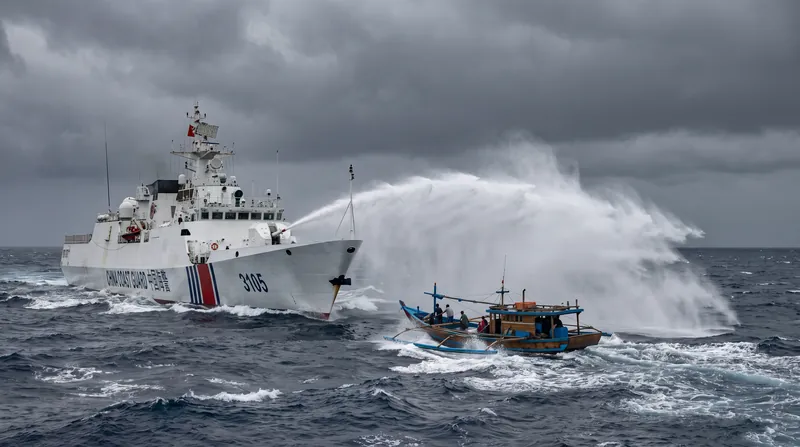
The verbal escalation arrives during a period of sustained physical friction over the South China Sea, where Beijing claims near-total sovereignty despite a 2016 international tribunal ruling. Manila has repeatedly accused the Chinese coast guard of aggressive maneuvers—including water-cannoning and blocking Philippine vessels—within its exclusive economic zone. The shift from maritime skirmishes to explicit warnings of military superiority leaves the relationship highly fragile ahead of Marcos's scheduled visit to Shenzhen in November.[1][3][4]
Perspectives explored
Manila's view
The Philippine government views the remarks as an unacceptable threat that undermines diplomatic norms.
Philippine officials argue that Ambassador Jing Quan's comments crossed the line from standard diplomatic posturing into outright intimidation. By explicitly referencing China's ability to 'easily win' a military conflict, Manila contends Beijing is attempting to coerce the Philippines into abandoning its sovereign claims in the South China Sea. The Department of Foreign Affairs maintains that such rhetoric damages mutual trust and proves why direct military-to-military channels remain suspended.
Beijing's view
China insists the ambassador was selectively quoted and blames Philippine politicians for escalating tensions.
The Chinese foreign ministry and its embassy in Manila assert that the ambassador's core message was one of peace and cooperation, not aggression. Beijing argues that Jing was merely responding to provocative labels from the Philippine defense secretary and that his remarks were intended to highlight the futility of conflict. Chinese officials accuse domestic Philippine politicians of 'malicious hyping' to score political points, warning that allowing outside forces to dictate the narrative will only steer bilateral relations toward unnecessary confrontation.
Key points
- Philippine Foreign Secretary Ma. Theresa Lazaro summoned Ambassador Jing Quan, calling his remarks "provocative and unacceptable."
- Jing told reporters last week that China "may easily win" a confrontation but would not use force because it loves peace.
- President Ferdinand Marcos Jr. characterized the envoy's comments as a "thinly veiled threat" that required an explanation.
- The Chinese foreign ministry accused Philippine politicians of "malicious hyping" and urged them to restrain their words.
Open questions
- Whether the Philippine government will take further diplomatic action, such as expelling the ambassador, as demanded by some senators.
- How this diplomatic rift will affect President Marcos Jr.'s scheduled visit to Shenzhen for the APEC Leaders' Meeting in November.
- The specific details of the broader coverage landscape, as the available sources provide limited depth on the exact military posture changes accompanying the diplomatic summons.
Timeline
Oct 15, 2026
Chinese Ambassador Jing Quan states China could 'easily win' a confrontation but chooses peace during a forum in Quezon City.
Oct 16, 2026
President Ferdinand Marcos Jr. characterizes the remarks as a threat and indicates he will summon the envoy.
Oct 19, 2026
The Philippine Department of Foreign Affairs formally summons Jing to express strong objections to his public statements.
- Philippine Government
- Argues the remarks were a provocative threat of force that undermines diplomatic relations.
- Chinese Foreign Ministry
- Maintains the envoy was selectively quoted and accuses Philippine politicians of maliciously hyping the issue.
- International Observers
- Views the exchange as a dangerous escalation in the ongoing South China Sea territorial dispute.
Perspectives this story doesn't cover
- United States State Department
- Philippine fisherfolk in the South China Sea
Sources
Source coverage
5 outlets
3 viewpoints surfaced





- [1]TRT WorldInternational Observers
Philippines summons Chinese ambassador over 'use of force' remarks
Read on TRT World → - [2]GMA News OnlinePhilippine Government
DFA summons Chinese Ambassador Jing Quan over remarks
Read on GMA News Online → - [3]CNAChinese Foreign Ministry
Philippines summons China's envoy over remarks conveying 'threat'
Read on CNA → - [4]Philippine Daily InquirerPhilippine Government
Marcos to summon Chinese envoy over ‘threatening’ remarks
Read on Philippine Daily Inquirer → - [5]AsiaOneChinese Foreign Ministry
Philippines summons China's envoy over remarks conveying 'threat'
Read on AsiaOne →
More in News & Politics
See all →Ukraine War Intelligence
US Resumes Intelligence Sharing With Ukraine Following Bilateral Rift Over Refinery Strikes
9 sources

Eurasian Diplomacy
US Secretary of State Rubio Opens Central Asia Summit to Counter Russian and Chinese Influence
6 sources
Strait of Hormuz
Tehran Outlines Six-Day Plan to Reopen Strait of Hormuz if US Meets Terms
5 sources
Sanctions Policy
Trump Suspends New Congressional Russia Sanctions Package Under Graham Act Authority
6 sources

Comments
Every angle. Every day.
Get News & Politics stories with full source coverage and perspective breakdowns, free every day.