
Palisades Nuclear Plant Secures $1.5 Billion Federal Loan to Become First Decommissioned US Reactor to Restart
Backed by a $1.52 billion federal loan guarantee, the Palisades Nuclear Plant in Michigan is completing major refurbishments to become the first decommissioned reactor in U.S. history to return to service.
By Hunter Cole

Share this story
For decades, the shutdown of a commercial nuclear reactor was an irreversible physical and regulatory process. When the 800-megawatt Palisades Nuclear Plant in Michigan ceased operations in May 2022, its fuel was removed, its operating license was modified to prohibit generation, and its workforce began to scatter. The facility was slated for demolition. Yet, the sudden surge in electricity demand from data centers and industrial electrification collided with that finality, forcing a systemic rethink of existing energy assets.[1]
That tension is now being resolved through an unprecedented federal intervention. Backed by a finalized $1.52 billion loan guarantee from the U.S. Department of Energy, owner Holtec International is executing the first-ever recommissioning of a retired nuclear power plant in American history.[1][2]
The project represents a fundamental shift in U.S. industrial policy. As grid operators warn of looming capacity shortfalls, the federal government has identified the preservation and resurrection of existing nuclear infrastructure as a critical node in maintaining grid stability. Palisades offers a rare source of firm, zero-carbon baseload power that can operate continuously, regardless of weather conditions.[1][3]
The financial architecture required to reverse a decommissioning process is immense. The $1.52 billion federal loan guarantee, finalized through the DOE's Loan Programs Office, provided the necessary capital to fund the massive mechanical overhaul. This federal backing fundamentally altered the risk calculus for Holtec, which had originally purchased the plant solely to dismantle it.[1][2]
The financial support extends beyond the plant's owner. To ensure a stable market for the resurrected facility's electricity, the U.S. Department of Agriculture awarded over $1.3 billion to rural electric cooperatives—including Wolverine Power Supply Cooperative and Hoosier Energy. These grants offset the costs of long-term power purchase agreements, securing the economic viability of the plant's 800-megawatt output.[2][5]
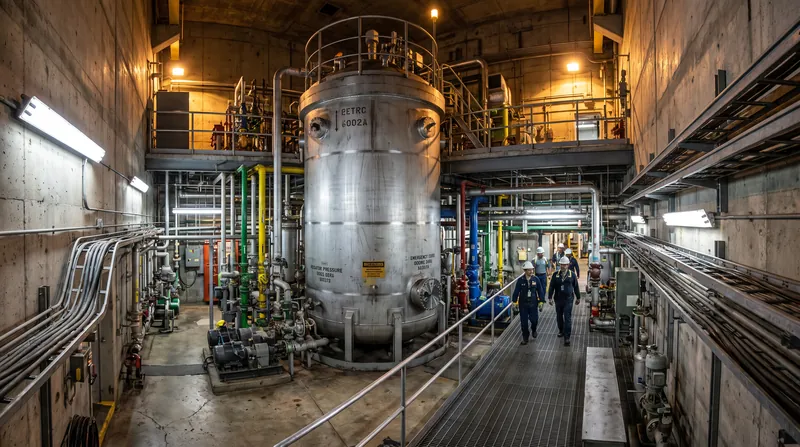
With the financing secured, the engineering reality of waking a dormant reactor has tested the limits of the nuclear supply chain. A nuclear power plant is a complex thermal and hydraulic system that degrades if left idle. Reversing the atrophy required a methodical, component-by-component restoration of the entire facility.[3][4]
By mid-2026, the project reached what Holtec described as a watershed moment. The site successfully transitioned from large-scale, heavy-industrial overhauls to the routine maintenance, testing, and operational readiness protocols required immediately prior to startup.[3][4]
The mechanical milestones achieved during this phase were substantial. Engineering crews successfully placed the plant's massive turbine-generator onto its turning gear—a critical mechanism that slowly rotates the offline turbine to prevent the heavy rotor from warping. This step followed months of extensive inspections, maintenance, and refurbishment of the power generation equipment.[3][4]
Simultaneously, the facility's fuel infrastructure required a complete modernization. Technicians installed and tested a state-of-the-art fuel handling machine, completing the upgraded system necessary to safely maneuver new uranium assemblies into the reactor core.[3][4]
The restoration extended deep into the plant's primary systems. The restart protocol mandated primary system chemical decontamination, comprehensive steam generator tube refurbishment, and the replacement of reactor head penetrations. These structural remediations were designed to ensure that the aging infrastructure, which first came online in 1971, could operate safely for decades to come.[3][4]
Parallel to the engineering effort, the regulatory pathway required navigating uncharted territory. The U.S. Nuclear Regulatory Commission had never before processed the licensing approvals needed to return a fully defueled, decommissioned plant to operational status.
The regulatory process required a series of exemptions and environmental assessments. The NRC ultimately concluded that the environmental impacts of restarting the facility would be minimal, a decision that recently survived legal challenges from anti-nuclear advocacy groups in federal court.
For the local economy of Covert Township, the restart acts as an economic lifeline. The initial 2022 closure threatened the region with a projected $250 million loss in tax revenue, local business sales, and wages. The resurrection of the plant restores hundreds of highly skilled, high-paying jobs to the Lake Michigan shoreline.[5]
While the physical and regulatory pieces are falling into place, the exact date of reconnection remains fluid. Holtec has declined to commit to a specific day, emphasizing that the facility will only restart once all federal requirements and operational readiness tests are unequivocally met.[3][4]
The current 800-megawatt reactor is viewed by Holtec as only the first phase of the site's future. The company has formally announced intentions to utilize the existing Palisades footprint to deploy two of its SMR-300 small modular reactors. If approved, this expansion would double the site's carbon-free generation capacity.[2][3]
Ultimately, the Palisades project serves as the proving ground for a new era of nuclear energy management. By establishing the regulatory, financial, and engineering blueprints for a reactor restart, the initiative paves the way for other decommissioned sites to return to the grid, fundamentally altering the trajectory of the American energy transition.[1][2]
Key points
- The U.S. Department of Energy finalized a $1.52 billion loan guarantee to fund the restart of the Palisades Nuclear Plant in Michigan.
- If successful, Palisades will become the first commercial nuclear reactor in U.S. history to return to service after entering the decommissioning process.
- Holtec International recently completed major large-scale refurbishments, including placing the turbine-generator on its turning gear and installing a new fuel handling machine.
- The U.S. Department of Agriculture awarded over $1.3 billion to rural electric cooperatives to purchase the plant's 800-megawatt output.
What we don’t know
- The exact date when the Palisades plant will officially reconnect to the Midcontinent Independent System Operator (MISO) grid.
- Whether the U.S. Nuclear Regulatory Commission will ultimately approve Holtec's application to extend the plant's operating license through 2051.
- How the final total cost of the unprecedented refurbishment will compare to initial estimates once all operational readiness testing is complete.
How we got here
May 2022
The Palisades Nuclear Plant ceases operations and enters the decommissioning process.
June 2022
Holtec International acquires the facility with the initial intention of dismantling it.
Early 2023
Driven by shifting energy economics, Holtec pivots and applies for federal loan funding to repower the plant.
March 2024
The U.S. Department of Energy announces a conditional $1.52 billion loan commitment for the restart.
September 2024
The federal loan guarantee is officially finalized, securing the project's financial foundation.
July 2026
Holtec announces a watershed moment, completing major large-scale refurbishments and transitioning to operational readiness testing.
- Federal & State Policymakers
- Advocating for the restart to secure zero-carbon baseload power and meet climate targets.
- Nuclear Industry & Utilities
- Focusing on the engineering feasibility and economic viability of resurrecting nuclear assets.
- Local Communities & Critics
- Balancing the economic benefits of job retention against the environmental risks of aging infrastructure.
Perspectives this story doesn't cover
- Grid operators managing the day-to-day baseload requirements of the Midcontinent Independent System Operator (MISO).
- Next-generation nuclear startups competing for the same federal loan pools.
Sources
Source coverage
5 outlets
3 viewpoints surfaced





- [1]U.S. Department of EnergyFederal & State Policymakers
EDF Project: Palisades
Read on U.S. Department of Energy → - [2]Utility DiveNuclear Industry & Utilities
DOE makes $1.5B conditional loan commitment to help Holtec restart Palisades nuclear plant
Read on Utility Dive → - [3]NucNetNuclear Industry & Utilities
Holtec Announces 'Watershed Moment' In Bid To Restart Palisades Nuclear Plant
Read on NucNet → - [4]World Nuclear NewsNuclear Industry & Utilities
Palisades enters final stage of work before restart
Read on World Nuclear News → - [5]Bridge MichiganLocal Communities & Critics
Report: Feds will give $1.5 billion to restart Palisades nuclear plant
Read on Bridge Michigan →
More in Energy
See all →SMR Financing
Holtec International Halts $900 Million IPO Amid Shifting AI Data Center Demand
6 sources
Reactor Physics
The Neutron Fluence and Displacement Per Atom (DPA) That Dictate a Reactor Pressure Vessel's Lifespan
7 sources
Neutron Economy
The Breeding Ratio and Neutron Economy That Dictate a Reactor's Ability to Create New Fuel
8 sources
Reactor Physics
The Physics of Decay Heat: Why Nuclear Reactors Require Cooling Long After the Chain Reaction Stops
7 sources
Comments
Every angle. Every day.
Get Energy stories with full source coverage and perspective breakdowns, free every day.